

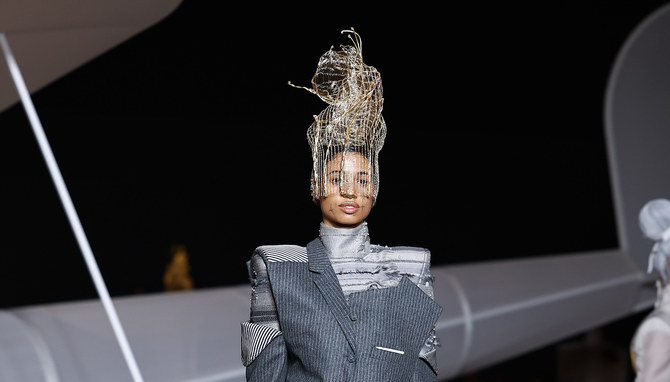
Moroccan Italian model Malika El-Maslouhi walks for US designer Thom Browne  

Moroccan Italian model Malika El-Maslouhi took part in Thom Browne's theatrical show. (Getty Images)
Short Url
Updated 15 February 2023
Follow

Moroccan Italian model Malika El-Maslouhi walks for US designer Thom Browne  

DUBAI: Moroccan Italian model Malika El-Maslouhi hit the runway at New York Fashion Week.  

The 24-year-old catwalk star, who was born in Milan, walked for US fashion label Thom Browne on Tuesday wearing a show stopping ensemble.  

El-Maslouhi stepped out in a grey deconstructed striped suit. The blazer and the trousers were taken apart and patched with another material, while the shoulders of the suit were hanging off. 


El-Maslouhi stepped out in a grey deconstructed striped suit. (Getty Images)

She also wore a large, intricate gold headpiece that covered her nose and extended over her hair.  

The designer’s show, which channeled the famed 1943 tale “The Little Prince,” was an elaborate, lengthy, fully realized theatrical production, with backstories, narration and music, along with fashion featuring endlessly inventive craftsmanship, The Associated Press reported.  

Brownev— who has just taken on the high-profile role of chairman of the Council of Fashion Designers of America — brought his guests to the Sahara to recreate the plane crash from Antoine de Saint-Exupéry’s story. The space had a small airplane stuck in real sand and planets and stars twinkling from above. 


The show’s set design was akin to a theatrical production. (AFP)

“We find ourselves in the desert,” the taped narration began. “A plane has crashed.” A model playing the pilot, dressed in a spacesuit like ensemble with puffed sleeves, wandered about, disoriented, soon to encounter another model with hair in blonde curls reminiscent of the prince who was dressed in one of Browne’s signature gray blazers with a four-stripe band on the arm. 

A series of models then walked the runway representing distant planets. These characters had high white buns with elaborate headpieces and endlessly long curled fingernails and toenails. 

The designer’s collection also features a series of coats in sumptuous tweeds, all with exaggerated shoulders, with suits and ties underneath. Some of the models carried briefcases bearing clock faces — the heels of their chunky shoes also formed round clock faces, as did the stage itself.  

An eclectic group of celebrities, from music figures Erykah Badu, Queen Latifah and Lil Nas X to actors Christine Baranski, Rebecca Hall and Jesse Williams, watched as the show took an emotional turn at the end, with the models coming back out in couples, hand in hand in a message of togetherness, accompanied by the song “You’ll Never Walk Alone” from the Broadway musical “Carousel.” 


At Jazan festival, Suad Al-Asiri paints memory, land and leadership

Updated 13 January 2026
Follow

At Jazan festival, Suad Al-Asiri paints memory, land and leadership

  • Local artist channels personal hardship into works that reflect Jazan’s identity, heritage
  • Jazan: A Nation and a Prince, places region at the heart of a composition featuring Prince Mohammed bin Abdulaziz and Prince Nasser bin Mohammed bin Abdullah bin Jalawi

RIYADH: At the Ahad Al-Masarihah pavilion at Jazan Festival 2026, Suad Al-Asiri’s paintings blend memory, place and personal history, offering visual narratives shaped by beauty and hardship. 

A novelist and visual artist, Al-Asiri has long used art as a storytelling tool. After a near-fatal car accident in March 2024, her work took on a new urgency. Bedridden for 11 months, cut off from the public world for more than a year, she describes that period as one of the most painful in her life — yet also transformative. 

“First of all, praise be to God for granting me life, as the accident was extremely severe,” she said. “By God’s grace, I was given a new life. All my thinking after the accident was about becoming an inspiration to others — about enduring pain and obstacles, and still leaving an impact.” 

Her return to public life came in 2025, when she participated in National Day celebrations with the ministry of interior. By the time she arrived at Jazan Festival, she was ready to channel that experience into her art. 

The centerpiece of her display, “Jazan: A Nation and a Prince,” places the region at the heart of a composition featuring Prince Mohammed bin Abdulaziz and Prince Nasser bin Mohammed bin Abdullah bin Jalawi, governor and deputy governor of Jazan respectively. 

Visitors linger over the details: the painting incorporates coffee beans, sesame and khudair — materials drawn from local products.

“I wanted people to recognize these products immediately,” she said. “They are part of Jazan’s daily life, and using them makes the work more tangible, more connected to everyday experience.” 

The painting sparks conversation. Visitors discuss leadership, identity, and the intimate relationship between people and their environment. 

Beyond the central piece, Al-Asiri presents individual portraits of the two princes, expanding the dialogue into a broader exploration of heritage and memory.  

Her journey into art is tied to her life as a storyteller. Early experiments with charcoal and pencil evolved into abstract art, drawn by its expressive freedom. 

From there, she explored realism, surrealism, and eventually modern art, particularly pop art, which has earned her wide recognition in artistic circles. Her novels and media work complement her visual practice, earning her the title “the comprehensive artist” from the governor.

Yet what stands out most in this exhibition is how Al-Asiri’s personal resilience flows through each piece. Her experience of surviving a devastating accident, enduring months of immobility, and returning to the public eye informs every brushstroke. 

Visitors sense not just her artistic skill, but her determination to turn life’s hardships into inspiration for others. 

Walking through the pavilion, one can see it in the way she blends heritage symbols, southern landscapes, and scenes of daily life. 

Each painting becomes both a document and a dialogue — a celebration of Jazan’s culture, a reflection on identity, and a testament to the power of human perseverance. 

At Jazan Festival 2026, Suad Al-Asiri’s art is a quiet, persistent inspiration for anyone who pauses long enough to listen.