

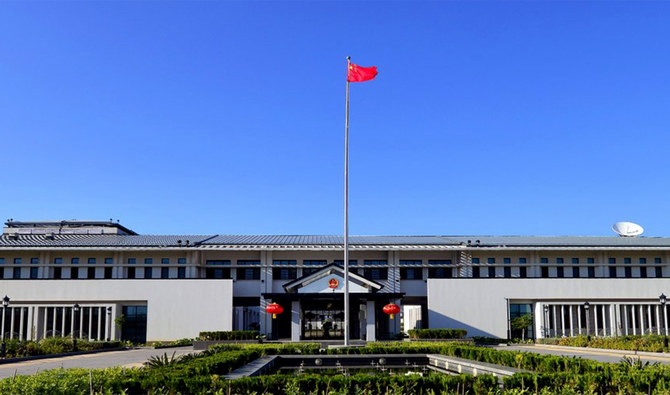
Chinese embassy in Islamabad closes consular section ‘due to technical reasons’

The picture posted by Chinese Embassy in Pakistan on September 27, 2022, shows Chinese Embassy in Islamabad. (Chinese Embassy in Pakistan/Facebook)
Short Url
Updated 15 February 2023
Follow

Chinese embassy in Islamabad closes consular section ‘due to technical reasons’

  • Last week Chinese government advised its nationals to be cautious in Pakistan due to deteriorating security situation
  • Militants have frequently attacked Chinese nationals, threatening a relationship on which Islamabad’s financial survival depends

ISLAMABAD: China has temporarily closed down the consular section of its embassy in Pakistan due to “technical issues,” the embassy said on its website.

The notice did not provide specific information about the nature of the “technical issues,” or a timeline for the closure. 

“Due to technical issues, the Consular Section of the Chinese Embassy in Islamabad will be temporarily closed from February 13, 2023 until further notice,” a notice on the website said.

The notice follows another one last week in which the Chinese government advised its citizens to be cautious while in Pakistan, saying they might be at risk due to a deteriorating security situation. 

Pakistan has seen a rise in terror attacks since late last year when the Pakistani Taliban group called off a fragile truce with the government.

Militant groups in Pakistan have frequently attacked Chinese nationals, aiming to threatened a major segment of Beijing’s Belt and Road infrastructure initiative, a $65 billion network of roads, railways, pipelines and ports in Pakistan that will connect China to the Arabian Sea and help Islamabad expand and modernize its economy.

Last April, a female suicide bomber killed three Chinese teachers in Karachi along with their local driver, targeting nationals from Pakistan’s most important partner and seeking to undermine a relationship on which Islamabad’s financial survival largely depends.


Pakistan bans ex-army officer, YouTuber Adil Raja under Anti-Terrorism Act

Updated 6 sec ago
Follow

Pakistan bans ex-army officer, YouTuber Adil Raja under Anti-Terrorism Act

  • Pakistan interior ministry says Raja misused online platforms to promote, facilitate anti-state narratives
  • Raja, a UK-based YouTuber-commentator, is a harsh critic of Pakistan’s government, powerful military

ISLAMABAD: Pakistan’s federal government has listed a former army officer and pro-Imran Khan YouTuber-commentator Adil Raja as a proscribed person in the Anti-Terrorism Act for pushing anti-state narratives, the interior ministry said this week. 

Raja, who is now a UK-based blogger who broadcasts political commentary on Pakistan, is severely critical of the government and the military in his YouTube vlogs. Critics also accuse him of being biased in favor of former prime minister Imran Khan. 

Pakistani officials have accused Raja of running propaganda campaigns from abroad in the past. Pakistan Interior Minister Mohsin Naqvi met British High Commissioner Jane Marriott in Islamabad this month and formally handed over extradition documents for Raja. The UK government has so far not commented on the development. 

In a notification issued on Saturday, the interior ministry said the government believes Raja has been demonstrating involvement in activities “posing a serious threat to the security, integrity and public order of Pakistan.”

“He has consistently misused online platforms to promote, facilitate and amplify anti-state narratives and propaganda associated with proscribed terrorist organizations, thereby acting in a manner prejudicial to the sovereignty and defense of Pakistan,” a notification by the interior ministry said. 

“Now, therefore in exercise of the powers conferred by section 11EE of the Anti-Terrorism Act, 1997, the Federal Government is pleased to direct to list Mr. Adil Farooq Raja, s/o Umer Farooq Raja, in the Fourth Schedule to the said Act as a proscribed person for the purposes of the said Act.”

Section 11EE empowers the government to list a person under the Fourth Schedule if there are reasonable grounds to believe that he/she is involved in “terrorism” or is an activist, office bearer or an associate of an organization kept under observation under the same Act, or is suspected to be concerned with any organization suspected to be involved in “terrorism.”

Those placed on the Fourth Schedule by the government are subjected to intense scrutiny and movement restrictions.

In a post on social media platform X, Raja denied any wrongdoing, saying the government had banned him after failing to extradite him from the UK.

“This designation is not a consequence of any crime, but a direct reprisal for my practice of journalism,” he wrote. 

Raja was also among two retired army officers who were convicted and sentenced under the Army Act, and for violations of the provisions of the Official Secrets Act in 2023.

 The former army officer was given 14 years of rigorous imprisonment by a military court. 

Khan, a former cricket star who served as Pakistan’s prime minister from 2018 to 2022, has been in jail since August 2023 on multiple charges his party says are politically motivated.

Despite incarceration, he remains the country’s most popular opposition figure, commanding one of the largest digital followings in South Asia. 

Overseas Pakistanis in particular drive sustained online activism on platforms such as YouTube and X, campaigning for his release and alleging human-rights abuses against Khan and his supporters, claims the Pakistani state rejects.