


ISLAMABAD: The Pakistani government has announced it would table a finance bill in parliament on Wednesday, aimed at levying additional taxes worth $636 million for the revival of the $7 billion International Monetary Fund (IMF) loan program.
The development came hours after President Arif Alvi advised the government to enact a law through parliament for the collection of additional taxes to meet the IMF requirements.
The South Asian nation of 220 million is making frantic attempts to complete all prior actions suggested by the global lender to reach a staff-level-agreement for the disbursement of a $1.2 billion tranche as part of its bailout program secured in 2019.
“The finance bill will be submitted in the parliament tomorrow which has been summoned,” the Pakistani finance ministry said late Tuesday.
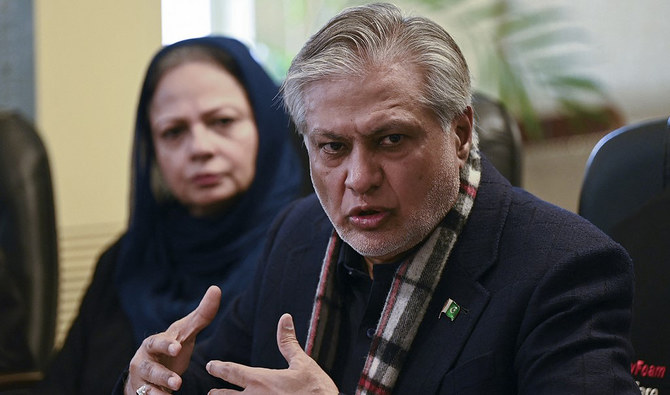
Earlier in the day, Finance Minister Ishaq Dar called on President Alvi and “apprised him about the progress in talks with the International Monetary Fund and that all modalities have been agreed upon,” according to a finance ministry statement.
The minister informed the president that the government wanted to raise additional revenue through taxes by promulgating an ordinance, but the president suggested him to do it through an act of parliament.
“The President advised that it would be more appropriate to take the Parliament into confidence on this important subject, and that a session be called immediately so that the bill is enacted without delay,” the finance ministry said.
“The president appreciated the efforts of the government for negotiating an agreement with the IMF and assured that the state of Pakistan would stand by the commitments made by the government with the IMF.”
The finance minister has already announced imposing new taxes of around Rs170 billion ($636 million) to fulfil one of the demands of the IMF to revive the program, which has been stalled since November.
The government can impose the additional taxes either through an act of parliament or through a presidential ordinance, which would remain valid for 120 days.
The government has already jacked up electricity and gas tariffs for all domestic and commercial consumers effective from January 1 till June 30 to meet the IMF conditions.
Finance ministry officials also shared this data with the IMF during virtual talks between the two sides on Monday.
An IMF delegation also visited Islamabad from January 31 till February 9 to negotiate the revival of the bailout program, but left the country without signing the agreement.
The lender has agreed to continue talks virtually while the government would implement all the prior actions mentioned in the memorandum of economic and financial policies (MEFP) to receive the $1.2 billion tranche after completion of the 9th review of the program.
Meanwhile, Fitch Ratings on Tuesday cut Pakistan’s rating by two notches to CCC- from CCC+, the fourth lowest score. The agency downgraded Pakistan’s rating for the second time in four months after the country’s foreign exchange reserves dropped to critically low levels amid a delay in its IMF bailout.
Economists say the government must firm up all fiscal and monetary actions as quickly as possible to stave off a balance-of-payment crisis as the country’s foreign exchange reserves have dwindled to a staggering $2.9 billion, barely enough to provide three-week cover for imports.
“The IMF is moving ahead cautiously as there is a serious credibility issue of the government if it will be able to implement all the actions in true spirit after disbursement of the tranche,” Dr. Salman Shah, a former economic adviser to the government, told Arab News.


