

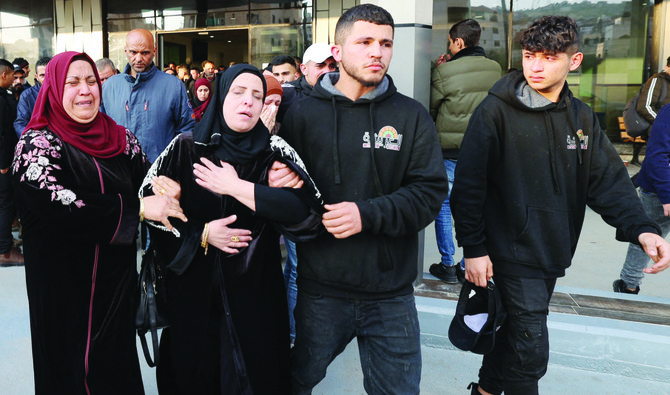

RAMALLAH: Palestinians and human rights groups have called on the world and the International Criminal Court to stop the Israeli government from perpetrating what they term the crimes of “ethnic cleansing” and “collective punishment” in the occupied city of Jerusalem.
The call came as Israeli authorities continued to demolish the homes of Jerusalemites in Silwan, Jabal Al-Mukaber and Issawiya, on the orders of extremist National Security Minister Itamar Ben-Gvir.
The Israeli government has reportedly been targeting the family homes of those who have carried out attacks on Israelis, and others that have allegedly been built without permits.
On Sunday, demolition crews from Jerusalem Municipality, accompanied by Israeli police and special forces, stormed homes in several towns in the city, including Silwan and Jabal Al-Mukaber.
Ben-Gvir has said he is determined to carry out Operation “Defensive Shield 2” in East Jerusalem starting Sunday, similar to that of the Israeli Defense Forces’ widescale military operation in the West Bank in 2002.
“We are determined to implement Defensive Shield 2 in Jerusalem,” Ben-Gvir said on his Twitter account.
The minister claimed that the powers of the police force include “destroying illegal homes, arresting more than 150 targets, raiding homes, and stopping incitement in mosques.”
He said Sunday’s security Cabinet meeting was important, but imposing control was more important, and “I will make sure that this happens.”
An Israeli army spokesman announced on Saturday evening that the military had decided to close the apartment where 13-year-old Mahmoud Aliwat, the alleged perpetrator of the Silwan operation, lived.
Aliwat is accused of shooting two settlers, one an officer who is still in critical condition.
Israeli security personnel on Sunday also sealed up the family home of Hussein Qaraqea who allegedly drove his car into an East Jerusalem bus stop, killing three people.
On Saturday evening, an Israeli court notified five Jerusalem families to vacate their homes in the town of Jabal Mukaber, south of the city, in preparation for their demolition.
Jessica Montell, executive director of human rights group HaMoked, criticized the escalation in the collective punishment of Palestinian families.
“It seems clear that vengeance and appeasing this government’s extremist constituencies are at the root of these measures rather than legitimate security considerations,” said Montel.
“There are serious questions about whether home sealing or demolition is effective as a deterrent. What is clear is that these are illegal and immoral collective punishments,” Montel told Arab News.
The Israeli authorities demolished 13 houses in East Jerusalem in 2022, while the Israeli High Court approved two demolitions in 2023.
Another five in East Jerusalem and two in the West Bank are facing either sealing or demolition.
Imad Muna, a prominent community leader from East Jerusalem, agreed with Montel.
Muna told Arab News that Jerusalem’s 350,000 people need more homes, as a natural consequence of their expanding families.
“The issue of building in Jerusalem is political and not granting Jerusalemites building permits and demolishing their homes is a silent process of expelling them from the city,” Muna told Arab News.
Muna said 50 percent of the residents of Jerusalem had problems with construction, whether by building a house without a permit or adding unlicensed residential units.
As the Israeli Municipality of Jerusalem often refuses to issue building permits, which each costs $100,000, the residents are forced to either build without a permit or leave for towns surrounding Jerusalem, such as Al-Ram, Bir Nabala and Abu Dis, said Muna.
They also face the risk of losing their permanent right of residence in Jerusalem, added the community leader.
Jerusalemites believe that the demolition of homes has escalated dramatically since the advent of Israel’s extreme rightwing government in late December, instigated by new minister Ben-Gvir.
This has coincided with the launch of the Arab League’s conference in Cairo on Jerusalem’s “steadfastness and development.”
The event aims to support the people of Jerusalem as the first line of defense for the city, and to protect their bond with Al-Aqsa Mosque.
Rawhi Fattouh, Palestinian National Council president, said the house demolitions carried out by the occupation authorities, specifically in the Jabal Mukaber neighborhood, was a new “war crime which combines forced displacement and ethnic cleansing against our people and the right of humanity.”
In a press statement, Fattouh called on the international community and the International Criminal Court to take immediate action to stop what he termed the Israeli crimes of ethnic cleansing.
He said Israel continues to disregard all UN resolutions that preserve the city of Jerusalem’s religious and historical monuments.
Fattouh said: “Israel, the occupying power, insists on killing, crime and displacement, and reveals to us every day its inhumane, fascist and hideous racist face.”
Palestinians have argued that Israel wants to change the demographics of Jerusalem through land confiscation, construction restrictions and home demolitions.
They say that 350,000 Palestinians live on 13 percent of occupied East Jerusalem, with only 2 percent of requests for construction considered.
When Palestinians are forced to build — in line with the natural growth of their families — this provides the Israeli authorities the pretext to demolish their homes or confiscate their land.
A report from the Israeli Information Center for Human Rights in the Occupied Territories, B’Tselem, indicated that 160 buildings, including 96 that were used for housing purposes, were demolished in East Jerusalem in 2021.


