East Germany’s last Communist premier dies aged 95

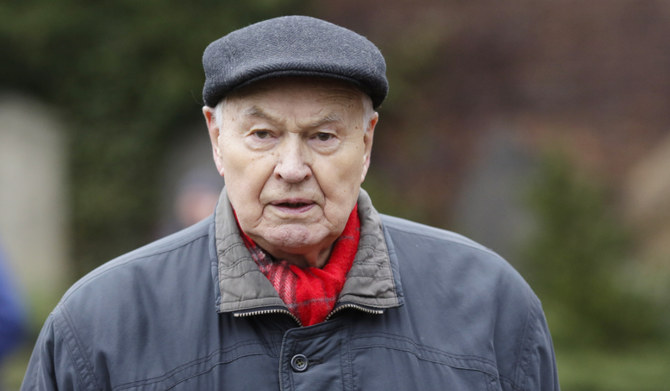
Hans Modrow, the last Communist Prime Minister of former East Germany, German Democratic Republic, attends a commemoration for former German socialists' leaders Rosa Luxemburg and Karl Liebknecht at a cemetery in Berlin, Jan. 13, 2019. (AP)
Short Url
Updated 12 February 2023
Follow

East Germany’s last Communist premier dies aged 95

  • The previous communist leadership had been forced out as protesters across East Germany demanded democracy and freedom, echoing calls for change across Soviet-dominated eastern Europe following Mikhail Gorbachev’s rise to power in the Soviet Union

BERLIN: Hans Modrow, who as the last Communist prime minister of East Germany oversaw democratic reforms that opened the way to German reunification, has died at age 95, Germany’s hard-left Die Linke party said on Saturday.
“Last night Hans Modrow left us at the age of 95. With this, our party loses an important personality,” the party, successor to the East German Communist Party, said in a statement.
Modrow had said he would help turn East Germany into a democracy when he became prime minister of a communist-led transition government on Nov. 13, 1989, four days after the opening of the Berlin Wall that had divided East and West Berlin for 28 years.
The previous communist leadership had been forced out as protesters across East Germany demanded democracy and freedom, echoing calls for change across Soviet-dominated eastern Europe following Mikhail Gorbachev’s rise to power in the Soviet Union.
Modrow announced the first and only free election in what was known as the German Democratic Republic (GDR) in March 1990, though it resulted in him ceasing to be prime minister.
Although he carried out reforms, he was accused by opponents of trying to delay political change and reunification, which took place in October 1990. He was also criticized for trying to rebrand rather than abolish the Stasi security police.
Modrow was found guilty in 1993 of electoral fraud in a municipal election in May 1989 but was not jailed and said the charges were politically motivated.
He went on to serve in the German parliament from 1990 until 1994, representing a forerunner to Die Linke called the PDS, and was a member of the European Parliament from 1999 until 2004.
Modrow saw himself as a reformer who had wanted to change the communist party from the inside and make it more democratic. In 1999, he told Reuters he did not want the old GDR back but said its achievements should be recognized.
“In foreign relations, under the GDR, the Cold War did not turn into a hot war,” he said. “And after the violence of World War Two, we succeeded in making friends with Poland.”
RISE THROUGH PARTY RANKS
Modrow was born in 1928 in what was then the German town of Jasenitz — now Jasienica in Poland — and trained as a machinist.
During World War Two he served as leader of a youth fire brigade platoon and toward the end of the conflict became a member of the Volkssturm, a Nazi militia that conscripted men aged from 16 to 60 in a last-ditch victory attempt.
At 17, Modrow was captured by Soviet troops and taken as a prisoner of war to the Soviet Union, where he attended anti-fascist classes and became a convinced Communist.
On his return home in 1949, the year the GDR was founded, he found work as a machinist and went on to study social science and then economics, in which he gained a doctorate.
Modrow was a functionary in the Free German Youth, the movement that nearly all East German youngsters joined, and rose through the ruling Socialist Unity Party (SED) to become regional party boss in Dresden from 1973 to 1989. He also served in the East German parliament for more than three decades.
Modrow became East Germany’s de facto leader after Egon Krenz resigned as SED leader on Dec. 5, 1990, leaving Modrow holding the highest state post.
As prime minister, he won respect for living more modestly than his communist predecessors. He initially sought to dampen enthusiasm for reunification but in February 1990 unveiled a plan for uniting East and West Germany.
Presenting his plan for reunification in 1990, he said Germany should “again become a united fatherland for all citizens of the German nation,” but said unity could be achieved only under conditions that calmed the fears of its neighbors.
From 2007, Modrow served as president of the council of elders for Die Linke, a role in which he focused on the party’s development and history.


Egypt reveals restored colossal statues of pharaoh in Luxor

Updated 14 December 2025
Follow

Egypt reveals restored colossal statues of pharaoh in Luxor

  • Amenhotep III, one of the most prominent pharaohs, ruled during the 500 years of the New Kingdom, which was the most prosperous time for ancient Egypt

LUXOR: Egypt on Sunday revealed the revamp of two colossal statues of a prominent pharaoh in the southern city of Luxor, the latest in the government’s archeological events that aim at drawing more tourists to the country.
The giant alabaster statues, known as the Colossi of Memnon, were reassembled in a renovation project that lasted about two decades. They represent Amenhotep III, who ruled ancient Egypt about 3,400 years ago.
“Today we are celebrating, actually, the finishing and the erecting of these two colossal statues,” Mohamed Ismail, secretary-general of the Supreme Council of Antiquities, said ahead of the ceremony.
Ismail said the colossi are of great significance to Luxor, a city known for its ancient temples and other antiquities. They’re also an attempt to “revive how this funerary temple of King Amenhotep III looked like a long time ago,” Ismail said.
Amenhotep III, one of the most prominent pharaohs, ruled during the 500 years of the New Kingdom, which was the most prosperous time for ancient Egypt. The pharaoh, whose mummy is showcased at a Cairo museum, ruled between 1390–1353 BC, a peaceful period known for its prosperity and great construction, including his mortuary temple, where the Colossi of Memnon are located, and another temple, Soleb, in Nubia.
The colossi were toppled by a strong earthquake in about 1200 BC that also destroyed Amenhotep III’s funerary temple, said Ismail.
They were fragmented and partly quarried away, with their pedestals dispersed. Some of their blocks were reused in the Karnak temple, but archeologists brought them back to rebuild the colossi, according to the Antiquities Ministry.
In late 1990s, an Egyptian German mission, chaired by German Egyptologist Hourig Sourouzian, began working in the temple area, including the assembly and renovation of the colossi.
“This project has in mind … to save the last remains of a once-prestigious temple,” she said.
The statues show Amenhotep III seated with hands resting on his thighs, with their faces looking eastward toward the Nile and the rising sun. They wear the nemes headdress surmounted by the double crowns and the pleated royal kilt, which symbolizes the pharaoh’s rule.
Two other small statues on the pharaoh’s feet depict his wife, Tiye.
The colossi — 14.5 meters and 13.6 meters respectively — preside over the entrance of the king’s temple on the western bank of the Nile. The 35-hectare complex is believed to be the largest and richest temple in Egypt and is usually compared to the temple of Karnak, also in Luxor.
The colossi were hewn in Egyptian alabaster from the quarries of Hatnub, in Middle Egypt. They were fixed on large pedestals with inscriptions showing the name of the temple, as well as the quarry.
Unlike other monumental sculptures of ancient Egypt, the colossi were partly compiled with pieces sculpted separately, which were fixed into each statue’s main monolithic alabaster core, the ministry said.
Sunday’s unveiling in Luxor came just six weeks after the inauguration of the long-delayed Grand Egyptian Museum, the centerpiece of the government’s bid to boost the country’s tourism industry. The mega project is located near the famed Giza Pyramids and the Sphinx.
In recent years, the sector has started to recover after the coronavirus pandemic and amid Russia’s war on Ukraine — both countries are major sources of tourists visiting Egypt.
“This site is going to be a point of interest for years to come,” said Tourism and Antiquities Minister Sherif Fathy, who attended the unveiling ceremony. “There are always new things happening in Luxor.”
A record number of about 15.7 million tourists visited Egypt in 2024, contributing about 8 percent of the country’s GDP, according to official figures.
Fathy, the minister, has said about 18 million tourists are expected to visit the country this year, with authorities hoping for 30 million visitors annually by 2032.