

Pakistan swaps police head in province facing militant attacks

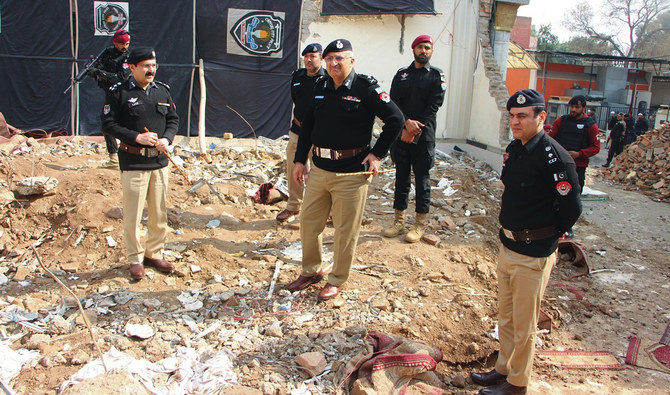
Newly appointed Khyber Pakhtunkhwa province's police chief Akhtar Hayat (center) inspects the damaged mosque following January 30 suicide blast inside the police headquarters in Peshawar on February 10, 2023. (Photo courtesy: KP Police)
Short Url
Updated 10 February 2023
Follow

Pakistan swaps police head in province facing militant attacks

  • Inspector general of Khyber Pakhtunkhwa police was changed after a suicide bombing in a police compound last month
  • The attack, which killed dozens of policemen, was followed by unprecedented protests by uniformed personnel of the force

PESHAWAR: Pakistan has replaced the police head in northwestern Khyber Pakhtunkhwa province where a suicide bomber killed more than 100 people at a police mosque last month, heightening fears of militant attacks elsewhere around the nation.

An official government notice this week said Akhtar Hayat would be posted as police chief, replacing Moazzam Jah Ansari who was in the role for about 18 months. No reason was given.

Police are on the frontlines of rising attacks in Pakistan, especially in Khyber Pakhtunkhwa, a restive northwestern province near the Afghan border.

The most active militant group in the area is the Pakistani Taliban, also called Tehreek-e-Taliban Pakistan (TTP).

Last month’s blast inside a fortified police compound in the regional capital Peshawar killed many police officers among the 100 fatalities in the city’s worst bombing in a decade.

That prompted unprecedented protests by police personnel.

Security threats have also been reported by embassies and authorities in Pakistan’s capital, Islamabad, which is a few hours’ drive from Peshawar.

The TTP has denied responsibility for the mosque attack, which no group has claimed so far.


Pakistan moves to digitize payments for 10 million women under flagship poverty initiative

Updated 5 sec ago
Follow

Pakistan moves to digitize payments for 10 million women under flagship poverty initiative

  • BISP Official says accounts will be linked to phones to boost financial inclusion and curb payment deductions
  • Over 1.9 million SIMs issued as the nationwide rollout continues across provinces ahead of the March deadline

ISLAMABAD: Pakistan’s flagship poverty alleviation initiative, the Benazir Income Support Program (BISP), plans to equip 10 million women with digital bank accounts linked to their phone numbers within four months in one of the largest such exercises in the world, one of its top officials said on Wednesday.

Launched in 2008, the initiative is named after the late former prime minister Benazir Bhutto and has a budget of Rs716 billion ($2.5 billion) during the current fiscal year. Through its Benazir Kafaalat — or financial assistance — program, BISP provides quarterly stipends of Rs13,500 ($48) to around 10 million women.

In an exclusive interview with Arab News, BISP Secretary Amir Ali Ahmed said the opening of digital bank accounts for the beneficiaries was part of Prime Minister Shehbaz Sharif’s initiative related to a cashless economy and digital transformation of the country.

“I’m glad to share that 10 million bank accounts, wallet accounts were created,” he said. “This is a follow-up of the same exercise whereby now 10 million SIMs are being distributed.

“It is significant to share that the entire beneficiary network that we have is female-centric,” he continued. “So these are 10 million female accounts that have been created.”

Ahmed said the process of issuing mobile phone SIM cards to BISP beneficiaries had started on November 17 and would be completed by March next year.

“Let me share that this is one of the largest such exercises to be conducted in the world which is female-centric, linked with financial inclusion and financial empowerment.”

The BISP official added that out of the more than 10 million beneficiaries, only five to 10 percent had bank accounts, but nearly 90 to 95 percent were excluded from the system.

He said they were being linked to the banking system with cellphone SIMs that are being distributed with the help of the IT ministry, Pakistan Telecommunication Authority, National Database and Registration Authority and telecom companies across the country.

“We feel that this initiative of the government of Pakistan will not only result in financial empowerment of our beneficiaries, it will also result in financial inclusion of a segment which was not part of the banking sector in Pakistan,” he said, adding that the move will also lead to transparency.

In the past, there have been complaints of women not getting their full payment from bank officials in the absence of their own accounts, but Ahmed said this was going to change.

“They will be free from any exploitation at the agent networks, the queues that one would witness, the complaints of corruption or deductions that would emerge,” he continued.

According to official data, more than 1.9 million SIMs have so far been issued for BISP beneficiaries across the country.

The province of Punjab leads the rollout with 810,597 SIMs, followed by Sindh with 523,629 and Khyber Pakhtunkhwa with 371,427 SIMs.

In other regions, Azad Jammu and Kashmir has received 59,617, Balochistan 82,826, Gilgit-Baltistan 45,184, and Islamabad 4,508 SIMs.