


ANKARA: The death toll from the Turkiye-Syria earthquakes passed 16,000 Thursday as hope faded of finding more survivors among the rubble of devastated towns and villages.
Across a swathe of southern Turkiye, people sought temporary shelter and food in freezing winter weather, and waited in anguish by piles of rubble where family and friends might still lie buried.
Rescuers were still finding some people alive. But many Turks have complained of a lack of equipment, expertise and support to rescue those trapped — sometimes even as they could hear cries for help.
Authorities have only reached 2-3 percent of collapsed buildings in some affected areas, sources said.
“Where is the state? Where have they been for two days? We are begging them. Let us do it, we can get them out,” Sabiha Alinak said near a snow-covered collapsed building in the city of Malatya where her young relatives were trapped.
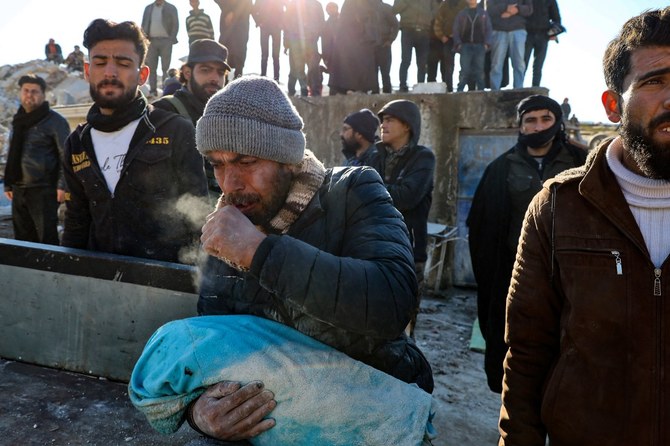
In Antakya, dozens of bodies, some covered in blankets and sheets and others in body bags, were lined up on the ground outside a hospital. One survivor, Melek, 64, said she had seen no rescue teams. “We survived the earthquake, but we will die here from hunger or cold.”
There were similar scenes in northern Syria, which was also hard hit by Monday’s two huge quakes. Syria’s ambassador to the UN admitted the regime in Damascus had a “lack of capabilities and lack of equipment,” which he blamed on Western sanctions.
Turkish President Recep Tayyip Erdogan admitted that his government’s initial response to the disaster had been inadequate, but insisted it was improving.
“We will be better tomorrow and later. We still have some issues with fuel ... but we will overcome those too,” Erdogan said on a visit to Kahramanmaras to view the damage and see the rescue and relief effort.

Turkish President Recep Tayyip Erdogan toured the site of destroyed buildings during his visit to the city of Kahramanmaras. (AFP)
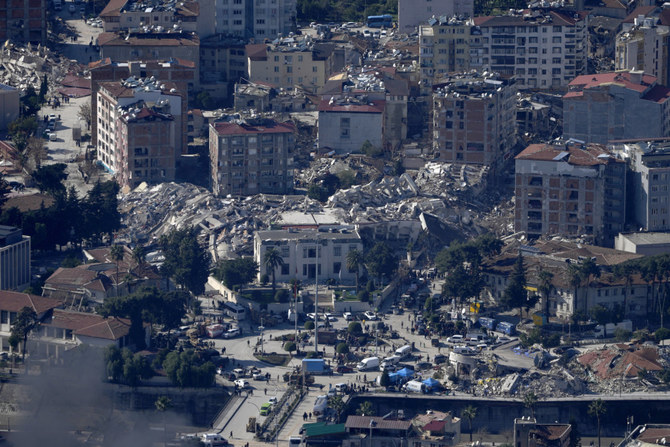
Entire streets in Kahramanmaras, closest city to the quake’s epicenter, were reduced to rubble, with plumes of smoke rising from fires. Hundreds of tents were set up as shelter in a sports stadium. About 50 bodies draped in blankets lay on the floor of a sports hall.
Death toll sure to rise
As search and rescue operations continued, the World Health Organization warned that the final death toll could exceed 20,000.
A similar earthquake in the region in 1999 killed at least 17,000 people.
Turkish officials say some 13.5 million people were affected in an area spanning roughly 450 km from Adana in the west to Diyarbakir in the east. In Syria, people were killed as far south as Hama, 250 km from the epicenter.
Some who died in Turkiye were refugees from Syria’s war. Their body bags arrived at the border in taxis, vans and piled atop flatbed trucks to be taken to final resting places in their homeland.
More than 298,000 people have been made homeless and 180 shelters for the displaced had been opened, Syrian state media reported, apparently referring to areas under government control, and not held by opposition factions.
In Syria, relief efforts are complicated by a conflict that has partitioned the nation and wrecked its infrastructure.
The delivery of UN humanitarian aid via Turkiye to millions of people in northwest Syria could resume on Thursday after the long-running operation was halted by the quake, UN officials said.
In the Syrian city of Aleppo, staff at the Al-Razi hospital attended to an injured man who said more than a dozen relatives including his mother and father were killed when the building they were in collapsed.
Press for aid
Syrian President Bashar Assad appears to be seeking political advantage from the quake, pressing for foreign aid to be delivered through his territory as he aims to chip away at his international isolation, analysts said.
A US-based NGO, Global Empowerment Mission, mobilized about $10 million of relief aid in the past 24 hours for earthquake victims.
On Wednesday, Erdogan visited affected Turkiye regions to inspect quake damage and speak to survivors.
“Initially, 10,000 Turkish liras ($500) will be allocated to each citizen affected by the earthquake,” he said.
In the wake of the disaster, search and rescue workers, as well as medics, have arrived in Turkiye and Syria from all corners of the globe.
Turkish municipalities have deployed hundreds of their own rescue personnel.
Though domestic rescue efforts have been criticized as insufficient by local residents, the rapid international response to the disaster has been praised.
Saudi Arabia’s leadership directed the King Salman Humanitarian Aid and Relief Center to operate an air bridge, bringing medical supplies, shelter, food and logistical assistance to victims.
A UN emergency fund allocated $25 million to the humanitarian response in the region.
Despite a growing diplomatic crisis between Greece and Turkiye, Greek TV opened a morning news session with images and videos from the quake zone, with lyrics from a folk song in the background saying: “I let the whole world know that I love you.”
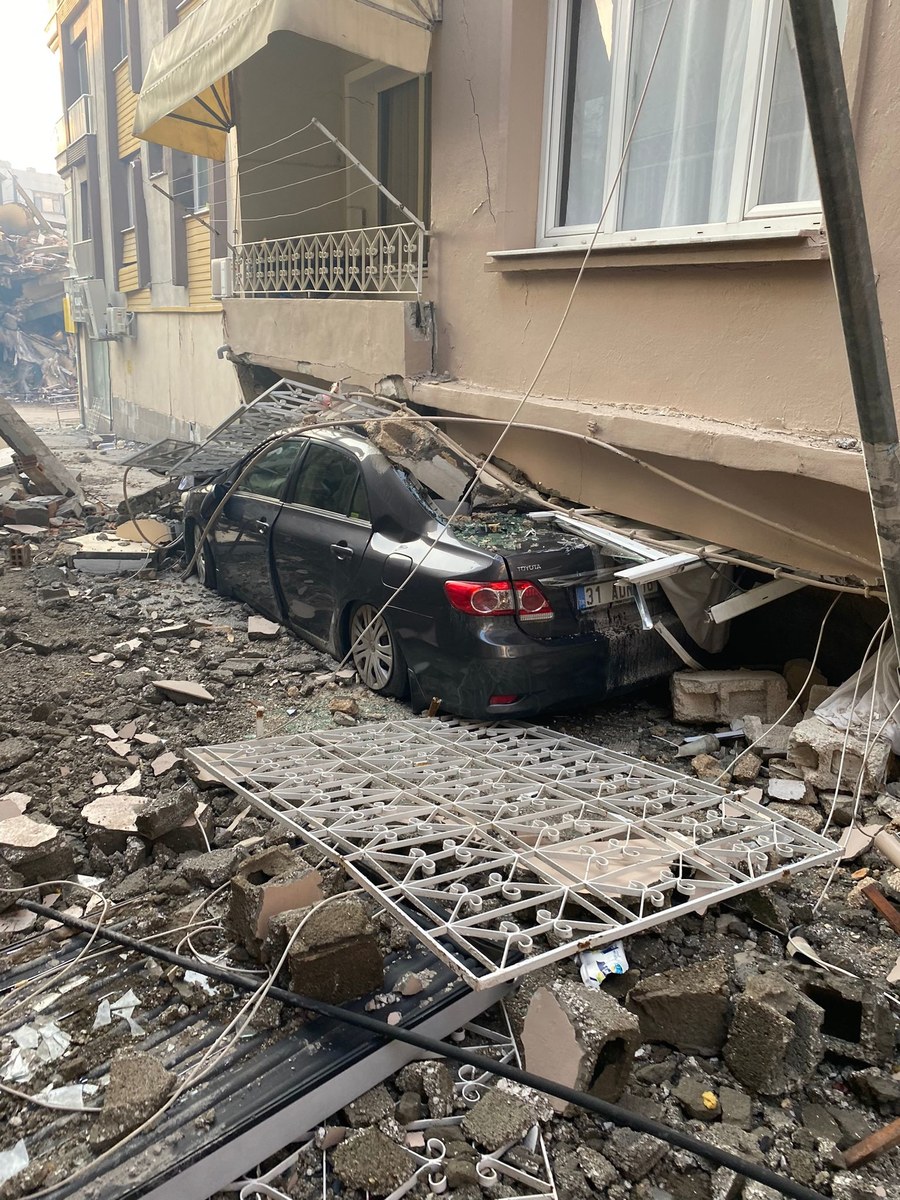
The rubble of toppled buildings in Hatay village. (Supplied)
Several refugee children were also rescued by firefighters and mine workers on Tuesday, while a “miracle” newborn baby was dragged from rubble in northern Syria.
Turkiye’s Association for Solidarity with Asylum-Seekers and Migrants has sent a team of 300 workers and volunteers to Antakya and Hatay, as well as translators and rescue dogs. Migrant survivors will be offered psychological support through the association.
Baris Sakir, an Urfa resident, survived the quake thanks to the modern design of his home.
“However, there are still some cracks inside the house and we don’t have the courage to go back inside. We are now living in the fine arts school where I was teaching piano lessons. My little son still faces post-trauma,” he told Arab News.
Restaurants and hotels are offering free meals and accommodation to those left homeless by the earthquake, with Turkish celebrities and municipalities sending food containers to locals as well as paying for their accommodation.
Meanwhile, Istanbul municipality intervened to stop a fire in Iskenderun port on Wednesday, while Ankara municipality started repairs on damaged Hatay airport. Communication channels have been significantly disrupted by the quake.
In Hatay, more than 2,000 buildings were destroyed, with just 2-3 percent being reached by rescuers, according to the latest reports.
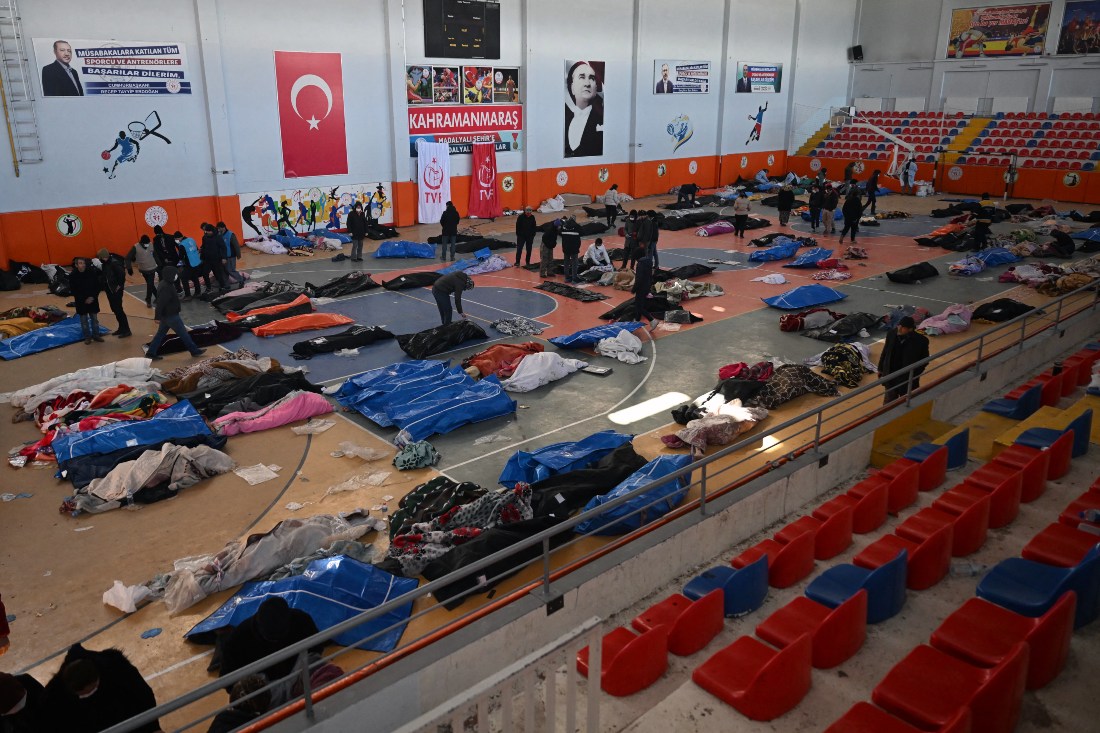
The dead are being held in makeshift morgues in sports halls. (AFP)
Authorities have warned that growing numbers of rescued children have been left unaccompanied in local hospitals, with precautions being taken to prevent abductions.
“Nature gave us exactly 23 years after the 1999 earthquake,” said Cem Say, a prominent Turkish computer scientist, referring to the major quake in the country’s northwest in 1999.
Last year, Turkey spent about $1.3 billion on programs for disaster management — some 0.5 percent of central government budgetary spending. But experts have described the funding as insufficient.
Ismail Yolcu, a survivor of the earthquake in southeastern Adiyaman province, said that the homes of some relatives were completely destroyed.
He told Arab News: “There is no electricity. There is no heating. It is rainy and extremely cold. We are sleeping in the streets. We are waiting for the tents to be established. But the situation is terrible.”
Sermet Cuhadar, president of the Journalists Association in Kahramanmaras, said that the situation had “slightly improved” in the province.
“We had to drink melted ice because there was no water in the city. Our eight-storey building collapsed during the first quake. Fortunately I was not in the building at that time. Only three people were rescued,” he told Arab News.
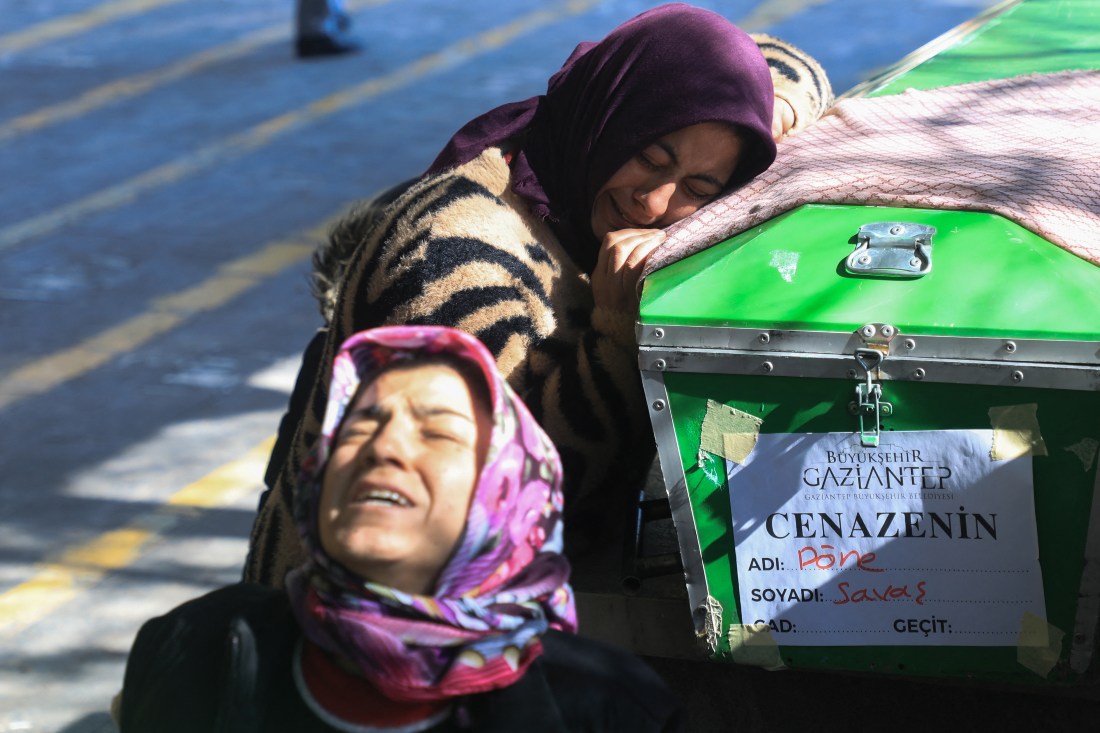
The hope of finding more survivors reduces with every hour. (AFP)
Kamil Cuhadar, former mayor of Pazarcik village of Kahramanmaras, suffered a fractured skull during the first quake when a stone fell on his head.
“The supportive columns were strong in the building in Pazarcik. However, there is no standing building left in the village. The rescue efforts were insufficient.
“They began today in the early morning, but it is already too late. The weather is so cold, it was minus 7 degrees Celsius yesterday when everybody was lying on the streets.
“There is no sufficient equipment to remove the debris. There is no lifting instrument,” he told Arab News.
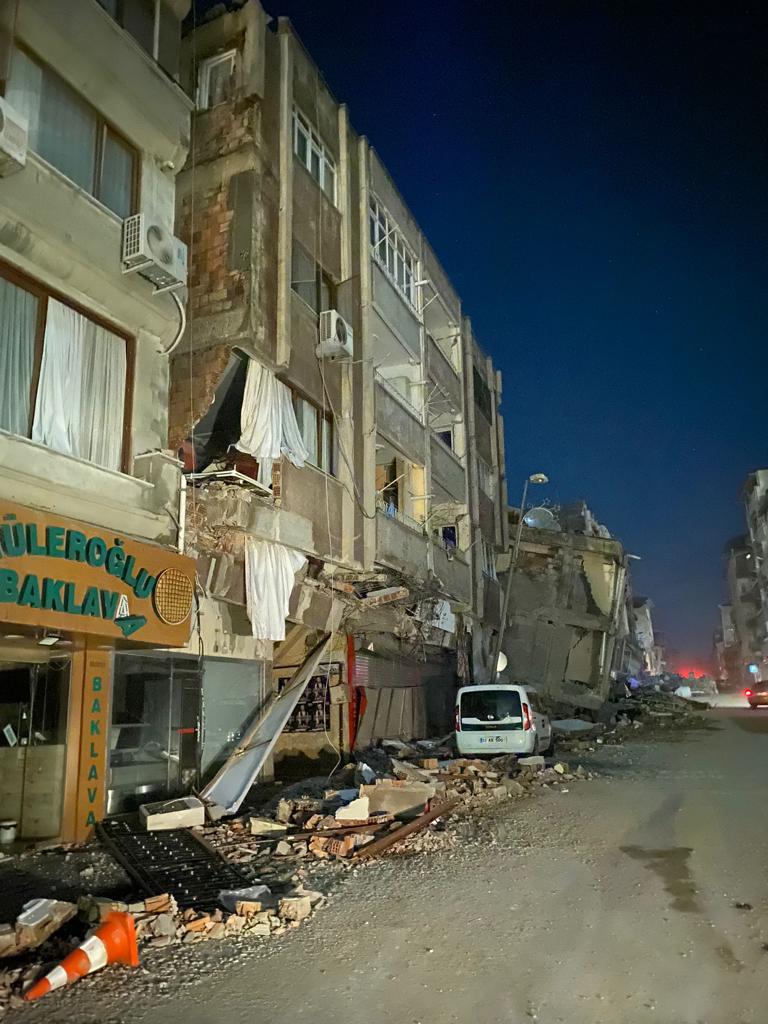
There are reports that the government of Turkiye has blocked Twitter in some areas. (Supplied)
Naile Islek, from Dulkadiroglu village in Kahramanmaras, saw her neighbor’s home collapse during the quake, and ran to take shelter in her mother’s house.
“We have electricity but still no water. Some people who benefit from this chaos are selling small bottles of water at double and sometimes triple prices. We didn’t have enough equipment to remove the debris. Men could barely remove it with their hands,” she told Arab News.
Several municipalities from western Turkiye sent mobile kitchens and container pharmacies to the disaster zone, and launched programs to distribute biscuits, bread and medicine to survivors.
Several sources told Arab News that the immediate rescue efforts were “minimal,” but have intensified in the last two days.
Volunteers have attempted to fill the manpower gap, while several prominent activists as well as chefs have traveled to affected regions to help local residents.
Tent cities were established in several regions while commando forces were deployed to the earthquake zone to aid in rescue efforts.
In the wake of the disaster, Turkiye’s stock exchange also suspended trading for the first time in 24 years.
(With agencies)


