BAMAKO: Russian Foreign Minister Sergei Lavrov on Tuesday promised the Kremlin’s help for states in West Africa’s Sahel and the Gulf of Guinea which are facing a ruthless extremist insurgency.
“The fight against terrorism is of course an issue for the other countries in the region,” Lavrov said during a visit to Mali, which Russia is already helping militarily.
“We are going to provide our assistance to them to overcome these difficulties. This concerns Guinea, Burkina Faso and Chad and the Sahel region generally and even the coastal states on the Gulf of Guinea,” he said.
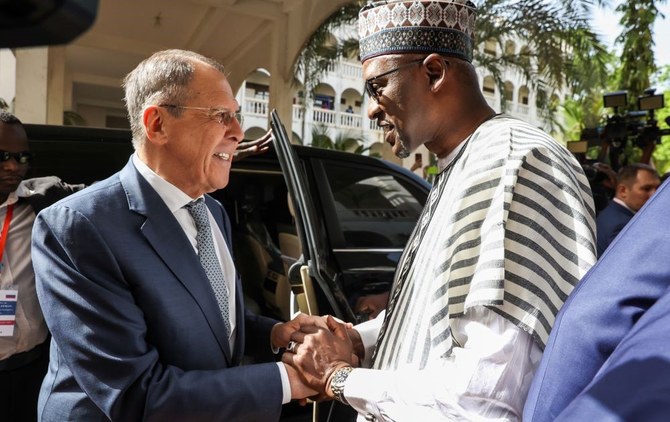
Lavrov made the remarks at a press conference during a visit to Bamako that the Russian envoy described as a “historic” first.
Since seizing power in 2020, Mali’s ruling junta has brought in Russian planes, helicopters and paramilitaries to strengthen its fight against extremist militants.
The closer ties with the Kremlin have coincided with the departure of France, the country’s former colony and traditional ally, which says the Russian operatives are Wagner mercenaries.
Human Rights Watch (HRW) and the UN have implicated Wagner and the Malian army in an alleged massacre at Moura in central Mali last March in which several hundred people were rounded up and killed.
The landlocked state is the epicenter of an extremist insurgency that began in northern Mali in 2012 and spread to neighboring Niger and Burkina Faso in 2015.
Thousands of civilians have died across the three countries, and millions have fled their homes.
Discontent within the military in Mali and Burkina has spurred two coups in both countries.
Sporadic cross-border attacks have also taken place in Togo, Benin and Ivory Coast in recent years, spurring fears that the extremists are seeking to push southwards to the Gulf of Guinea.
France wound down its long-running military presence in Mali in the face of mounting hostility with the junta and pulled out its last troops in 2022.
Similar tensions have recently broken out between France and Burkina Faso. The French military contingent there, a unit of special forces numbering around 400 men, is to be withdrawn this month.
Lavrov promised Mali further military support and declared Russia’s wider backing for Africa in the face of what he described as the West’s “neo-colonial approach.”
“We are going to provide our support for resolving problems on the African continent,” he said.
“We always start from the basis that African problems must be resolved by African solutions.”


![]()

Russia’s Lavrov vows aid for West Africa’s extremist fight
Short Url
https://arab.news/rj3ee
Russia’s Lavrov vows aid for West Africa’s extremist fight
- Lavrov made the remarks at a press conference during a visit to Bamako that the Russian envoy described as a ‘historic’ first
- Lavrov promised Mali further military support and declared Russia’s wider backing for Africa in the face of what he described as the West’s ‘neo-colonial approach’


Latest updates


© 2026 SAUDI RESEARCH & PUBLISHING COMPANY, All Rights Reserved And subject to Terms of Use Agreement.