

Pakistani winners of Saudi university fest say event helped them show diversity of local culture

Pakistani students, officials of King Abdulaziz University and Pakistani consulate pose for a group picture in Jeddah, Saudi Arabia on January 19, 2023. (Photo courtesy: Ghazanfar Ali)
Short Url
Updated 08 February 2023
Follow

Pakistani winners of Saudi university fest say event helped them show diversity of local culture

  • Pakistan’s stall secured 1st position in the festival at the King Abdulaziz University in Jeddah 
  • The three-day annual event featured stalls and performances by students from 32 countries 

ISLAMABAD: Pakistani students, who secured first position at an annual cultural event at the King Abdulaziz University (KAU) in Jeddah, said on Tuesday that the competition helped them present a positive image of Pakistan by showing its cultural diversity to visitors belonging to more than 30 countries. 

The third edition of KAU’s three-day annual cultural festival was held on January 17-19, featuring stalls and performances by university students from 32 countries. 

Teams of students competed with each other in various aspects of culture, such as food, language, art and music. 

“A total of 30 Pakistani students are studying here and all participated in the event with the aim to show the diversity of our culture to the world as students from different countries were participating in the event,” Ghazanfar Ali, who led the Pakistan team in the competition, told Arab News over the phone from Jeddah. 

“This success will further highlight Pakistan’s positive image among Saudi people as well as other nationalities who visited our stall.” 
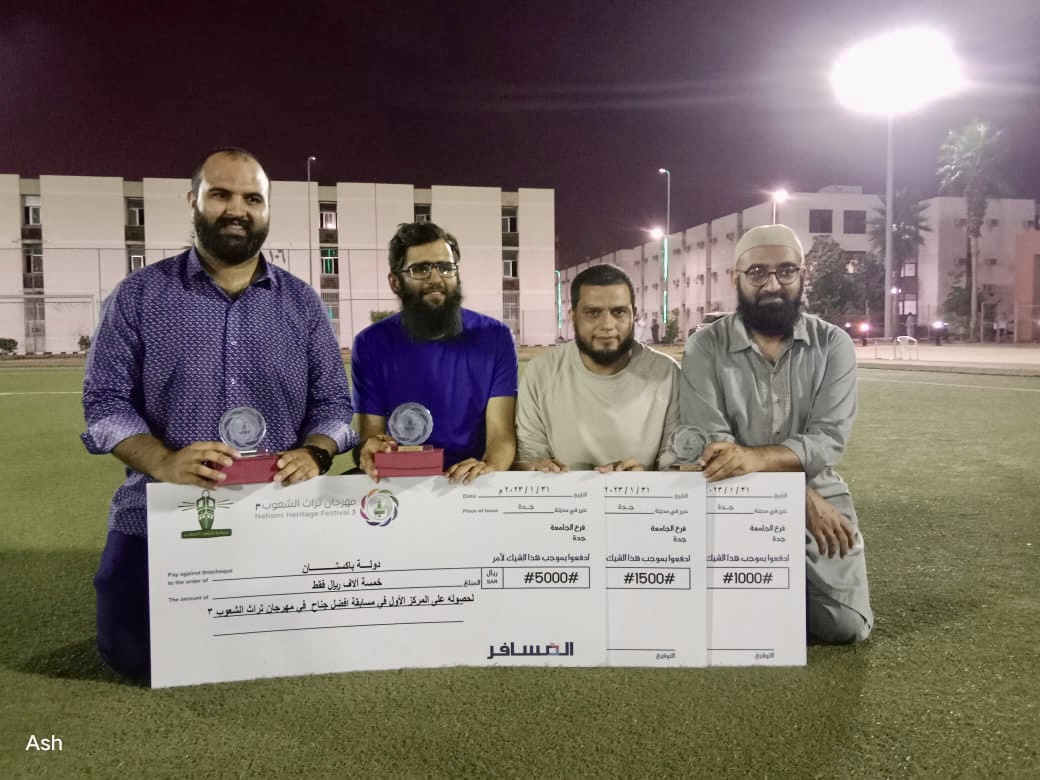


In this photo, Pakistani students who secured first position in King Abdulaziz University's cultural festival can be seen with their winning shields and prizes in Jeddah, Saudi Arabia on January 19, 2023. (Photo courtesy: Ghazanfar Ali) 

Pakistan has very good historical places, variety of food and different cultural dresses, and the event provided an opportunity to show the richness of Pakistani culture to the world, according to Ali. 

“We worked very hard as a team to pull this off and that was why we got the first position,” he added. 

Another Pakistani student, Abdullah Zia, said it took them more than a month’s hard work to prepare for the performances and stall. 

“We prepared all food items ourselves and assigned this responsibility to different students based on their region in Pakistan,” he said. 

“In the morning sessions, we used to display stall and brief visitors about the unique aspects of different items there, and show Pakistani culture through traditional dance performances during the evening sessions.” 
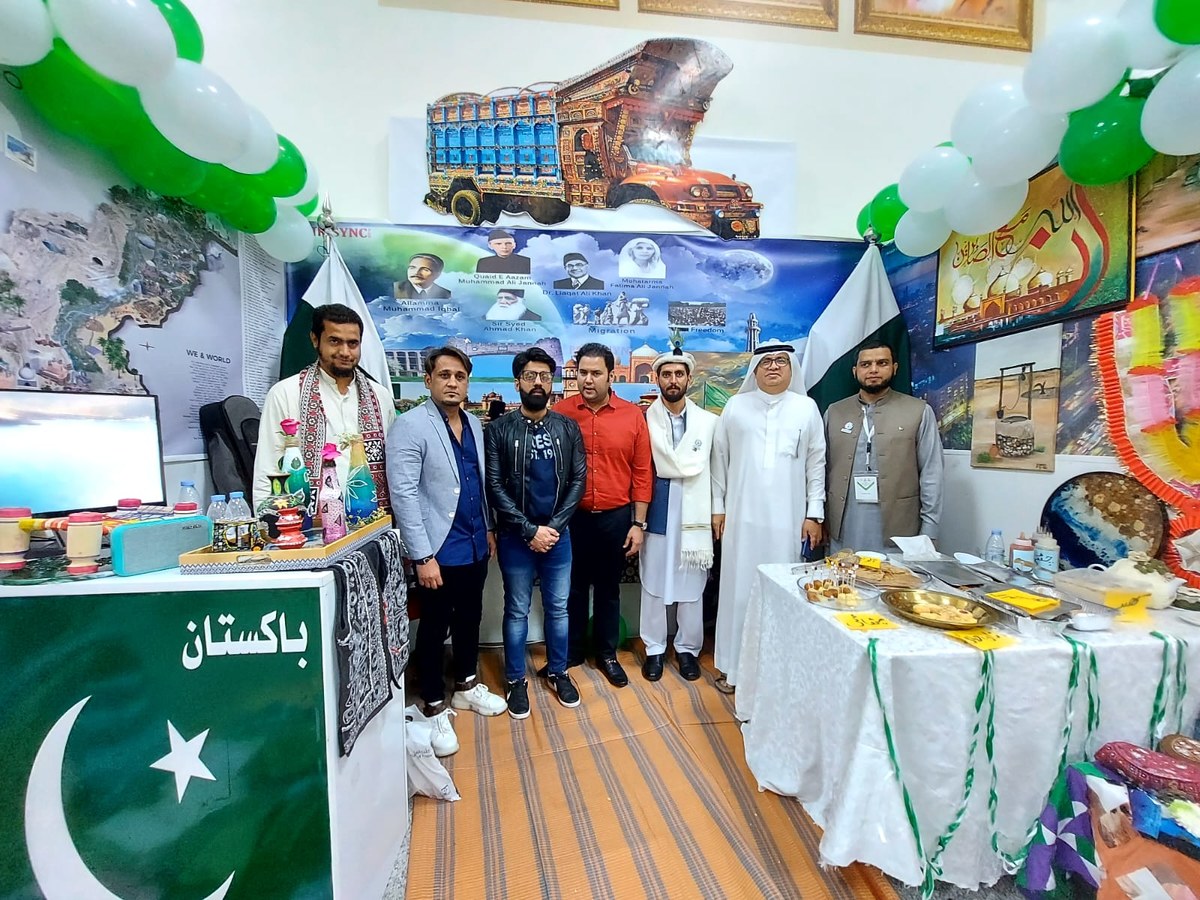


A group of Pakistani students poses for a picture with their stall at King Abdulaziz University's cultural festival in Jeddah, Saudi Arabia on January 19, 2023. (Photo courtesy: Ghazanfar Ali)

Zia said their stall presented food from different parts of Pakistan, traditional dresses, paintings of scenic places and artifacts. 

Both visitors from within the university and the outside guests loved the Pakistani cuisine and culture, he said. 

“It gave a good representation to Pakistan in the Kingdom and after the event, many international as well as Saudi students told us they did not know that Pakistani culture was so rich, colorful and diverse,” Zia said. 

The Pakistani consulate in Jeddah helped these expat students arrange items of cultural significance, especially paintings. 


A Pakistani stall is pictured at King Abdulaziz University's cultural festival in Jeddah, Saudi Arabia on January 19, 2023. (Photo courtesy: Ghazanfar Ali)

Hamzah Gilani, a press counselor with Pakistan’s consulate in Jeddah, said such events enabled people from different backgrounds to come together and appreciate each other’s culture, thus strengthening diplomatic ties between nations. 

“The norms of diplomacy are changing; cultural activities have become the most effective tool of public diplomacy,” Gilani told Arab News. 

He said events such as the one held at the KAU provided a great opportunity to promote a “soft image” of Pakistan as countries could showcase the best of their heritage and traditions through art and culture. 

“I am immensely thankful to the Saudi government for providing us an opportunity to demonstrate the true nature of Pakistan which has been buried under negative stereotypes for far too long,” Gilani added. 


Pakistan saw up to 17% drop in cross-border attacks after Afghan border closure — think tank

Updated 5 sec ago
Follow

Pakistan saw up to 17% drop in cross-border attacks after Afghan border closure — think tank

  • CRSS calls 2025 the deadliest year in a decade with 3,417 violence-linked fatalities nationwide
  • Violence remained concentrated in the western provinces as security forces killed 2,060 militants

ISLAMABAD: Pakistan recorded a sharp decline in cross-border militant attacks and violence-linked fatalities in the final months of 2025 after it closed its border with Afghanistan in October, even as the country endured its deadliest year in a decade overall, according to an annual security report released by a local think tank on Wednesday.

Pakistan has frequently accused Afghanistan of sheltering proscribed armed factions, such as the Tehreek-e-Taliban Pakistan (TTP) and the Balochistan Liberation Army (BLA), in the past, while also pointing a finger at the Taliban administration in Kabul for “facilitating” their attacks against Pakistani civilians and security forces.

The Center for Research and Security Studies (CRSS) said in its report that terrorist attacks fell by nearly 17% in December, following a 9% decline in November, after Pakistan shut the border on Oct. 11. It noted that violence-linked fatalities among civilians and security personnel also declined in the final quarter of the year, falling by nearly 4% and 19% respectively in November and December.

“Pakistan recorded a significant drop in cross-border terrorist attacks and violence-linked fatalities after it closed down the border to Afghanistan,” CRSS said.

Despite the late-year decline, the think tank said 2025 “went by as the most violent year for Pakistan in a decade,” with overall violence surging nearly 34% year-on-year.

Fatalities rose from 2,555 in 2024 to 3,417 in 2025 — an increase of 862 deaths — extending a five-year upward trend in violence that coincides with the Taliban’s return to power in Afghanistan in 2021, the report said.

“2025 marked another grim year for Pakistan’s security landscape,” it added, noting that violence has increased every year since 2021, with annual surges of nearly 38% in 2021, over 15% in 2022, 56% in 2023, nearly 67% in 2024 and 34% in 2025. 

REGIONAL CONCENTRATION

Violence remained heavily concentrated in Pakistan’s northwestern Khyber Pakhtunkhwa (KP) and southwestern Balochistan provinces, which together accounted for more than 96% of all fatalities and nearly 93% of violent incidents nationwide.

KP was the worst-hit region, recording 2,331 fatalities in 2025 — a 44% increase from 1,620 deaths in 2024 — accounting for more than 82% of the net national rise in violence.

Balochistan saw fatalities rise from 787 to 956, an increase of nearly 22%.

In contrast, Punjab and Sindh recorded relatively low levels of violence, together accounting for less than 3% of total casualties, which CRSS said pointed to “relative containment of violence despite the provinces’ large populations.”

The report also flagged the spread of violence into previously calmer regions, with Azad Jammu and Kashmir recording 15 fatalities in 2025 after reporting no violence a year earlier.

MILITANT DEATH TOLL

CRSS said 2025 was also the deadliest year in a decade for militant groups, with outlaws accounting for more than 60% of all fatalities.

“2025 turned out to be the deadliest year for outlaws in a decade,” the report said, with 2,060 militants killed during at least 392 security operations, surpassing the combined fatalities of civilians and security personnel.

Security forces, however, remained the primary targets of militant groups.

The army and Frontier Corps recorded 374 fatalities, including 22 officers, while police suffered 216 casualties.

The TTP claimed responsibility for the largest share of attacks on security personnel, followed by the BLA, the Baloch Liberation Front (BLF) and Daesh’s regional chapter.