

Former military ruler Gen. Musharraf buried in Karachi amid tight security measures

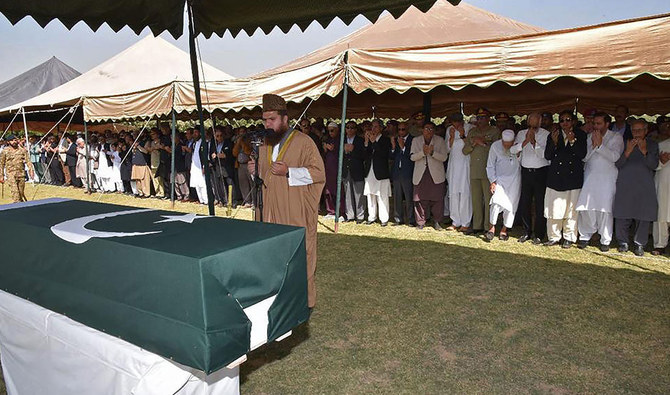
This handout photograph taken on February 7, 2023 and released by Pakistan's Inter-Services Public Relations (ISPR) shows military officials and others offering funeral prayers in front of the coffin of former military ruler Pervez Musharraf, in Karachi. (AFP/Pakistan's Inter-Services Public Relations (ISPR)
Short Url
Updated 07 February 2023
Follow

Former military ruler Gen. Musharraf buried in Karachi amid tight security measures

  • Top military leadership, former army chiefs and politicians attend the funeral at Malir garrison
  • In 1999, after a military career spanning 38 years, Musharraf took power in Pakistan in a bloodless coup

KARACHI: Top military leaders and politicians attended the funeral prayers of former Pakistani president and army chief, General Pervez Musharraf, at a military garrison in the seaside metropolis of Karachi, before he was laid to rest in an army graveyard.

In 2022, Musharraf’s family said he had been hospitalized due to complications from a rare organ disease called amyloidosis. He died on Sunday at a Dubai hospital, aged 79. 

Musharraf’s body and his family reached Karachi via a special flight from Dubai on Monday night, state-run Radio Pakistan reported. 

Strict security arrangements were made for the funeral which media was not allowed to cover. Army and paramilitary forces were deployed outside Malir cantonment and around the military graveyard to prevent any media or members of the public from entering. 

Dr. Muhammad Amjad, former chairman of the Musharraf’s All Pakistan Muslim League, told Arab News the Chairman Joint Chiefs of Staff Committee, General Sahir Shamshad, former army chiefs Generals Ashfaq Parvez Kayani and Qamar Javed Bajwa, former governor Moinuddin Haider and other ex-military officers attended the funeral. 

“Leaders of the PMLN, PTI and MQM also attended,” said Amjad, referring to three major political parties in Pakistan. 

In 1998, after a military career spanning 37 years, Prime Minister Nawaz Sharif, the brother of Pakistan’s current prime minister, appointed Musharraf as army chief. The following year, he seized power and toppled Sharif’s government, citing the deteriorating political and economic conditions in Pakistan. 

In 2002, Musharraf was appointed president, a title he held in addition to army chief, after winning more than 90 percent of the vote in a controversial national referendum. He stepped down as army chief in 2007 and as president in 2008. 

Musharraf subsequently lived in London but returned to Pakistan in 2013 aiming to contest elections later that year. However, he instead faced a slew of court cases and was subsequently banned for life from holding public office. 

In 2016, he left Pakistan for medical treatment in Dubai, where he died on Feb. 5. 


Pakistan bank enables Shariah-compliant digital payment facility for passengers at Islamabad airport

Updated 23 February 2026
Follow

Pakistan bank enables Shariah-compliant digital payment facility for passengers at Islamabad airport

  • Pakistan is a cash-dominated market where a significant portion of transactions in the informal sector are made without any taxes, officials say
  • The move comes amid Pakistan’s efforts to introduce a cashless model at airports under which only digital service providers can provide services

KARACHI: Aik, Pakistan’s first Islamic digital bank, has enabled fully digital payments at Islamabad International Airport to offer travelers and passengers secure, Shariah compliant digital transaction facility.

The development comes amid Pakistan’s efforts to introduce a cashless model at airports across the country, under which only digital service providers can provide services to customers.

Aik, a subsidiary of Bank Islami, said it has onboarded merchants across the Islamabad airport and integrated QR code deployments at key touchpoints to allow passengers and visitors to make secure, seamless, and Shariah-compliant digital transactions at all counters, retail outlets, and service points.

It said the implementation complies with the regulations and framework set by the State Bank of Pakistan (SBP) and is a working model for a large-scale adoption of cashless systems in public infrastructure.

“This deployment reflects our commitment to building practical digital infrastructure that improves everyday transactions,” Aik Chief Officer Ashfaque Ahmed said in a statement.

“By enabling a fully cashless environment at a major national gateway, we are supporting efficiency, transparency, and financial inclusion at scale. This is not only a project; it is a foundation for Pakistan’s cashless future.”

Pakistan is a cash-dominated market where a significant portion of transactions, particularly in the informal sector, are conducted in cash. Officials say many of these transactions are aimed at avoiding taxes.

In recent years, the SBP has taken steps to ensure a transition toward a more cashless economy so that transactions are more traceable, reducing chances of tax evasion and corruption.

By digitizing Islamabad airport, aik said it continues to invest in secure and accessible financial solutions that “expand digital participation and support national economic modernization.”