

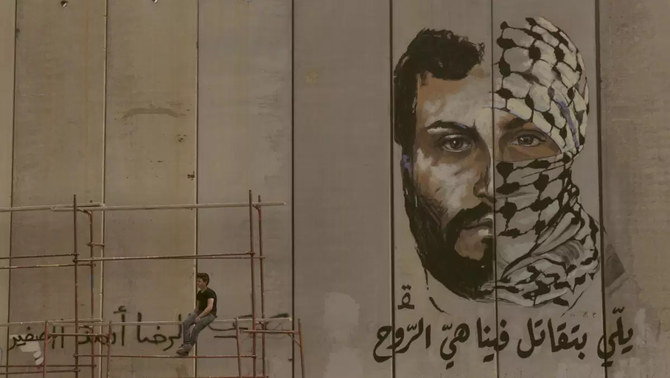

LONDON: French broadcaster France 5 aired night a three-part docuseries on Sunday looking into Iran-backed Lebanese militia Hezbollah and its ties to drug cartels and the Beirut port explosion.
The series, titled “Hezbollah, l’enquête interdite” which translates to “Hezbollah, the Forbidden Investigation,” delves into the Lebanese militant group’s history over the past 40 years.
Through a series of testimonials from high-profile officials, it casts a light on the group’s defiance of justice, protected by the Iranian regime.
The three-part film, each episode an hour long, also exposes Hezbollah’s secretive funding methods and seeks to highlight how the international community failed to curb its activities.
Directed by Jerome Fritel and Sofia Amara, it is based on the US Drug Enforcement Agency investigations and indictments and includes interviews with high-ranking Hezbollah leaders, including the number two official, Naim Qassem.
Alternating archive images and exclusive testimonies, Fritel and Amara explore in detail the story of Hezbollah from its creation in hiding during the Lebanese Civil War in 1982, up to the explosion which ravaged the Port of Beirut in 2020.
The two journalists also uncover the ambiguities that surround Hezbollah’s finances, revealing its involvement in Colombian cocaine trafficking.
The docuseries, which is currently only available in France, immediately triggered reactions from Lebanese people and the international community.
Some people welcomed the documentary, saying that although Hezbollah’s facts are well known to the Lebanese people, the report helps to expose the group to international scrutiny.
Hezbollah “is responsible for the explosion of Beirut and the destruction of our beautiful country,” one user said on Twitter.
“We Lebanese knew it but it’s time for the world to know it too!”
Le terrorisme de Hezbollah , la vrai vérité de ct organisation terroriste !Le terrorisme qui est responsable de l explosion de beyrouth et la détruite de notre joli pays ! Nous les libanais on le savait mais ce le temps que te le monde le sache aussi ! #sauvezleliban #France5
— Marie Noël (@mnkhs0) February 5, 2023
Following the revelations, some users urged foreign actors to take action against Hezbollah.
“The International Society now knows an important part of the truth … what we really hope is a reaction to the magnitude of our expectations,” commented a Lebanese Twitter user.
La Société Internationale connaît maintenant une partie importante de la vérité dévoilée ce soir sur le triste sort que le liban a subit et continue de subir par l'emprise de la Milice sur l'Etat..ce que nous ésperons vraiment est une réaction à l'ampleur de nos attentes..
— Christaaa(new account) (@Christa_Maksoud) February 6, 2023
Sky News Arabia and Arab News columnist Maria Maalouf was among the many users who posted links to download the episodes and urged followers to watch the documentary, which otherwise would not be available in Lebanon.
Some users, however, accused France 5 of propaganda against Hezbollah, and argued that the report is only a tactic to deter people, to “scare” and “alienate” them.
“Leave Lebanon in peace. No need for fake reportage,” one user said.
leave lebanon in peace no need for fake reportage
— جبل عامل (@jabal3amel) February 5, 2023


