

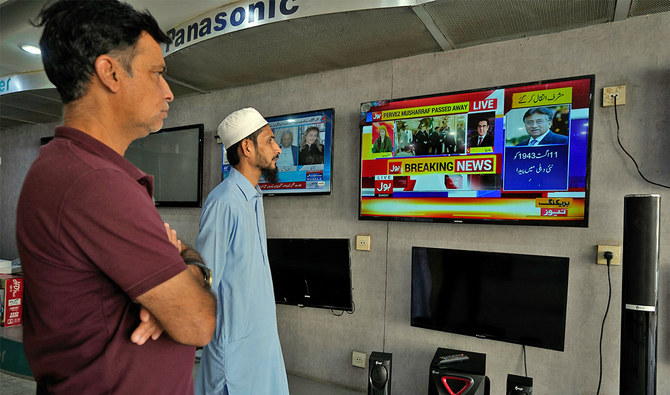

ISLAMABAD: The body of former Pakistani president and army chief General (retired) Pervez Musharraf, who passed away in Dubai on Sunday, will be repatriated to Pakistan today, one of his close aides said on Monday, adding Musharraf would be laid to rest in the southern city of Karachi.
Musharraf, 79, left Pakistan in 2016 for medical treatment after a travel ban was lifted. The former military ruler had since been living in a self-exile in the United Arab Emirates and was under treatment at a Dubai hospital for amyloidosis, a rare disease.
Musharraf seized power in a 1999 bloodless coup and was acting simultaneously as Pakistan’s army chief, chief executive, and president when the 9/11 attacks on the United States took place. He later became a key ally of the US during its invasion of Afghanistan.
The general twice suspended the constitution and was accused of rigging a referendum shoring up his power, as well as rampant rights abuses including rounding up opponents during his nearly nine-year rule.
“General Musharraf’s body will be repatriated to Pakistan today evening and he will be buried in Karachi tomorrow,” Dr. Muhammad Amjad, a former chairman of Musharraf’s All Pakistan Muslim League (APML) party, told Arab News.
"His funeral prayers will be offered tomorrow at 1:30 p.m. after Zuhr prayers at the Malir Garrison Polo Ground in Malir Cantt, Karachi," he added.
Amjad said Musharraf’s family had obtained a no-objection certificate from the Pakistani consulate in Dubai to repatriate his body.
“I am traveling to Karachi now to attend his last rites,” he told Arab News in Islamabad. “His last rites will be performed in a simple but dignified manner.”
Pakistan’s foreign office spokesperson Mumtaz Zahra Baloch expressed ignorance about the timing of the arrival of Musharraf’s body, but said that “our missions in the UAE are in contact with the family and are facilitating the transportation of the mortal remains.”
Mahreen Malik Adam, a former secretary-general of Musharraf’s party, also confirmed that his body would be brought to Pakistan today, on Monday, but she was not aware of the burial place.
“We hope General Musharraf’s family will formally be issuing a statement regarding burial and last rites of the deceased,” she told Arab News.
Arab News made repeated attempts to reach Bilal Musharraf, the deceased’s son, for details about Musharraf’s last rites, but could not succeed.
Musharraf, the son of a career diplomat, was born in New Delhi in 1943 and migrated to the newly independent Pakistan with his family in 1947. He joined the army in 1964 and graduated from the Army Command and Staff College in Quetta. He later attended the Royal College of Defense Studies in London and fought in Pakistan’s 1965 and 1971 war against neighboring India.
After holding a number of appointments in the army’s artillery, infantry, and commando units, Musharraf was appointed army chief by then prime minister Nawaz Sharif in 1998 — a move he would later come to regret when the military ruler ousted Sharif in a bloodless military coup in 1999. Musharraf then served as Pakistan’s president from 2001 to 2008.
Following the US invasion of Afghanistan after the September 11 attacks in 2001, Washington sought Pakistan’s support in the ‘War on Terror,’ and Musharraf became a close ally of the then US administration of George Bush. He also won mass appeal in the West through his calls for Muslims to adopt a lifestyle of “enlightened moderation.” He also embraced liberal economic policies during his rule that impressed business leaders, brought in foreign investment and led to annual economic growth of as much as 7.5 percent.
Musharraf ruled as army chief until 2007 when he quit, trading the military post for a second five-year term as president.
He stepped down as president also in 2008 over fears of being impeached by Pakistan’s then ruling coalition. He subsequently left the country but returned in 2013 with the hope of regaining power as a civilian at the ballot box. However, he encountered a slew of criminal charges, and within a year, was barred for life from running for public office.
In 2016, after a travel ban was lifted, Musharraf left for Dubai to seek medical treatment and remained there until his death.


