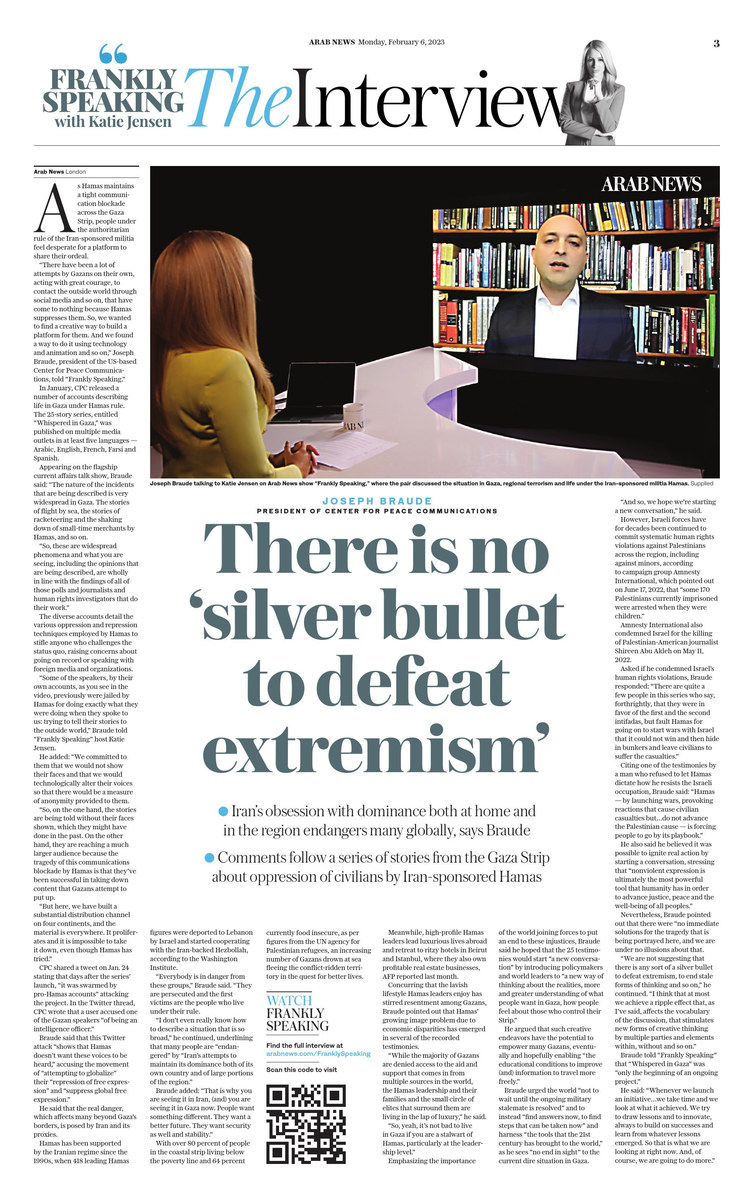
LONDON: As Hamas maintains a tight communication blockade across the Gaza Strip, people under the authoritarian rule of the Iran-sponsored militia feel desperate for a platform to share their ordeal.
“There have been a lot of attempts by Gazans on their own, acting with great courage, to contact the outside world through social media and so on, that have come to nothing because Hamas suppresses them. So, we wanted to find a creative way to build a platform for them. And we found a way to do it using technology and animation and so on,” Joseph Braude, president of the US-based Center for Peace Communications, said on Arab News’ “Frankly Speaking.”
In January, CPC released a number of accounts describing life in Gaza under Hamas rule. The 25-story series, entitled “Whispered in Gaza,” was published on multiple media outlets in at least five languages — Arabic, English, French, Farsi and Spanish.
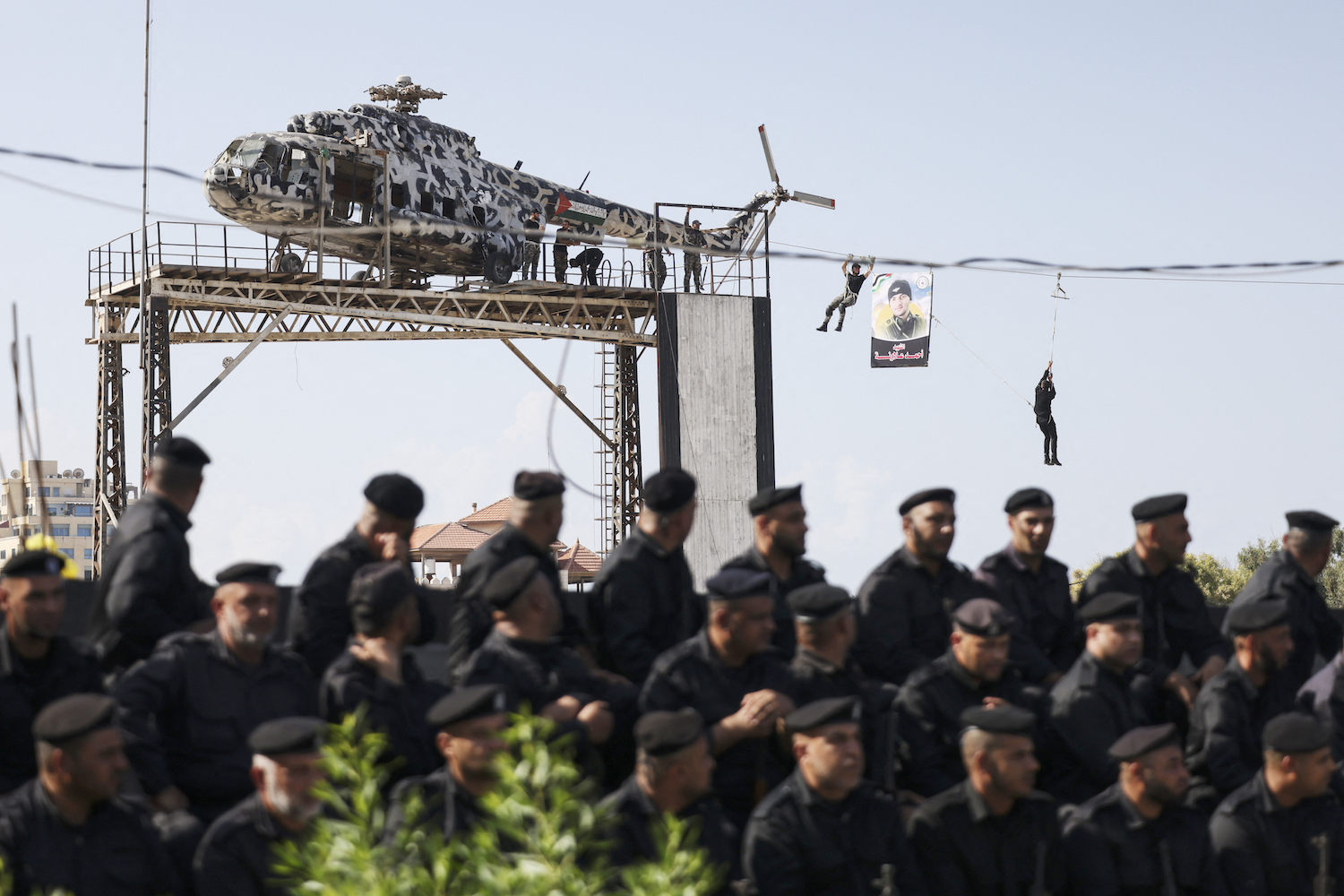
Members of the Hamas security forces show their skills in a drill held during a graduation ceremony in Gaza City on October 31, 2022. (AFP)
Appearing on the flagship current affairs talk show, Braude said: “The nature of the incidents that are being described is very widespread in Gaza. The stories of flight by sea, the stories of racketeering and the shaking down of small-time merchants by Hamas, and so on.
“So, these are widespread phenomena and what you are seeing, including the opinions that are being described, are wholly in line with the findings of all of those polls and journalists and human rights investigators that do their work.”
The diverse accounts detail the various oppression and repression techniques employed by Hamas to stifle anyone who challenges the status quo, raising concerns about going on record or speaking with foreign media and organizations.
“Some of the speakers, by their own accounts, as you see in the video, previously were jailed by Hamas for doing exactly what they were doing when they spoke to us: trying to tell their stories to the outside world,” Braude told “Frankly Speaking” host Katie Jensen.
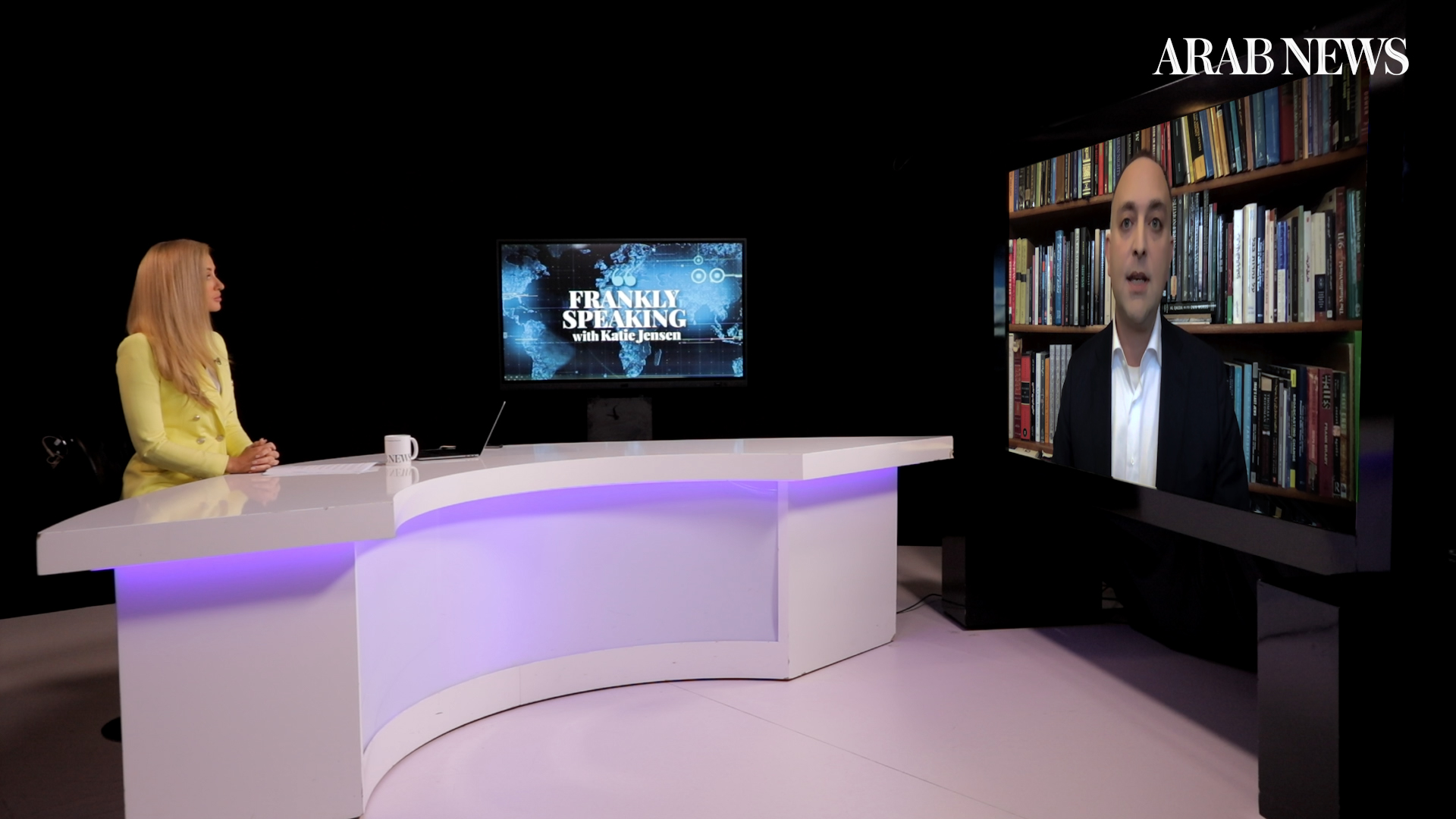
Joseph Braude, president of the US-based Center for Peace Communications (CPC), appears on Arab News’ “Frankly Speaking” talk show. (Screenshot)
He added: “We committed to them that we would not show their faces and that we would technologically alter their voices so that there would be a measure of anonymity provided to them.
“So, on the one hand, the stories are being told without their faces shown, which they might have done in the past. On the other hand, they are reaching a much larger audience because the tragedy of this communications blockade by Hamas is that they’ve been successful in taking down content that Gazans attempt to put up.
“But here, we have built a substantial distribution channel on four continents, and the material is everywhere. It proliferates and it is impossible to take it down, even though Hamas has tried.”
CPC shared a tweet on Jan. 24 stating that days after the series’ launch, “it was swarmed by pro-Hamas accounts” attacking the project. In the Twitter thread, CPC wrote that a user accused one of the Gazan speakers “of being an intelligence officer.”

Supporters of the Palestinian Hamas movement demonstrate in Jabalia in the northern Gaza Strip on October 21, 2022, against Israel. (AFP)
Braude said that this Twitter attack “shows that Hamas doesn’t want these voices to be heard,” accusing the movement of “attempting to globalize” their “repression of free expression” and “suppress global free expression.”
He highlighted that the real danger, which affects many beyond Gaza’s borders, is posed by Iran and its proxies, including Hamas.
Hamas has been supported by the Iranian regime since the 1990s, when 418 leading Hamas figures were deported to Lebanon by Israel and started cooperating with the Iran-backed Hezbollah, according to the Washington Institute.
“Everybody is in danger from these groups,” Braude said. “They are persecuted and the first victims are the people who live under their rule.
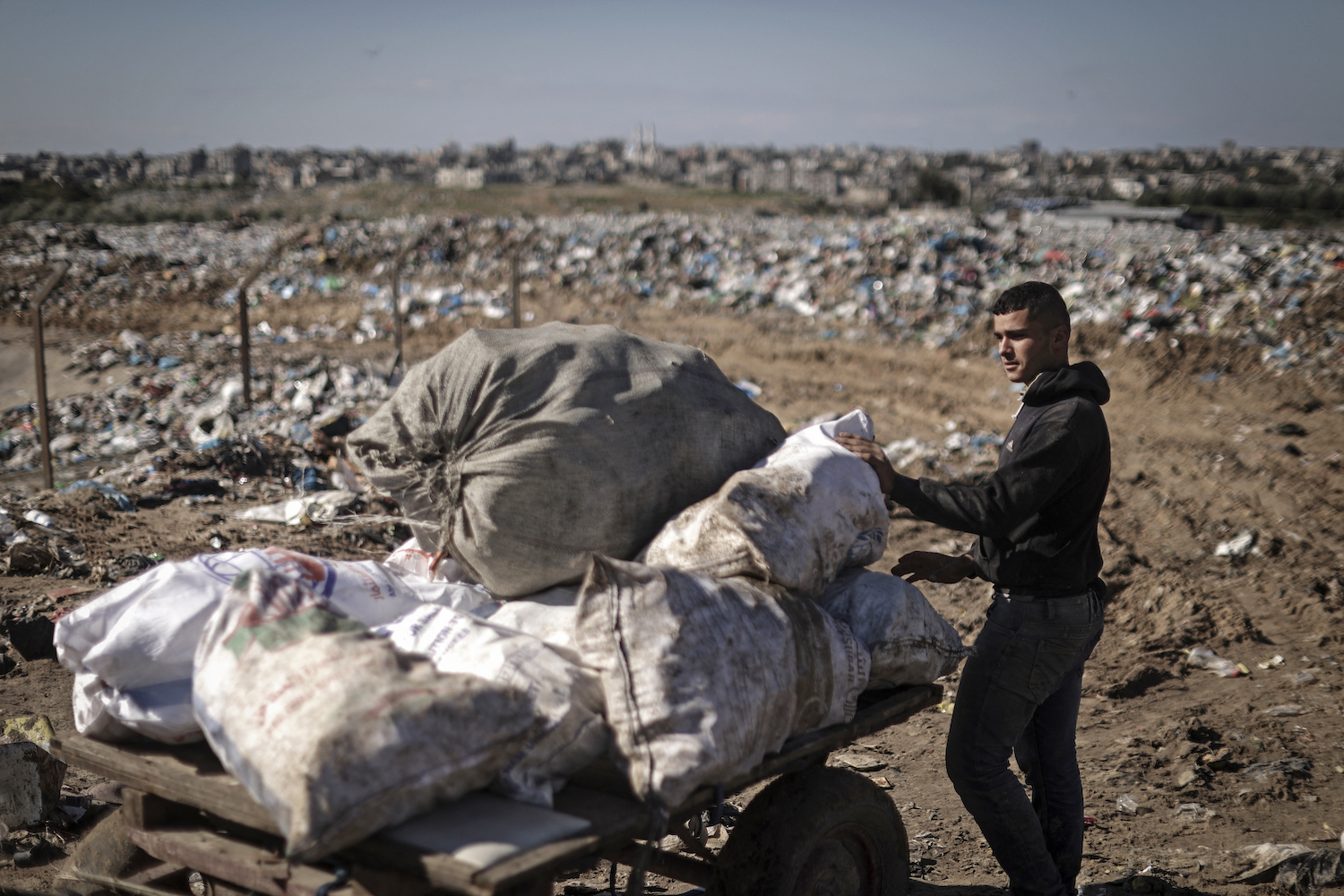
A Palestinian youth collects plastic and iron from a landfill in Beit Lahia in the northern Gaza Strip, on January 17, 2022. (AFP)
“I don’t even really know how to describe a situation that is so broad,” he continued, underlining that many people are “endangered” by “Iran’s attempts to maintain its dominance both of its own country and of large portions of the region.”
Braude added: “That is why you are seeing it in Iran, (and) you are seeing it in Gaza now: People want something different. They want a better future. They want security as well and stability.”
With over 80 percent of people in the coastal strip living below the poverty line and 64 percent currently food insecure, as per figures from the UN agency for Palestinian refugees, an increasing number of Gazans drown at sea fleeing the conflict-ridden territory in the quest for better lives.
Meanwhile, high-profile Hamas leaders lead luxurious lives abroad and retreat to ritzy hotels in Beirut and Istanbul, where they also own profitable real estate businesses, AFP reported last month.
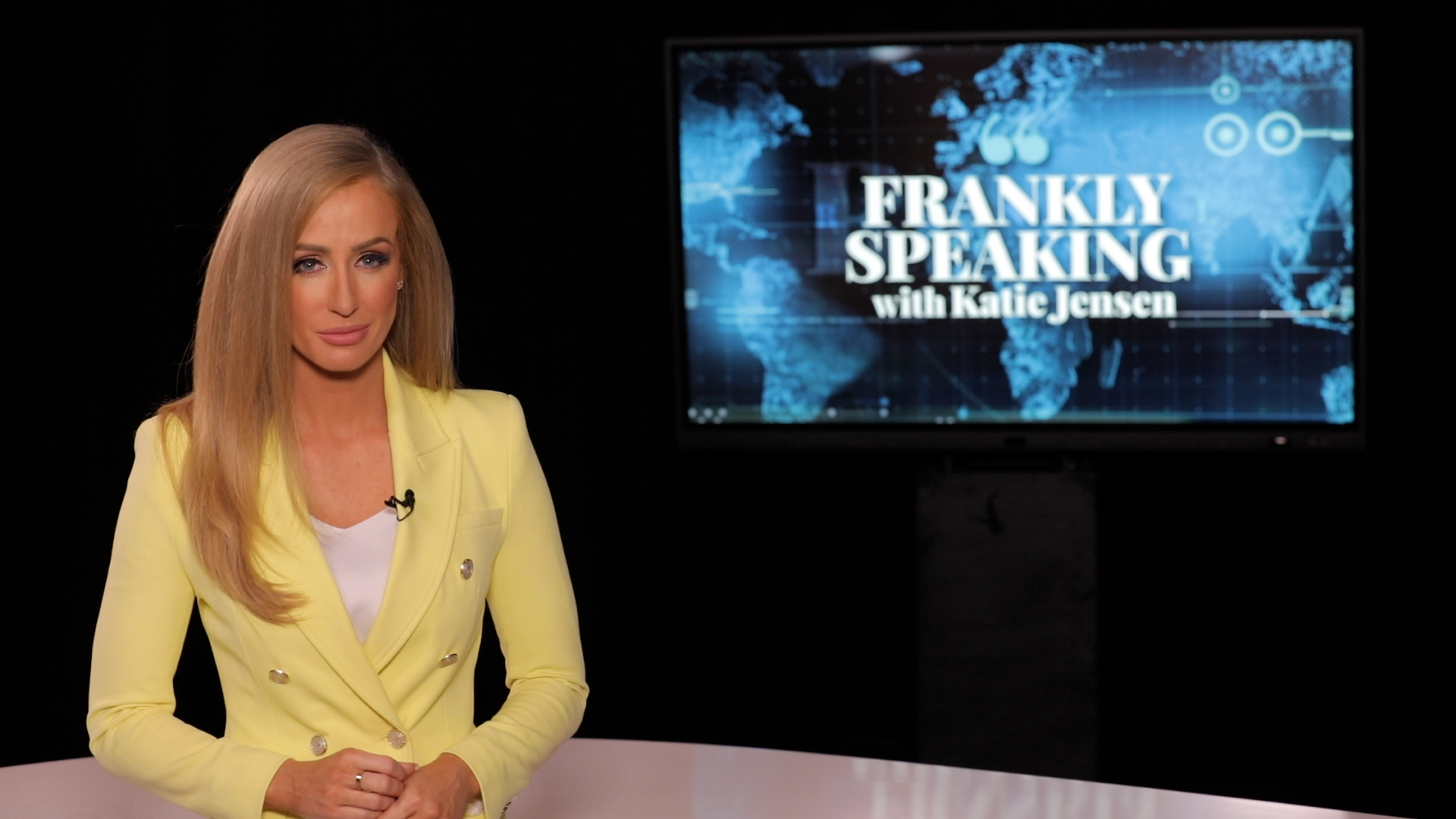
Arab News’ “Frankly Speaking” talk show host Katie Jenson. (Screenshot)
Concurring that the lavish lifestyle Hamas leaders enjoy has stirred resentment among Gazans, Braude pointed out that Hamas’ growing image problem due to economic disparities has emerged in several of the recorded testimonies.
“While the majority of Gazans are denied access to the aid and support that comes in from multiple sources in the world, the Hamas leadership and their families and the small circle of elites that surround them are living in the lap of luxury,” he said.
“So, yeah, it’s not bad to live in Gaza if you are a stalwart of Hamas, particularly at the leadership level.”
Emphasizing the importance of the world joining forces to put an end to these injustices, Braude said he hoped the 25 testimonies would start “a new conversation” by introducing policymakers and world leaders to “a new way of thinking about the realities, more and greater understanding of what people want in Gaza, how people feel about those who control their Strip.”
He argued that such creative endeavors have the potential to empower many Gazans, eventually and hopefully enabling “the educational conditions to improve (and) information to travel more freely.”
Braude urged the world “not to wait until the ongoing military stalemate is resolved” and to instead “find answers now, to find steps that can be taken now” and harness “the tools that the 21st century has brought to the world,” as he sees “no end in sight” to the current dire situation in Gaza.
“And so, we hope we’re starting a new conversation,” he said.
However, Israeli forces have been for decades committing systematic human rights violations against Palestinians, including minors, according to Amnesty International, which pointed out on June 17, 2022, that “some 170 Palestinians currently imprisoned were arrested when they were children.”
Amnesty International also condemned Israel for the killing of Palestinian-American journalist Shireen Abu Akleh on May 11, 2022.
Asked if he condemned Israel’s human rights violations, Braude responded: “There are quite a few people in this series who say, forthrightly, that they were in favor of the first and the second intifadas, but fault Hamas for going on to start wars with Israel that it could not win and then hide in bunkers and leave civilians to suffer the casualties.”
Citing one of the testimonies by a man who refused to let Hamas dictate how he resists the Israeli occupation, Braude said: “Hamas — by launching wars, provoking reactions that cause civilian casualties but…do not advance the Palestinian cause — is forcing people to go by its playbook.”
He also said he believed it was possible to ignite real action by starting a conversation, stressing that “nonviolent expression is ultimately the most powerful tool that humanity has in order to advance justice, peace and the well-being of all peoples.”
Nevertheless, Braude pointed out that there were “no immediate solutions for the tragedy that is being portrayed here, and we are under no illusions about that.
“We are not suggesting that there is any sort of a silver bullet to defeat extremism, to end stale forms of thinking and so on,” he continued. “I think that at most we achieve a ripple effect that, as I’ve said, affects the vocabulary of the discussion, that stimulates new forms of creative thinking by multiple parties and elements within, without and so on.”
Braude told “Frankly Speaking” that “Whispered in Gaza” was “only the beginning of an ongoing project.”
He said: “Whenever we launch an initiative … we take time and we look at what it achieved. We try to draw lessons and to innovate, always to build on successes and learn from whatever lessons emerged. So that is what we are looking at right now. And, of course, we are going to do more.”