Pope Francis wraps up South Sudan trip, urges end to ‘blind fury’ of violence

(AFP)
Short Url
Updated 05 February 2023
Follow

Pope Francis wraps up South Sudan trip, urges end to ‘blind fury’ of violence

JUBA: Pope Francis wound up a peace mission to South Sudan on Sunday urging the people to make themselves immune to the “venom of hatred” to achieve the peace and prosperity that have eluded them through years of bloody ethnic conflicts.
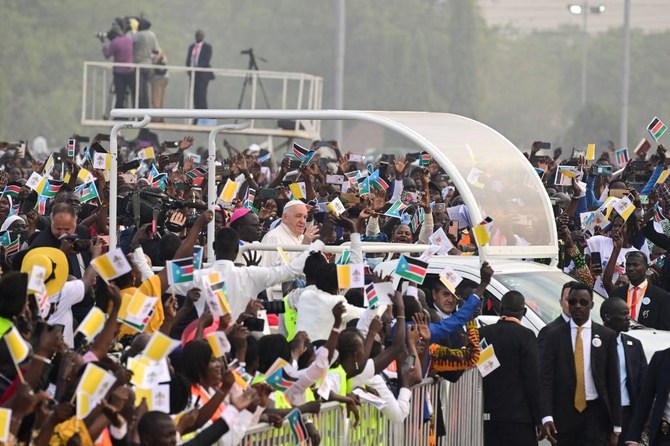
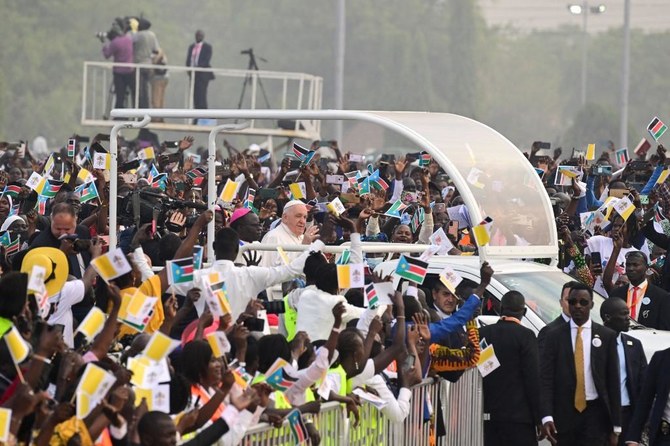
Francis presided at an open-air Mass on the grounds of a mausoleum for South Sudan’s liberation hero John Garang, who died in a helicopter crash in 2005 before the predominantly Christian country broke away from Muslim Sudan in 2011.
The 86-year-old pope wove his homily around the themes that have dominated his trip to the world’s newest nation — reconciliation and mutual forgiveness for past wrongs. The crowd sang, drummed and ululated as Francis entered the dusty area.
He begged the crowd of about 70,000 people to shun the “blind fury of violence.”
Two years after independence, South Sudan plunged into a civil war that killed 400,000 people. Despite a 2018 peace deal between the two main antagonists, bouts of fighting have continued to kill and displace large numbers of civilians.
At the end of the service, in a farewell address shortly before heading to the airport to fly home, the pope thanked the people of South Sudan for the affection they showed him.
“Dear brothers and sisters, I return to Rome with you even closer to my heart,” he told them. “Never lose hope. And lose no opportunity to build peace. May hope and peace dwell among you. May hope and peace dwell in South Sudan!“
The pope has had a longstanding interest in South Sudan. In one of the most remarkable gestures of his papacy, he knelt to kiss the feet of the country’s previously warring leaders during a meeting at the Vatican in 2019.
Archbishop of Canterbury Justin Welby, leader of the global Anglican Communion, and Iain Greenshields, Moderator of the General Assembly of the Church of Scotland, accompanied the pope during his visit to South Sudan.
The “pilgrimage of peace” was the first time in Christian history that leaders of the Catholic, Anglican and Reformed traditions conducted a joint foreign visit.
HOPE OF A TURNING POINT
Earlier on his Africa trip, the pope visited Democratic Republic of Congo, home to the continent’s largest Roman Catholic community, where he celebrated Mass for a million people and heard harrowing stories from people harmed by war in the eastern part of the country.
Among the worshippers at Sunday’s Mass in the South Sudanese capital Juba was Ferida Modon, 72, who lost three of her children to conflict.
“I want peace to come to South Sudan. Yes, I believe that his visit will change the situation. We are now tired of conflict,” she said. “We want God to listen to our prayers.”
Jesilen Gaba, 42, a widow with four children, said: “The fact that the three Churches united for the sake of South Sudan, this is the turning point for peace. I want the visit to be a blessing to us. We have been at war, we have lost many people.”
Francis made another appeal for an end to the tribalism, financial wrongdoing and political cronyism at the root of many of the country’s problems.
He urged the people to build “good human relationships as a way of curbing the corruption of evil, the disease of division, the filth of fraudulent business dealings and the plague of injustice.”
South Sudan has some of the largest crude oil reserves in sub-Saharan Africa but a UN report in 2021 said the country’s leaders had diverted “staggering amounts of money and other wealth” from public coffers and resources.
The government dismissed the report and has denied accusations of widespread corruption.


Panama wrests control of canal ports from Hong Kong group

Updated 2 sec ago
Follow

Panama wrests control of canal ports from Hong Kong group

  • In January, the country’s supreme court declared as “unconstitutional” the contract which had allowed Hutchison’s subsidiary Panama Ports Company (PPC) to manage the ports
PANAMA: Panamanian authorities have taken control of two ports on the Panama Canal from CK Hutchison after the Hong Kong-based conglomerate’s concession was annulled amid a row between the United States and China.
CK Hutchison objected Tuesday to the takeover, which it called “unlawful” and said raises “serious risks to the operations, health and safety” at terminals.”
In January, the country’s supreme court declared as “unconstitutional” the contract which had allowed Hutchison’s subsidiary Panama Ports Company (PPC) to manage the ports of Balboa on the Pacific and Cristobal on the Atlantic since 1997.
“The Panama Maritime Authority has taken possession of its ports and guarantees the continuity of operations,” an official said Monday after the Panamanian Supreme Court annulled Hutchison’s contracts to operate the ports.
The court ruling was the latest legal move to ripple through the interoceanic waterway, which handles about 40 percent of US container traffic and five percent of world trade.
The Central American country has been swept up in broader tensions between Washington and Beijing, with US President Donald Trump claiming, without providing evidence, last year that China effectively runs the canal.
Panama has always denied Chinese control over the 80-kilometer (50-mile) waterway, which is used mainly by the United States and China.
Hutchison had asked the Panamanian government to enter into negotiations to allow it to continue operating the two terminals — to no avail.
Publication of the court ruling in the official gazette Monday effectively ended the legal process.
“This does not imply the expropriation of those assets, but rather their use to guarantee the operation of the ports until their real value is determined for the corresponding actions,” said Panamanian President Jose Raul Mulino.
Ports director Max Florez said an 18-month transition period now begins, with the ports being operated by two other companies before contracts are awarded under a new international tender.
PPC denounced the move as an “illegal takeover without transparency or coordination” and said Panama’s actions were “confiscatory.”
In its statement Tuesday, CK Hutchison said: “None of the actions by the Panama State were advised to or co-ordinated with PPC.”
It will continue to consult with legal advisers regarding the ruling and “all available recourse including... legal proceedings against the Republic of Panama and its agents and third parties colluding with them,” CK Hutchison added.
Hong Kong’s government lodged a “stern protest” on Tuesday, saying in a statement that the “heavy-handed action” had “seriously infringed upon the lawful rights and interests of Hong Kong enterprises.”
’No layoffs’
China’s Hong Kong and Macao Affairs Office had previously warned that Panama would pay a “heavy price, both politically and economically” for stripping Hutchison of its tender.
Panama said APM Terminals, a subsidiary of the Danish Maersk group, will operate the port of Balboa, and Terminal Investment Limited, owned by the logistics giant MSC, will operate the port of Cristobal.
Labor Minister Jackeline Munoz assured there would be “no layoffs” at the two terminals, which employ around 1,200 people.
Following the court’s January ruling, the Panama Maritime Authority had said a division of Maersk Group would temporarily take over operation of the facilities.
Last week, Hutchison warned of possible legal action against Maersk and others over the annulment of its contract.
The Hong Kong company has said it will challenge Panama’s decision before the International Chamber of Commerce.
US Ambassador to Panama Kevin Cabrera defended Panamanian authorities, saying they have the right “to have their judicial system make its own decisions” and that the Supreme Court ruling was “very good” for the people of Panama.
The Panama Canal was built by the United States, which operated it for a century before ceding control to Panama in 1999.
On his first day back in the White House last year, Trump threatened to seize the canal.
He cooled his threats after Panamanian authorities decided that the concession ran counter to Panama’s interests.