

After deadly Peshawar bombing, top security body to meet today on steps to eradicate militancy

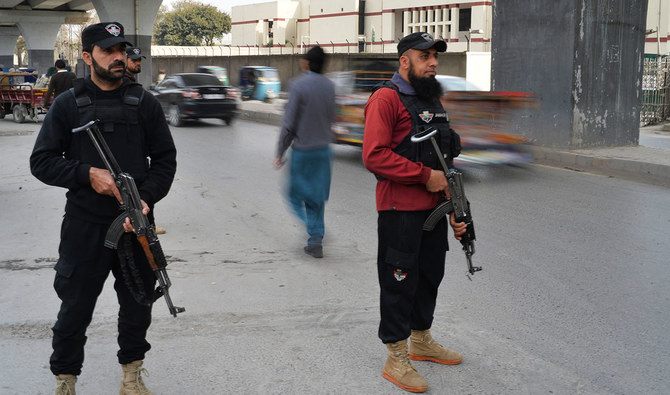
Policemen stand guard along a street in Peshawar on February 1, 2023, days after a mosque suicide blast inside a police headquarters. (AFP)
Short Url
Updated 03 February 2023
Follow

After deadly Peshawar bombing, top security body to meet today on steps to eradicate militancy

  • Meeting comes days after a suicide bomber killed over 100 people in the northwestern Pakistani city 
  • The attack, one of the deadliest in Peshawar in a decade, has raised alarm after years of relative calm

ISLAMABAD: Pakistani civilian and military officials will meet in the northwestern city of Peshawar on Friday to discuss step to root out militancy, the state media reported, days after a suicide bomber killed more than a hundred people, mostly police, and injured over 220 others in the city. 

Monday’s attack, one of the deadliest in Peshawar in a decade, came amid an uptick in militant attacks on police and security forces in the northwestern Khyber Pakhtunkhwa and southwestern Balochistan provinces. 

Pakistan’s defense and interior ministers in speeches to parliament this week blamed the Pakistani Taliban, who maintain sanctuaries in neighboring Afghanistan, for orchestrating the bombing. 

The Pakistani Taliban, or the Tehreek-e-Taliban Pakistan (TTP), are a separate group but allied with the Afghan Taliban and have carried some of the deadliest attacks in the South Asian country since late 2000s. 

Pakistani officials will meet at the KP governor’s residence and consider capacity building of the police department, among other measures, against the renewed militant threat in the province. 

“Meeting of Apex Committee will be held in Peshawar today to consider steps to eradicate terrorism and upgrade the Counter-Terrorism Department and police in wake of the recent terrorist incident in the provincial capital, the state-run Radio Pakistan broadcaster reported on Friday. 

“All stakeholders including Rangers and officers of the intelligence institutions will attend the committee’s meeting at the Governor House in Peshawar.” 

Pakistan has seen a surge in militant attacks since November, when the Pakistani Taliban ended a cease-fire with government forces, which was brokered by the Afghan Taliban in May. 

While Islamabad demanded the Afghan Taliban to take action against the TTP, Afghanistan’s Taliban-appointed foreign minister urged Pakistani authorities to look domestically for the reasons behind violence in their country instead of blaming Afghanistan. 

On Thursday, Pakistan’s foreign ministry spokesperson Mumtaz Zahra Baloch dismissed the Afghan Taliban’s criticism and said her government expected “cooperation” from Kabul. 

“We take the loss of innocent lives very seriously and would expect our neighbors to do the same,” Baloch said at a weekly press briefing. “Pakistan expects sincere cooperation” from Afghanistan. 

The provincial apex committees were established as part of the then government’s counter-terrorism measures after the massacre of nearly 150 people, mostly children, at a military-run school in Peshawar in December 2014. 

As subsequent military operations pushed militants out of Pakistan, these committees gradually became dormant. 


Pakistan says defense pact with Saudi Arabia elevated brotherly ties to ‘new heights’

Updated 25 February 2026
Follow

Pakistan says defense pact with Saudi Arabia elevated brotherly ties to ‘new heights’

  • Pakistan, Saudi Arabia signed strategic defense pact last year pledging aggression against one will be treated as attack on both
  • Deputy PM Ishaq Dar says enduring bonds with Islamic and Arab nations form vital pillar of Pakistan’s foreign policy 

ISLAMABAD: Deputy Prime Minister Ishaq Dar said on Wednesday that Pakistan’s defense pact with Saudi Arabia elevated its brotherly ties with the Kingdom to “new heights,” stressing that close ties with Arab and Islamic nations form a key pillar of Islamabad’s foreign policy. 

Pakistan and Saudi Arabia signed a Strategic Mutual Defense Agreement on Sept. 17 last year, pledging that aggression against one country would be treated as an attack on both, enhancing joint deterrence and formalizing decades of military and security cooperation.

Both nations agreed in October 2025 to launch an economic cooperation framework to strengthen trade and investment ties. 

“In the Middle East, our landmark Strategic Mutual Defense Agreement with Saudi Arabia has elevated our brotherly ties to new heights,” Dar said while speaking at the Pakistan Governance Forum 2026 event in Islamabad. 

The Pakistani deputy prime minister was speaking on the topic “Navigating International Relations Amidst Changing Geo-Politics.”

Dar noted that Pakistan has reinforced partnerships with other Middle Eastern nations such as the UAE, Qatar, Jordan, Oman, Egypt and Bahrain. He said these partnerships have yielded “concrete agreements” in investment, agriculture, infrastructure, and energy sectors. 

“Our enduring bonds with Islamic and Arab nations form a vital pillar of our foreign policy, and we will continue to expand our partnerships across Asia, Latin America, and Africa,” he said. 

Dar pointed out that the presidents of Kazakhstan, Uzbekistan and Kyrgyzstan have undertaken visits to Pakistan in recent months, reflecting Central Asian nations’ desire to boost cooperation with Islamabad.

On South Asia, the Pakistani deputy PM said Pakistan has successfully transformed its fraternal ties with Bangladesh into “a substantive partnership.”

“Similarly, the trilateral mechanism involving China, Pakistan, and Bangladesh has been launched with a view to expanding and deepening regional cooperation and synergy,” the Pakistani minister said. 

He said Islamabad has strengthened its “all-weather” partnership with China via the second phase of the multi-billion-dollar China-Pakistan Economic Corridor agreement and “unwavering support” from both sides for each other’s core interests. 

Dar said Pakistan had also reinvigorated its partnership with the US, advancing cooperation in trade, technology, investment, and regional stability. 

“This calibrated approach has enhanced our ability to navigate complexity with skill and confidence, ensuring that our national interests are served without compromising our core foreign policy principles,” he said.
