

Israel’s finance minister confiscates Palestinian money to compensate Israeli victims of attacks

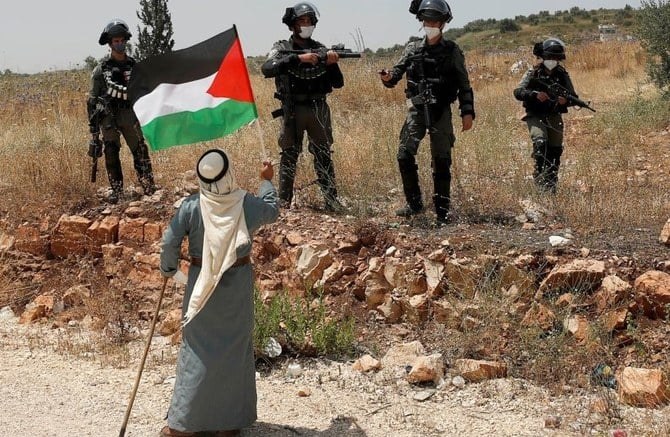
A demonstrator holds a Palestinian flag facing Israeli forces near Tulkarm in June 2020. Israel, which collects taxes on behalf of the Palestinian Authority, would use $29m from PA funds to compensate victims of Palestinian attacks. (Reuters/File)
Short Url
Updated 03 February 2023
Follow

Israel’s finance minister confiscates Palestinian money to compensate Israeli victims of attacks

  • The amount to be deducted is double the amount normally confiscated monthly
  • This is not the first time that Israeli authorities have confiscated Palestinian tax revenues as “compensation” to the families of Israelis

RAMALLAH: Israel, which collects taxes on behalf of the Palestinian Authority, would use 100 million shekels ($29 million) from PA funds to compensate victims of Palestinian attacks, Israeli Finance Minister Bezalel Smotrich has said.
The amount to be deducted is double the amount normally confiscated monthly — $14.7 million — in the first such move since Smotrich took office.
Smotrich signed off orders, claiming these funds would normally be transferred by the PA to the families of prisoners and those carrying out attacks against the occupation.
This is not the first time that Israeli authorities have confiscated Palestinian tax revenues as “compensation” to the families of Israelis killed and injured in Palestinian operations.
On Jan. 8, Smotrich ordered the seizure of $40.5 million from the PA’s funds as part of the sanctions he decided to impose on the Palestinians.
The sums deducted by Israel between 2011 and 2021 under this clause reached $11 billion.
In 2022 alone, the total unilateral Israeli deductions from Palestinian tax revenues amounted to $450 million.
A senior PA economic official, who preferred anonymity, told Arab News that the Israeli decision to double the deductions would exacerbate the financial crisis the PA has been suffering from for over a year.
“This is a deliberate attempt to weaken and undermine the Palestinian Authority,” he said.
“Considering the rise in prices and the increase in financial obligations for public sector employees, the additional deductions will make the PA unable to even pay 80 percent of the monthly salary to its employees, which will weaken the security establishment and push people to support violence against Israel,” he added.
The authority, he said, had exceeded the limit allowed to borrow from the Palestinian banks, and it was concerned that if it continued to borrow, it would cause a shock to the Palestinian banking sector.
Ahmed Majdalani, Palestinian social development minister, told Arab News that the additional Israeli cuts would impact the private sector as well as the Palestinian government’s ability to pay salaries and provide welfare for impoverished Palestinian families.
“Israel is pushing the PA to the brink of inability to fulfill its obligations, which aggravates the Palestinian situation and weakens PA institutions, including the security services,” he said.
Meanwhile, Israeli forces have arrested 27 Palestinians from the West Bank, most of them from Ramallah, transferred five Jerusalemites to administrative detention for three to six months, and demolished two houses in Duma village, south of Nablus, in the northern West Bank.
Suleiman Dawabsha, the head of the Duma village council, told Arab News that large forces from the Israeli army, accompanied by a military bulldozer, stormed the eastern area of the village and demolished the homes.
At the same time, the houses of 15 more people were threatened with demolition.
In a separate incident, an Israeli settler attacked a child from Hawara, south of Nablus, with pepper spray.
The settler stopped Suleiman Al-Mukhtar’s vehicle on the main street in the town and shot pepper spray through the car window at the face of his 14-year-old son, Faisal.
The Wall and Settlement Resistance Commission said the month of January saw 150 attacks carried out by settlers against Palestinians, including an attempt to establish six new settlement outposts. It added that 72 attacks were carried out in Nablus.
Meanwhile, 160 Palestinian and American human rights and humanitarian organizations have called on the US Congress to stop funding the “massacres” committed by the Israeli government against the Palestinian people.
They stressed the need for Congress to take immediate political measures to stop arming Israel by ending its military funding.
Amnesty International has called on Israeli authorities to dismantle the “apartheid” system, which is upheld by “unlawful killings” that constitute “crimes against humanity.”
It also condemned other grave and ongoing violations committed by Israeli authorities, such as administrative detention and forcible transfer of detainees.
In its statement, the organization said Israeli authorities controlled virtually every aspect of the lives of Palestinians, “subjecting them to oppression and unfair discrimination daily through the fragmentation of regions and legal segregation.”
People in the occupied Palestinian territories are isolated in enclaves, with those living in the Gaza Strip cut off from the rest of the world by Israel’s illegal blockade, which has caused a humanitarian crisis, a form of collective punishment, Amnesty said.
Elsewhere, Hamas condemned the opening of the Chadian Embassy in Israel on Thursday, calling on Chad to review its decision, which contradicts the position of the country’s people, who have historically supported Palestine.
Separately, the Islamic-Christian Organization for the Support of Jerusalem and Sanctities denounced an attack by settlers on a church in the Old City of Jerusalem.
It described the vandalism of the church as “a dangerous transgression by the settlers toward everything that is not Jewish in Jerusalem.”
The Israeli police said the culprit was an American tourist in his 40s who has been arrested.
Press reports said US Secretary of State Antony Blinken, during his visit, pressured Palestinian President Mahmoud Abbas to accept a security plan formulated by US Security Coordinator Gen. Michael Wenzel to restore the authority’s control over the cities of Nablus and Jenin, which have become centers of unrest.
The plan includes training a special Palestinian force to confront militants in the occupied West Bank.
“Such a security plan will never succeed because it has nothing to do with reality. The security problem in both Jenin and Nablus is not limited to suppressing those who resist Israel,” Jenin Gov. Maj. Gen. Akram Rajoub told Arab News.

The Kingdom vs Captagon
Inside Saudi Arabia's war against the drug destroying lives across the Arab world

Enter


keywords

Inaction over UAE’s role is prolonging ‘worst proxy war in the world,’ Sudan justice minister says

Updated 9 sec ago
Follow

Inaction over UAE’s role is prolonging ‘worst proxy war in the world,’ Sudan justice minister says

  • Had international community characterized it as ‘military rebellion’ and countered Emirati sponsorship of ‘terrorist militia’ it would not have endured, he tells UN Human Rights Council
  • He accuses paramilitary Rapid Support forces of ‘targeting basic infrastructure, strategic facilities and public services,’ and ‘atrocities beyond our capacity to describe’

NEW YORK CITY: Sudan’s justice minister on Wednesday blamed the prolongation of the near-three-year conflict in his country on what he described as the failure of the international community to properly label the war as a rebellion.

He also accused the UAE of sponsoring and arming a militia, the Rapid Support Forces, he said was responsible for widespread abuses.

“The war has outstayed its welcome and it should not have gone on for this long had the international community, and particularly the UN and its bodies, fulfilled their responsibility in rightly characterizing this military rebellion,” said Abdullah Mohammed Dirif, “and had they called a spade a spade and countered the Abu Dhabi government, which sponsored this terrorist militia and provided it with high-tech arms and provided it with mercenaries.”

Speaking during the high-level segment of the 61st session of the UN Human Rights Council in Geneva, he warned that “the misleading characterization of this war has given a green light for the militia to keep its flagrant violations.”

The minister, who said he was speaking “on behalf of the government of Sudan and its people,” described the conflict between the Sudanese Armed Forces and the RSF, which began in April 2023, as “one of the worst proxy wars in the world,” which had “targeted the very existence of Sudan and its people.”

The RSF has “continued its methodic targeting of basic infrastructure and strategic facilities and all public services,” Dirif said, adding that “the aim is to displace civilians against whom it has committed atrocities beyond our capacity to describe them.

“The violations and crimes of the militia are going unabated. Yesterday it invaded Moustahiliya region in northern Darfur. It targeted civilians, killed them. It looted. It scorched villages and cities.”

Sudan’s military was “conducting its constitutional responsibility by standing up to the militia, protecting the civilians, preserving the unity of the country and the rule of law,” he said, and it remains “committed to international humanitarian law and the rules governing military engagement, and taking into account proportionality principles in order to protect civilians.”

Khartoum remains “open to genuine efforts which aim to end the war and the rebellion” based on a road map presented by the president of the Transitional Sovereignty Council, and a peace initiative submitted by the prime minister to the UN Security Council on Dec. 22, he added.

Dirif stressed his government’s commitment to continued “cooperation and coordination with human rights mechanisms in Sudan,” including the presence of the UN’s Office of the High Commissioner for Human Rights in the country and the UN special rapporteur on the human rights situation in Sudan.

“We recall, nationally, that achieving justice and redress to victims and ensuring impunity is a top priority for us,” he said, adding that authorities had made progress by investigating violations of national laws and international humanitarian laws.

He also underscored Sudan’s “commitment to continue facilitating and expediting delivery of humanitarian assistance to those affected by the war, including those under the control of the rebellious militia.”

Later, Sudan’s representative to the UN in Geneva exercised his right of reply and responded to prior remarks by the representative from the UAE.

“This is not a mere accusation, it is a well-known fact that is predicated on a number of evidence and documented proofs,” he said, referring to the UAE’s sponsorship of the RSF.

He cited in particular a report by a UN panel of experts on Sudan published on Jan. 15, 2024, which he described as “an official document of the Security Council” that referred to “lines of transferring weapons from Abu Dhabi International Airport” based on “clear-cut evidence.”

Other major international organizations and Sudan’s national commission of inquiry have provided further proof, he added, and Khartoum had submitted “a number of complaints, with proof, to the Security Council of the proven sabotage by the Abu Dhabi authority.”

The Sudanese representative continued: “It is paradoxical that the same authority that is sponsoring criminal militia, that the whole world is seeing and is attesting to its crimes, is now talking about peace in the Sudan. Peace is a noble value, that you have to be full of peace before you talk about it.

“The people of Sudan are only requesting this country stop sponsoring this criminal militia that is killing the innocent people in my country on a daily basis.”

The UAE has denied accusations that it provides military support to armed groups in Sudan, and says it supports efforts to achieve a peaceful resolution to the conflict.