

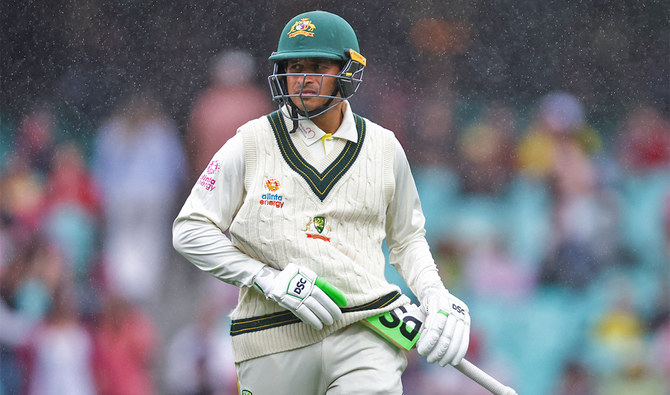
Pakistan-born Australian cricketer Khawaja finally gets visa to tour India

Australian batsman Usman Khawaja watches the ball during the first day of the second cricket Test match between Australia and the West Indies at the Adelaide Oval in Adelaide on December 8, 2022. (AFP)
Short Url
Updated 02 February 2023
Follow

Pakistan-born Australian cricketer Khawaja finally gets visa to tour India

  • It is not the first time Khawaja, who was born in Islamabad, has faced visa challenges when trying to enter India
  • In 2011, Khawaja took to social media to say he was not permitted to enter India because he was not born in Australia

MELBOURNE, Australia: Pakistan-born Australia cricketer Usman Khawaja was cleared to join the national squad for a tour of India after his visa issues were cleared up ahead of his rescheduled departure on Thursday.

Cricket Australia said Khawaja was flying out of Melbourne, more than a day later than planned, after having to wait for his visa to be approved.

The other members of Australia’s 18-man squad were granted entry to India in time to take flights on Tuesday and Wednesday to their training camp in Bangalore.

It is not the first time Khawaja, who was born in the Pakistan capital of Islamabad, has faced visa challenges when trying to enter India. In 2011, the top-order batter took to social media to say he had not been permitted to enter the country because he was not born in Australia.

On Wednesday, Khawaja posted a popular meme on Instagram along with the hashtags “stranded”, “dontleaveme”, “standard” and “anytimenow.”

The 36-year-old Khawaja hasn’t played in India in any of his 56 test matches dating back to 2011, although he has played other formats of cricket there. He has undergone a career revival since returning to Australia’s test lineup during the Ashes series win over England in January of last year following an almost three-year absence.

He posted centuries in each innings of his test recall in Sydney and has added three more hundreds, including an unbeaten 195 against South Africa last in Sydney last month, and five big half-centuries in 11 matches.

The four-test series against India begins in Nagpur next Thursday. The second test is set for New Delhi starting Feb. 17, the third March 1 in Dharamsala and the final test beginning March 9 in Ahmedabad.


Australia depth shows up England’s Ashes ‘failures’

Updated 5 sec ago
Follow

Australia depth shows up England’s Ashes ‘failures’

SYDNEY: A well-drilled Australia are on the cusp of retaining the Ashes after just six days of cricket — not bad for a team lambasted by England great Stuart Broad before the series began as its weakest since 2010.
The hosts take a 2-0 lead into the third Test at Adelaide on December 17 needing only a draw to keep the famous urn and pile more humiliation on Ben Stokes’s tourists.
Australia have put themselves on the brink despite missing injured pace spearheads Pat Cummins and Josh Hazlewood, with the performances of stand-ins Michael Neser and Brendan Doggett a reflection of their depth.
“The great and the healthiest thing for Australian cricket right now is that they’ve got almost a second XI or an Australia ‘A’ side that could come in and play some outstanding cricket too,” said former Australia Test quick Brett Lee.
“The guys who have had their opportunity, the Doggetts and the Nesers, have stood up. They’ve taken their opportunity and taken it with both hands, which is brilliant.”
The strength of the country’s talent pool was driven home by Australia ‘A’ crushing England’s second-tier side by an innings and 127 runs at Allan Border Field while Stokes’s men were being thrashed down the road in the second Test at the Gabba.
Young prospects Fergus O’Neill, Cooper Connolly and Campbell Kellaway stood out, while discarded Test batsman Nathan McSweeney fired a double-century reminder to selectors.
It is a far cry from the pre-Ashes war-of-words where England were hyped as having their best chance in a generation to win a series in Australia, with seamer Broad’s comments coming back to haunt him.
“It’s probably the worst Australian team since 2010 when England last won and it’s the best English team since 2010,” said Broad, who retired in 2023 and is now working as a pundit.
“It’s actually not an opinion, it’s fact.”
At the time, he pointed to questions over the make-up of Australia’s batting line-up and a perceived lack of bowling depth.
Both have been blown out of the water.

On the go

Australia went into the first Test in Perth dogged by uncertainty, with the uncapped Jake Weatherald as Usman Khawaja’s sixth opening partner since David Warner retired nearly two years ago.
In a quirk of fate, Khawaja was unable to bat in the first innings because of back spasms with Marnus Labuschagne replacing him.
But it was when he pulled out again in the second innings and Travis Head stepped up that the tide turned on England with his stunning 69-ball match-winning century.
“Ever since Travis Head stuck his hand up to open when Khawaja got hurt in Perth, Australia have looked like a different team,” said Australian legend Glenn McGrath.
Labuschagne said Head and Weatherald’s confidence trickled down to the lower order in Brisbane, where himself, Steve Smith and Alex Carey all blasted quick-fire half centuries.
It leaves selectors with a dilemma for the third Test: recall now-fit 85-Test veteran Khawaja or persist with Weatherald and Head, whose home ground is Adelaide.
Smith, who stood in for Cummins as skipper in the first two Tests, attributed Australia’s success so far to being able to adapt “in real time.”
“We play ‘live’. We adapt on the go, instead of getting back in the sheds and going, ‘We should have done this’,” he said.
“Sometimes it’s just playing the long game. I think we’ve just adapted so well the last couple of years, and played in real time, I suppose.”
For former Australia captain Greg Chappell, Australia’s success has been as much about England’s failures.
While their aggressive “Bazball” approach might be suited to flat English pitches and small grounds, it has been brutally exposed by the bigger boundaries and demanding conditions in Australia.
“The failure that has ensued across the first two Tests is a whole-of-system one, a catastrophic breakdown of both the game plan and its execution,” he wrote in a column.
“While the players have been the immediate culprits, the off-field leaders —  Brendon McCullum and Ben Stokes — are equally responsible for not recognizing the different challenges presented by Test cricket in Australia.”