

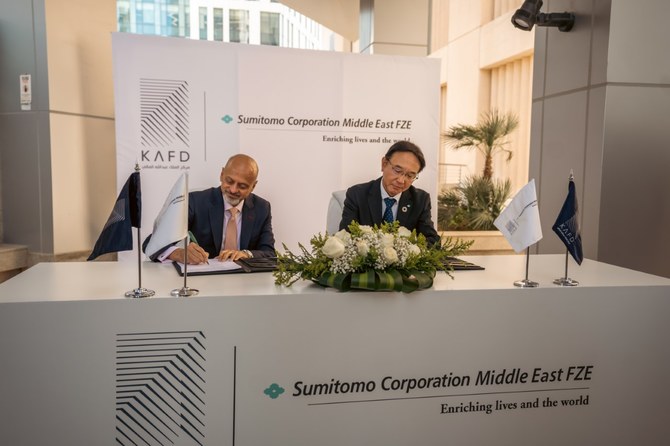

RIYADH: King Abdullah Financial District signed a Memorandum of Understanding with Sumitomo Corporation Middle East to utilize its innovative and eco-friendly technology to tackle climate change by reducing the heat island effect on surfaces within KAFD on Tuesday in Riyadh.
“For us, partnering with Sumitomo on this new technology is extremely important, because as a district, as KAFD, reducing greenhouse emissions and reducing the heat island effect are extremely important, and this technology with Sumitomo will help us,” Gautam Sashittal, CEO of KAFD, told Arab News.
According to Sashittal, from a KAFD point of view, being a sustainable district is very important. “We have several initiatives that have been implemented and are being implemented, and that is just part of our sustainable solutions to burnish our credentials,” he said.
Sumitomo, a subsidiary of the Fortune 500 global trading and business investment company, Sumitomo Corporation Group, signed the agreement with KAFD Development and Management Company to support KAFD’s goals for smart city development and technological advancements to create energy-efficient, intelligent buildings.
The products manufactured in Japan use state-of-the-art technology that will be applied in KAFD to reflect infrared radiation, which in return reduces surface temperature, heat flow, and maintenance costs caused by the heat island effect.
“We are honored to have the opportunity to collaborate on this project with KAFD, implementing our advanced solutions. Sustainability is a top priority for both companies. With this agreement, we look forward to working with KAFD DMC and sharing our experiences to enhance energy efficiency in its facilities,” Hajime Mori, managing director of Sumitomo Corporation Middle East FZE said.
Heat islands are created in cities that experience higher temperatures, when structures and pavements begin to absorb and re-emit heat from the sun to surrounding areas, intensifying the effects of climate change and potentially having a harmful effect on health.
Through the agreement, Sumitomo is already in line to begin pilot testing in several locations within KAFD for two products, one of which is called MIRACOOL. This product reduces surface temperatures of buildings and facilities that are exposed to solar radiation. The other product is PERFECT COOL, which is a solar heat-blocking pavement that reduces surface temperature by applying a cooling coat to the pavement surface.
Through this cooperation, KAFD will implement the PERFECT COOL coating that will reflect infrared radiation through a combination of special heat reflecting pigment that reduces the increase in road surface temperatures during the day and suppresses radiant heat at night.
“Combatting climate change is a priority for KAFD as a modern, sustainable metropolis. It’s estimated that by 2030, 1.9 billion people will be exposed to heat stress, and this collaboration with Sumitomo is an excellent opportunity for the district to develop heat resilience and sustainable cooling solutions.
By lowering the temperature, we will contribute to a better living and working environment for our tenants and residents and employees,” the CEO of KAFD DMC said.
Sashittal explained to Arab News that the use of the technology in the pavements not only reduces the heat island impacts but also increases the longevity of KAFD assets.
“We have looked at several initiatives in order to minimize our carbon footprint. We have an intelligent waste evacuation system for the entire district, we have water recycling opportunities, we have district cooling plants that supply chilled water across the districts,” he said.
“Last year we went through a major greenification drive, and today we have about 700 palm trees, 4,000 canopies, we have almost about half a million shrubberies and bushes that we have planted last year, and all of this actually compliments what we are doing with Sumotoma, which is about reducing the heat, making it more comfortable and sustainable.”


