

Pakistani artist Iman Sara uses Mughal miniatures to create niche in fine line tattooing

A collage of photos shows fine line tattoos depicting Mughal miniature art drawn by Pakistani artist Iman Sara. (Photo courtesy: Iman Sara)
Short Url
Updated 01 February 2023
Follow

Pakistani artist Iman Sara uses Mughal miniatures to create niche in fine line tattooing

  • Without apprenticeship options in Lahore or fake skin to work with, Sara had to experiment on her own body and has 120 tattoos 
  • Fine line tattoos are relatively new to the tattoo industry and Mughal miniature motifs are virtually unheard of in body art

LAHORE: When miniaturist Iman Sara decided during the first coronavirus lockdowns in 2020 that she wanted to learn tattooing, she scoured through a number of body art parlors in her hometown of Lahore and discovered that there was not a single practitioner who had a formal arts education and could teach her the craft.

Then an idea struck her: she could be the first one.

A graduate of the Miniature Department at the National College of Arts (NCA), for the past three years Sara has been making her mark as a fine line tattooist, using her expertise in Mughal miniatures to create a niche in the body art industry. 

Fine line tattoos, which involve creating designs with very fine, delicate lines, are relatively new to the tattoo industry, compared to the thicker lines and heavy color shading of traditional machine-made tattoos. And Mughal miniature motifs are virtually unheard of in body art.

So, without any apprenticeship options in Lahore or fake skin to work with, Sara had to experiment on her own body, working with Mughal motifs as her way of grounding her art in her subcontinental roots. She started practicing on her legs, then moved onto her arms, her torso and finally her hands, pouring over videos on the Internet, and researching hygiene and cleanliness to avoid infections in fresh skin wounds.

Soon her friends, husband and siblings also wanted to get tattoos from her. As word spread, other people started approaching her too, setting her off on a professional trajectory.

“I had a friend in America [who got] me all the equipment I needed,” Sara, who has 120 tattoos on her body, told Arab News from London, where she is now based and working at Lost Fox Studios. “During quarantine I taught myself how to tattoo.”
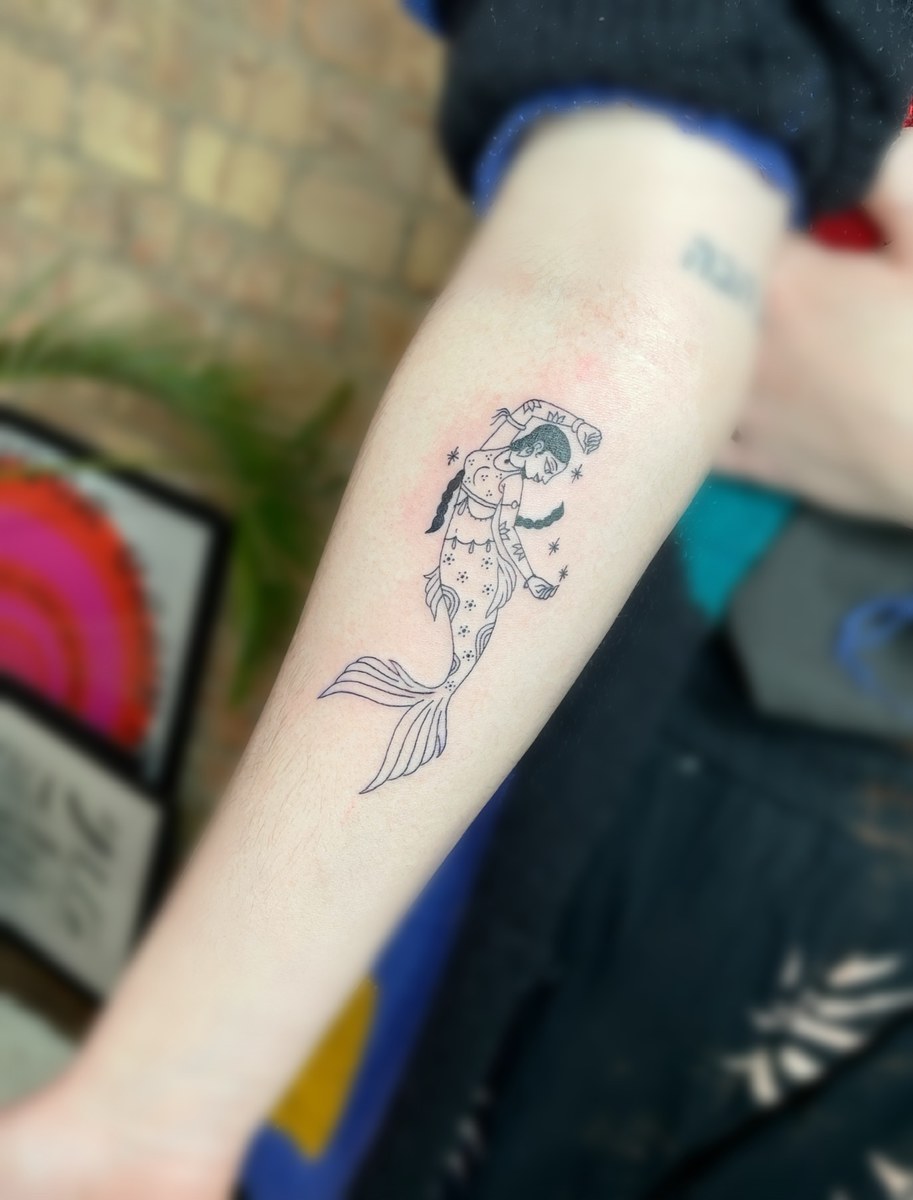


A forearm tattoo with a Mughal mermaid motif made in London on January 18, 2023. (Photo courtesy: Iman Sara)

Sara most frequently uses a 0.30mm Round Liner instrument, which comprises a tight cluster of needles, narrower than the needles used for traditional machine tattoos, but ideal for fine line work.

“We used to paint with brushes that were made of 10-15 strands of squirrel hair [for miniatures at NCA]. They were very thin, so it was a natural transition to fine line tattooing,” the artist said. “The miniature background was a blessing, same hand pressure, clean lines, attention to detail.”
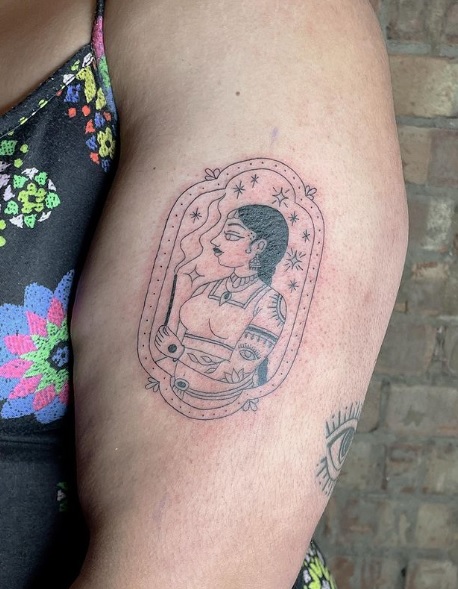


Custom Mughal miniature tattoo made in London on November 22, 2022. (Photo courtesy: Iman Sara)

Sara said she had wanted to be a tattoo artist since she was 14 years old:

“But living in Pakistan, I never thought it would be a possibility for me, especially being a girl.”

Before moving to London, Sara had a client waiting list of 200 in Lahore, while the biggest tattoo parlor in Pakistan, Inkgrave Studios in Karachi, currently averages around 50 clients a month and has a waiting list of about 20 people.

One of the most experienced tattoo artists in Lahore, Meer, who only uses his first name and learnt tattooing in Thailand and Poland, said he had “never seen anything like it,” when describing Sara’s work.

“With tattoos that small and lines that thin, it would take years of experience to keep a steady hand,” he told Arab News. “Even now I see people around me, we make mistakes, ink spills out of the stenciled area. That’s easier to cover up when you have thicker lines.”
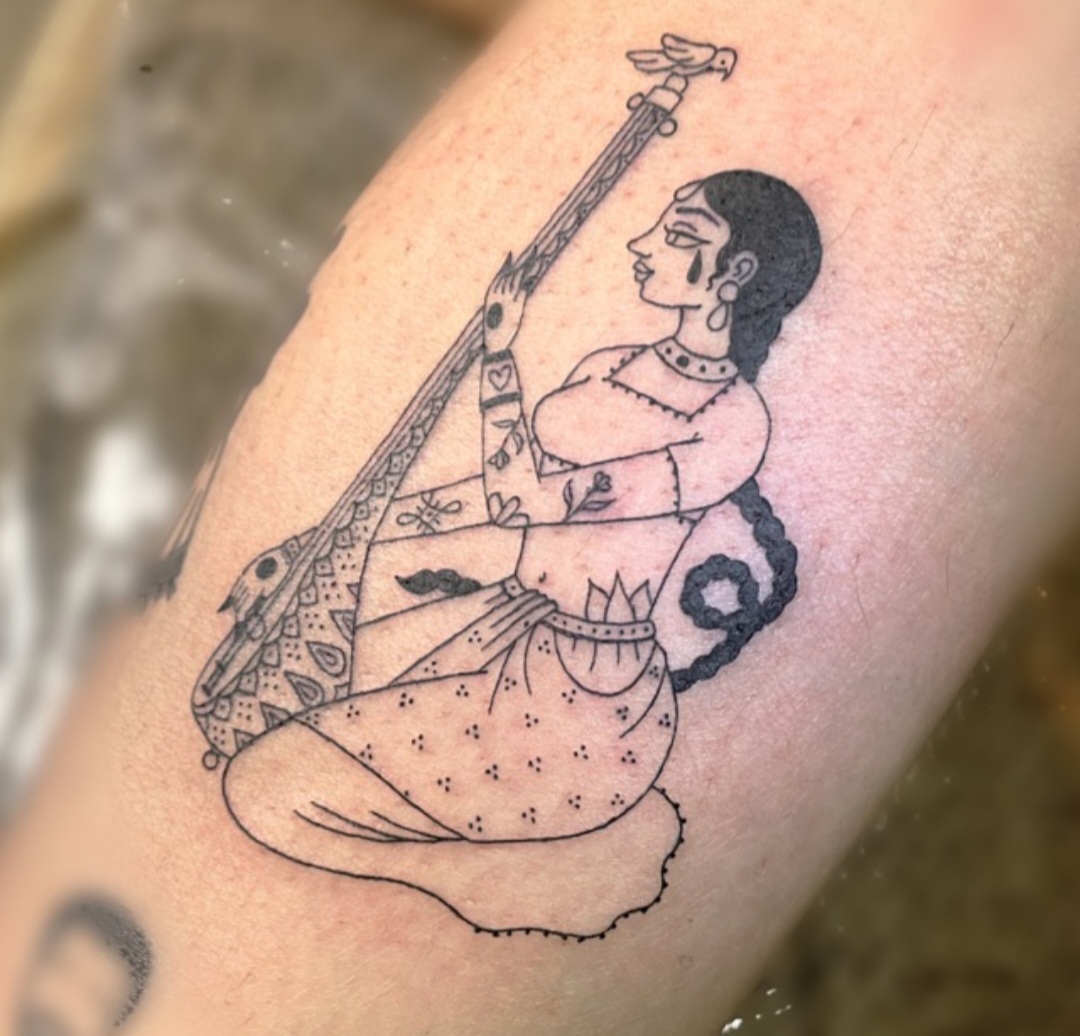


Custom miniature of a woman holding a sitar made in Lahore on September 17, 2022. (Photo courtesy: Iman Sara)

But the margin of error was “much smaller” in Sara’s work, Meer said:

“I’ve been tattooing in three countries. Watercolors are hard, but you can still use a free hand on those, this seems harder.”

An artist, model and digital content creator from Lahore who publicly uses the name Baemisaal said she found out about Sara through a colleague and had gotten multiple tattoos done from her.

“Seeing her tattoos up close instantly got me obsessed with her line work and precision. As an artist myself, detailing and finesse is super important to me,” she said. “I went to see her a year ago. I’d been wanting the tattoos I have now since I was literally 14. I [just] couldn’t trust anyone because some of my tattoos are my own illustrations.”

But Sara’s work is “so incredibly unique,” Baemisaal said. “Everywhere I go, people ask if they can look at my tattoos.”

What was best about the miniaturist, Baemisaal said, was that she gave her clients “complete freedom” over their designs.

“Some tattoo artists insist on doing things their own way,” the model said, “which never makes sense to me since it’s our bodies, the tattoos [are] etched on our skins forever.”


Pakistan rules out talks with Afghanistan, says over 330 Afghan fighters killed in clashes

Updated 10 sec ago
Follow

Pakistan rules out talks with Afghanistan, says over 330 Afghan fighters killed in clashes

  • Clashes between the neighbors erupted after Pakistan’s airstrikes on Afghan territory last weekend
  • US voices support for Pakistan, Information Minister Attaullah Tarar says they aim to make Pakistan safe

ISLAMABAD: Pakistan has ruled out any talks with Afghanistan until an end to “terrorism” emanating from the Afghan soil, officials said on Friday, following the killing of more than 330 Afghan fighters in cross-border clashes this week.

The latest clashes between the neighbors erupted after Pakistan’s airstrikes on Afghan territory last weekend triggered Afghan retaliatory attacks along the border on Thursday, escalating long‑simmering tensions over Pakistan’s claim that Afghanistan shelters Pakistani Taliban militants. Afghanistan denies this and argues Pakistan is deflecting blame for its own security failures.

Pakistani Information Minister Attaullah Tarar said they had killed 331 Afghan fighters, destroyed over 100 posts and targeted 37 military locations across Afghanistan. Afghan officials have said that more than 50 Pakistani soldiers have been killed and several Pakistan posts have been captured by their forces. None of the casualty figures or battlefield claims from either side could be independently verified.

Meanwhile, Mosharraf Zaidi, Prime Minister Shehbaz Sharif’s spokesperson for foreign media, ruled out any talks with Afghanistan until Kabul addresses the issue as the United States (US) expressed his support for what it called Pakistan’s “right to defend itself” against attacks from Afghanistan’s Taliban rulers.

“There won’t be any talks, there is nothing to talk about... Terrorism from Afghanistan has to end,” Zaidi told Pakistani state media, saying Islamabad would continue to target militant havens inside Afghanistan.

“Pakistan’s responsibility is to protect its citizens. If we know that there is a terrorist in point A and we know that there is a terrorist enabler at point A, we will find a weapon to land at point A and eliminate the threat.”

Zaidi said he didn’t expect Pakistan to deviate from this position and that the government had clearly conveyed what it was doing.

“We have clearly articulated what we are doing and what we plan on continuing to do and what it will take for us to stop doing what we are doing,” Zaidi said.

“And we will expect that both the international community and the regime in question, the Afghan Taliban, will come to their senses and will help reduce instability and disorder in this region.”

Pakistan is a major non-NATO ally of Washington, while the US considers the Afghan Taliban to be a “terrorist” group.

“The United States supports Pakistan’s right to defend itself against attacks from the Taliban, a Specially Designated Global Terrorist group,” Reuters quoted a State Department spokesperson as saying. US diplomat Allison Hooker said on X she spoke on Friday with Pakistan Foreign Secretary Amna Baloch.

The State Department spokesperson said Washington was aware of the escalation in tensions and “outbreak of fighting between Pakistan and the Afghan Taliban,” adding the US was “saddened by the loss of life.”

“The Taliban have consistently failed to uphold their counterterrorism commitments,” the State Department said, adding that “terrorist groups use Afghanistan as a launching pad for their heinous attacks.”

Meanwhile, Afghan Taliban spokesperson Zabihullah Mujahid called for talks to resolve the crisis.

“We have always emphasized peaceful resolution, and now too we want the issue to be resolved through dialogue,” he said on Friday afternoon.

Asked what Pakistan desired, Information Minister Tarar said: “Neutralizing the threat and ensuring that Pakistan is safe.”

“Because for us, we’ve been good neighbors, we’ve been very friendly neighbors, we’ve been very, very generous neighbors. Our generosity, unfortunately, has often been seen as our weakness,” he told state media.

“So the objective, aim is to neutralize the threat and make Pakistan safe.”

To a question about a ceasefire, Tarar said it was “too early” to comment on that as it was an evolving situation.