

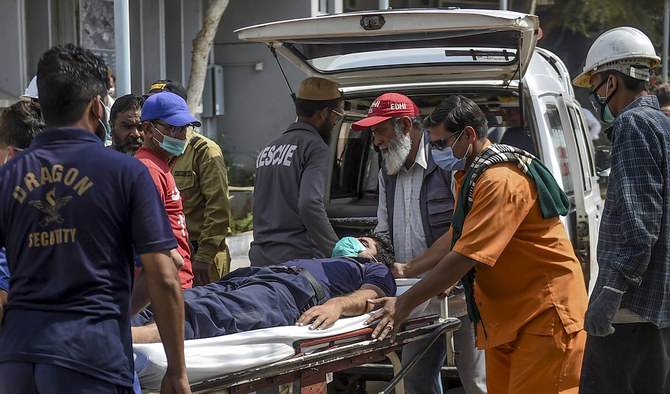

KARACHI: Police have filed a case against three factory owners for manslaughter and negligence and arrest one of them in the southern port city of Karachi, a police official said on Monday, on a complaint that poisonous gas from their factories had leaked and caused multiple deaths in recent weeks.
At least 15 people were reported dead between January 10-26 in the city's Ali Muhammad Goth neighborhood in district Keamari, according to an investigation report by the Sindh health department that was released last week. The report said 34 others who fell ill in the area had survived and were treated at hospital.
Authorities sealed three factories in the Keamari neighborhood on Friday after health teams observed a "very foul smell" in the affected area. All infected cases and deaths were reported among residents who were living an estimated 10-20 feet away from factories that produce rubber, plastic, stone, and oil.
“One [factory] owner, Khair Mohammed alias Sher Mohammed, has been arrested while two others have also been nominated in the case registered by a resident whose four family members have died,” Chaudhry Shahid, station house officer (SHO) Moachko, told Arab News.
The case was registered under Sections 322 (punishment for an unintentional, unlawful act that causes death), 284 (negligent conduct with respect to poisonous substance) and 34 (common intention) of the Pakistan Penal Code against factory owners Mohammed, Shahid Husain and Saeed Khan.
Complainant Khadim Husain stated in the FIR that toxic fumes emitted by factories in the neighborhood had killed his wife Razia, 32, sons Shoaib and Shahid, 18 and 4 respectively, as well as his one-year-old daughter, Haleema.
“These deaths occurred owing to the negligence of the factory owners,” a copy of the first information report by police, seen by Arab News, stated.
However, the health department said both measles and gas emissions could be the reasons for the deaths, adding in its investigation report 40 out of 49 total victims were younger than 11 years of age and not vaccinated against measles.
“During an active search in the community, the team observed cases of suspected measles," the report said. "We cannot exclude the measles virus as a risk factor of the outbreak until the confirmation of blood samples.”
Senior Sindh health official Dr. Abdul Hameed Jumani said nothing conclusive could be said about the cause of death yet, adding: “But since there are no deaths [after the closure of factories], it can be assumed that toxic chemical emitted by the factory was the cause.”
Dr. Seemin Jamali, a health expert and former executive director of Karachi's Jinnah hospital, also said toxic pollution may not be the only cause of the deaths, adding that in Pakistan, common causes were often overlooked by authorities in their search for unusual explanations in such incidents.
"Common causes include diseases which could be measles or diphtheria or something of the kind," Jamali said. "Because the immunization of the population here [in Ali Muhammad Goth] is almost 0%."
In February 2020, at least fourteen people died in a case of the emission of toxic gas in the same port side Keamari district. Authorities also suspected soybean dust from shipping containers could have led to the deaths.
Incidents of gas leakages and mishaps are common in Karachi, where many factories are built inside residential areas, or operate illegally and without proper safety measures.


