

Islamabad district judge sends ex-PM Khan aide on 14-day judicial remand

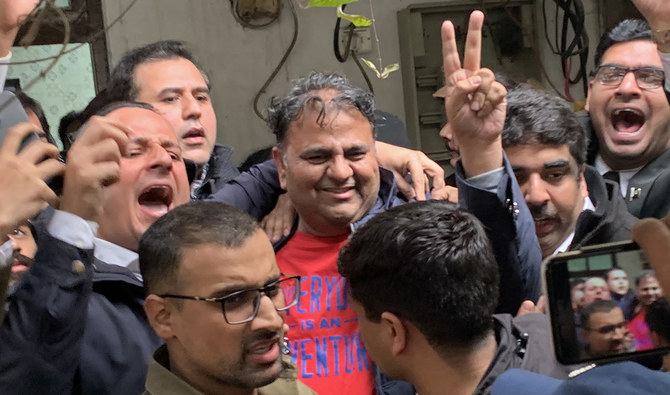
Police officials escort the Pakistan's former information minister Fawad Chaudhry, center, to present him before a court in Lahore on January 25, 2023. (AFP/File)
Short Url
Updated 30 January 2023
Follow

Islamabad district judge sends ex-PM Khan aide on 14-day judicial remand

  • Chaudhry Fawad Hussain was arrested in Lahore last Wednesday on a complaint filed by the Election Commission
  • ECP says Hussain threatened members of regulator and families in a TV interview, incited violence against them

ISLAMABAD: A district judge in Islamabad has ordered that ex-premier Imran Khan’s close aide, Chaudhry Fawad Hussain, be jailed on judicial remand for 14 days in a case involving charges of sedition, among others, filed by the country's election regulator.

The former information minister was arrested in Lahore last Wednesday after the Election Commission of Pakistan (ECP) lodged a complaint with Islamabad police saying the leader of Khan’s Pakistan Tehreek-e-Insaf (PTI) party had threatened members of the regulator as well as their families and made remarks in a TV interview that were tantamount to inciting violence against them. 

“He [Fawad Hussain] is remanded to judicial custody,” Magistrate Waqas Ahmad Raja said in a short order, rejecting the prosecution’s plea for an extension in Hussain's physical remand.  

Police were granted two-day physical remand of the PTI leader on Saturday to carry out a photogrammetry test and recover his laptop and mobile phone for forensic analysis.

On Sunday, Hussain was taken to Lahore for the test which the prosecution said was mandatory to complete the investigation.

The magistrate on Monday asked what the need was for the photogrammetry test in such a case and the prosecution failed to provide an answer that satisfied the judge.

Photogrammetry can be a very powerful tool in forensic analysis and is often useful to get an accurate 3D reconstruction of an accident or crime scene, especially in cases where position, distance and perspective are important.

“I have been on the road for the last 48 hours,” Hussain told the judge.  “I haven’t gotten enough sleep,” he added, referring to his journey to Lahore and back for the photogrammetry test.

“The police were under special instructions to take me [to Lahore] in the police van. I have slept only two and a half hours in the last six days," he added.

Hussain's counsel, advocate Babar Awan, said the accused had already acknowledged his statement during the TV appearance.

“Fawad Chaudhry says he stands by his statement,” Awan told the court. “He has categorically announced that he would not surrender. He is the first accused who is accepting his statement.”

The judge rejected the prosecution's plea for an extension in Hussain's physical remand and sent him to a judicial lockup for 14 days. The judge also allowed Hussain’s family to meet him in the lockup at the Islamabad district court’s premises.

The PTI leader’s legal team is pursuing a bail petition in the district court for his release.  

During the hearing on Monday, which took place in a packed courtroom amid heavy deployment of police, the magistrate ordered police officials to remove Hussain's handcuffs.

PTI supporters and leaders chanted slogans outside the court's premises, demanding Hussain's release in what they described as a "shady case."


Pakistan FM discusses regional situation with Saudi counterpart, urges restraint and dialogue

Updated 5 sec ago
Follow

Pakistan FM discusses regional situation with Saudi counterpart, urges restraint and dialogue

  • This is the second time the two foreign ministers have spoken since the Arab Coalition targeted weapon shipments on Yemen’s Mukalla port
  • Saudi Arabia’s foreign ministry has invited factions in south Yemen to hold a dialogue in Riyadh to ‘discuss just solutions to southern cause’

ISLAMABAD: Pakistan’s foreign minister, Ishaq Dar, discussed the regional situation with his Saudi counterpart, Prince Faisal bin Farhan, and called for restraint and dialogue to resolve issues, the Pakistani foreign office said late Friday, amid tensions prevailing over Yemen.

This is the second time the two foreign ministers have spoken this week since the Saudi Arabia-led Coalition to Support Legitimacy in Yemen carried out a “limited” airstrike on Dec. 30, targeting two shipments of smuggled weapons and military equipment sent from the Emirati port of Fujairah to Mukalla in southern Yemen.

A coalition forces spokesperson said the weapons were meant to support the Southern Transitional Council (STC) forces, backed by the United Arab Emirates (UAE), in Yemen’s Hadramaut and Al-Mahra “with the aim of fueling the conflict.” The UAE has since announced withdrawal of its remaining troops from Yemen, rejecting any actions that could threaten the Kingdom or undermine regional stability.

In their telephonic conversation late Friday, the Pakistani and Saudi foreign ministers discussed the latest situation in the region, according to the Pakistani foreign office.

“FM [Dar] stressed that all concerned in the region must avoid any escalatory move and advised to resolve the issues through dialogue and diplomacy for the sake of regional peace and stability,” it added.

Separately, Saudi Arabia’s foreign ministry invited factions in south Yemen to hold a dialogue in Riyadh to “discuss just solutions to the southern cause.”

The ministry statement said the conference in the Saudi capital had been requested by Rashad Al-Alimi, President of the Yemeni Presidential Leadership Council, and the Kingdom urged all factions to participate “to develop a comprehensive vision” that would fulfill the aspirations of the southern people.

Disregarding previous agreements with the Arab Coalition, the STC separatist group launched a sweeping military campaign early in December, seizing the governorates of Hadramaut along the Saudi border and the eastern governorate of Al-Mahra in Yemen’s border with Oman. It also took control of the strategic PetroMasila oilfields, which account for a massive portion of Yemen’s remaining oil wealth.

The advance has raised the spectre of the return of South Yemen, a separate state from 1967 to 1990, while dealing a hammer-blow to slow-moving peace negotiations with Iran-backed Houthi rebels.

Saudi Arabia said the STC action poses a direct threat to the Kingdom’s national security, and regional stability. The Kingdom has reiterated the only way to bring the southern cause to a resolution is through dialogue.

On Thursday, Pakistan’s foreign office expressed solidarity with Saudi Arabia and reaffirmed Islamabad’s commitment to the Kingdom’s security, amid rising tensions in Yemen.

“Pakistan expresses complete solidarity with the Kingdom of Saudi Arabia and reaffirms its commitment to security of the Kingdom,” Pakistani foreign office spokesperson Tahir Andrabi told reporters at a weekly news briefing.

“Pakistan maintains its firm support for the resolution of Yemen issue through dialogue and diplomacy and hopes that Yemen’s people and regional powers work together toward inclusive and enduring settlement of the issue, safeguarding regional stability.”

Pakistan and Saudi Arabia signed a landmark defense pact in September last year, according to which aggression against one country will be treated as an attack against both. The pact signaled a push by both governments to formalize long-standing military ties into a binding security commitment.