



MELBOURNE, Australia: One point away from her first Grand Slam title, Aryna Sabalenka faulted. And then she faulted again. She grimaced. She yelled and turned her back to the court. She wiggled her shoulders and exhaled.
Clearly, this business of winning the Australian Open was not bound to happen without a bit of a struggle Saturday night. Sabalenka knew deep inside that would be the case. She also knew that all of the effort she put in, to overcome self-doubt and those dreaded double-faults, had to pay off eventually. Just had to.
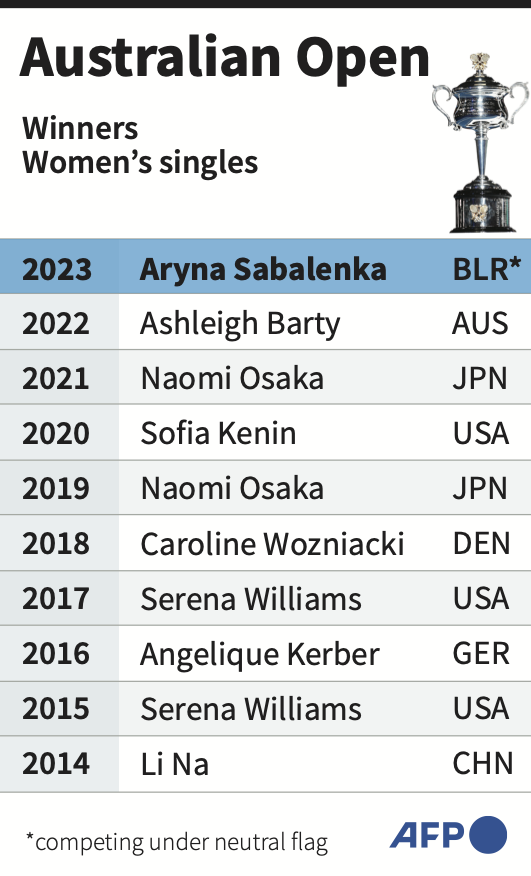
And so, as she wasted a second match point by flubbing a forehand, and a third by again missing another, Sabalenka did her best to stay calm, something she used to find quite difficult. She hung in there until a fourth chance to close out Elena Rybakina presented itself — and this time, Sabalenka saw a forehand from her similarly powerful foe sail long. That was that. The championship belonged to Sabalenka via a 4-6, 6-3, 6-4 comeback victory over Wimbledon winner Rybakina.
“The last game, yeah, of course, I was a little bit nervous. I (kept) telling myself, like, ‘Nobody tells you that it’s going to be easy.’ You just have to work for it, work for it, ‘til the last point,” said Sabalenka, a 24-year-old from Belarus who is now 11-0 with two titles in 2023 and will rise to No. 2 in the WTA rankings on Monday.
“I’m super happy that I was able to handle all those emotions,” she said, “and win this one.”
The only set she has dropped all season was the opener on Saturday against Rybakina, who eliminated No. 1 Iga Swiatek in the fourth round.
It was telling that Sabalenka’s remarks during the post-match ceremony were directed at her coach, Anton Dubrov, and her fitness trainer, Jason Stacy — she referred to them as “the craziest team on tour.”
“We’ve been through a lot of, I would say, downs last year,” said Sabalenka, who was appearing in her first major final and had been 0-3 in Slam semifinals until this week. “We worked so hard and you guys deserve this trophy. It’s more about you than it’s about me.”
Well, she had a lot to do with it, of course. Those serves that produced 17 aces, helping erase the sting of seven double-faults. Those hammered groundstrokes and relentlessly aggressive style that produced 51 winners, 20 more than Rybakina’s total. And, despite her go-for-broke shotmaking, somehow Sabalenka limited her unforced error count to 28. One more key statistic: Sabalenka managed to accrue 13 break points, converting three, including the one at 4-3 in the last set that put her ahead for good.
“She played really well today,” said Rybakina, who has lost all four matches she’s played against Sabalenka, all in three sets. “She was strong mentally, physically.”
While the latter has long been a hallmark of her game, even Sabalenka acknowledges that the first has been an issue.
Her most glowing strength was also her most glaring shortfall: her serve. Capable of delivering aces, she also had a well-known problem with double-faulting, leading the tour in that category last year with nearly 400, including matches with more than 20.
After much prodding from her group, she agreed to undergo an overhaul of her mechanics last August. That, along with a commitment to trying to keep her emotions in check — she used to work with a sports psychologist but no longer, saying she relies on herself now — is really paying off.
“She didn’t have great serve last year, but now she was super strong and she served well,” said Rybakina, a 23-year-old who represents Kazakhstan. “For sure, I respect that. I know how much work it takes.”
With seagulls squawking loudly while flying overhead at Rod Laver Arena, Rybakina and Sabalenka traded serious racket swings for nearly 2 1/2 hours.
The serves were big. So big. Rybakina’s fastest arrived at 121 mph (195 kph), Sabalenka’s at 119 mph (192 kph).
The points were over quickly. So quickly: Seven of the first 13 were aces.
Sabalenka had been broken just six times in 55 service games through the course of these two weeks, but Rybakina did it twice in the opening set.
And never again. Sabalenka resolved to take the initiative even more, and the payoff for her high-risk, high-reward attitude was too much for Rybakina to withstand over the last two sets.
Sabalenka said ahead of time that she expected to feel some jitters. Which makes perfect sense for anyone: This was the most important match of her career.
At the end, when it mattered more than ever, Sabalenka was able to steady herself. After the final point, she dropped to her back on the court and stayed down for a bit, covering her face as her eyes welled with tears.
Quite a difference from a year ago at Melbourne Park, when Sabalenka departed after 15 double-faults in a fourth-round loss.
“I really feel right now that I really needed those tough losses to kind of understand myself a little bit better. It was like a preparation for me,” Sabalenka said at her post-match news conference, her new trophy nearby and a glass of bubbly in her hand. “I actually feel happy that I lost those matches, so right now I can be a different player and just a different Aryna, you know?”


