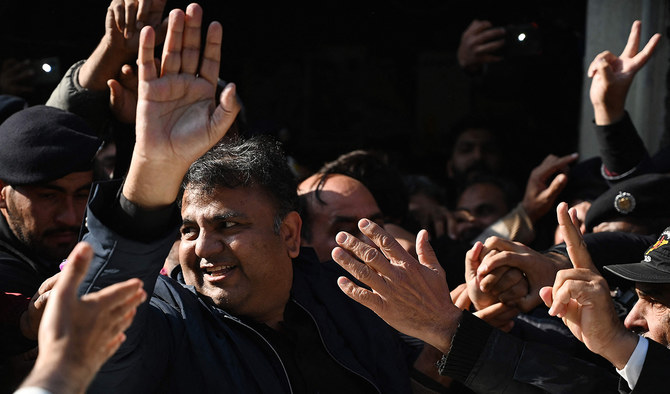
ISLAMABAD: After a daylong hearing, an Islamabad district court on Saturday remanded Chaudhry Fawad Hussain, a close aide to former prime minister Imran Khan, to police custody for two days for completion of investigation in a sedition case.
The development came only a day after Hussain was sent to Adiala Jail in Rawalpindi on a 14-day judicial remand, making the police challenge the verdict and seek his physical remand.
Khan’s aide, who is also a former information minister, was arrested from Lahore on Wednesday after a complaint was filed against him by a senior official of the Election Commission of Pakistan (ECP) who accused him of “threatening” members of the regulatory body, according to a complaint registered with an Islamabad police station.
“Two-day physical remand [of Chaudhry Fawad Hussain] is granted,” judicial magistrate Waqas Ahmad Raja announced at the conclusion of the court proceeding.
Earlier, a district and sessions court, Judge Tahir Mahmood Khan, accepted the plea submitted by the Islamabad Police on Saturday that challenged the judicial magistrate’s ruling of sending the former minister to Adiala Jail. The judge also rejected Hussain’s petition seeking a discharge from the sedition case on the complaint of ECP secretary Omar Hamid Khan.
The court directed the police to produce the arrested leader of ex-PM Khan’s Pakistan Tehreek-e-Insaf (PTI) party before the judicial magistrate’s court for further proceedings into the plea.
The prosecution requested the court for Hussain’s seven-day physical remand, saying they had to take him to Lahore for a photogrammetry test to complete the investigation.
Hussain was presented in the district court amid tight security with his face covered with a black cloth. However, the judge expressed his displeasure over the covering of the accused’s face and reprimanded the investigation officer.
The prosecution said they needed to recover the accused’s mobile phone, laptop and other electronic devices for analysis. “We have to find out the mastermind behind his [Fawad Hussain] hateful statement against the election commission,” it argued.
Later, the police presented Hussain before judicial magistrate Waqas Ahmad Raja while seeking his physical remand for seven days to complete the investigation. However, he only gave them two days and while instructing them to present him before a judicial magistrate on Monday.
Hussain’s lawyer Dr. Babar Awan objected to the covering of his client’s face by the police during the proceedings and said he had not even been allowed to meet his legal team.
“The way he is brought to the court is a clear violation of human rights,” Awan said, adding the accused would be joining the investigation and there was no need to extend his physical remand for further investigation.
Hussain’s lawyer contended his client would not travel abroad. “He is healthy and here [to join the investigation],” he added.
Advocate Faisal Fareed, who is also the brother of the accused, informed the court that Hussain’s mobile phone and SIM card were still being used while requesting the court to get them blocked.
“We fear that Fawad could be subjected to torture,” he said. “And if it happens, it will be illegal.”
Taking to the rostrum in the fully packed courtroom, Hussain said he stood by everything he said while telling the court he would not back down.
“Denying freedom of expression is tantamount to ending democracy in Pakistan,” he said. “If you can’t handle criticism, you should not accept such positions.”


![]()

After daylong proceedings, Islamabad court remands ex-PM Khan aide to police custody in sedition case
Short Url
https://arab.news/84ey7
After daylong proceedings, Islamabad court remands ex-PM Khan aide to police custody in sedition case
- Chaudhry Fawad Hussain was accused of ‘threatening’ election commission officials before being arrested from Lahore
- The court accepted his physical remand for two days, asking police to present him before a judicial magistrate on Monday
Latest updates




Recommended


© 2026 SAUDI RESEARCH & PUBLISHING COMPANY, All Rights Reserved And subject to Terms of Use Agreement.