Indian police detain students for screening Modi documentary

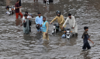
Security guards of Delhi University escort protesting students out of the campus in New Delhi, India, Friday, Jan. 27, 2023. (Photo courtesy: AP)
Short Url
Updated 28 January 2023
Follow

Indian police detain students for screening Modi documentary

  • At least 1,000 people, mostly Muslims, were killed in 2002 riots in India’s Gujarat state
  • The documentary alleges Modi had ordered police to turn a blind eye while he was CM

NEW DELHI: Indian police on Friday detained students in New Delhi after stopping the screening of a BBC documentary on Prime Minister Narendra Modi’s role during deadly sectarian riots in 2002.

The students at Delhi University had followed several campuses around the country in staging a broadcast, defying government efforts to stop its spread by blocking its publication on social media.

Police swarmed the university after student groups supportive of Modi’s ruling party objected to the screening, seizing laptops and imposing a ban on assemblies of more than four people.

Police officer Sagar Singh Kalsi told Indian news channel NDTV that 24 students were detained.

The two-part BBC program alleges that Modi had ordered police to turn a blind eye to deadly riots while he was chief minister of Gujarat state.

The violence began after 59 Hindu pilgrims were killed in a fire on a train. Thirty-one Muslims were convicted of criminal conspiracy and murder over that incident.

At least 1,000 people, mostly Muslims, died in the unrest that followed.

The documentary quoted a previously classified British foreign ministry report which said the violence was “politically motivated” and the aim “was to purge Muslims from Hindu areas.”

The report also claims that the riots were impossible “without the climate of impunity” created by Modi’s administration.

India has dismissed the series as a “hostile” propaganda piece and ordered big social media platforms like Twitter and YouTube to block sharing or streaming it under controversial information technology laws.

Earlier this week, authorities at New Delhi’s prestigious Jawaharlal Nehru University also banned an attempted screening and warned of “strict disciplinary action” if the edict was ignored.

But defiant groups of students there and at numerous college campuses across India have gathered to watch the documentary on laptops and phone screens.

Modi ran Gujarat from 2001 until his election as prime minister in 2014 and briefly faced a travel ban by the United States over the violence.

An investigation team appointed by the Indian Supreme Court to probe the role of Modi and others in the violence said in 2012 it did not find any evidence to prosecute him.


From round fruits to lucky charms: How Filipinos invite prosperous New Year

Updated 4 sec ago
Follow

From round fruits to lucky charms: How Filipinos invite prosperous New Year

  • Lights are lit, doors and windows open to allow good spirits in
  • Sticky rice dishes are served to keep family sticking together

MANILA: With the dining table set with symbolic foods, a bit of noise and rituals to invite good luck, Filipinos are ready to welcome the New Year, carefully observing every tradition and superstition to bring prosperity.

Media noche or the midnight dinner on New Year’s Eve is central to the celebration. Besides traditional meats, there will be sticky rice dishes to keep the family sticking together, and pancit or long rice noodles to represent long life.

There should also be 13 round fruits prepared specifically for the occasion, with 12 representing each month of the year, and the 13th adding extra luck. Because they are round like coins, they are believed to invite abundance, wealth and prosperity.

“We cook bilo-bilo (sticky rice balls) with coconut milk and palitaw (sweet rice cakes). It’s something we simply grew up with,” said Cel Reyes from Mabini in Batangas province, south of Manila.

“It’s sticky, so it symbolizes togetherness, and it is also round. Anything that’s round is prepared also as a symbol of prosperity.”

In Malabon, a coastal city in the northern part of Metro Manila, Priam Nepomuceno’s 86-year-old mother-in-law sets unhulled rice on the table.

“Because of the gold color, it’s believed to bring luck and abundance,” he said. “Grapes are also hung on the door. They’re not meant to be eaten and are kept hanging for the whole year as a symbol of prosperity.”

Some people also jump when the clock strikes 12, believing it will help them grow taller.

In many households, all lights are lit before midnight, with doors and windows open to allow good spirits to enter, while noise from firecrackers and party horns keeps the bad ones at bay.

“By nature, Filipinos are superstitious. We believe in good luck, deities. We give in to faith and luck, and it’s tied to deep spirituality,” said Juanita Galang-Trinidad, an 80-year-old editor from Bulacan province north of Manila.

“We also put 12 coins in varying amounts in our pockets and wear polka dot clothing. Rice, cereal, and salt containers should be full.”

New Year’s celebrations, like Christmas, bring families together, but with extra traditions for good luck. Beyond the midnight feast and keeping round objects on the table and at hand, Filipinos try to pay off debts to avoid financial trouble in the coming year.

On New Year’s Eve, they also avoid serving chicken, as chickens are believed to scratch backward when they eat, symbolically scratching away good fortune.

“We hold on to our traditions despite these growing changes, modernity, in our environment,” Trinidad said.

“We still hold on to our traditions and customs because they identify us as a people, as Filipinos.”