

End of an Era: BBC Arabic Radio goes off air after 85 years

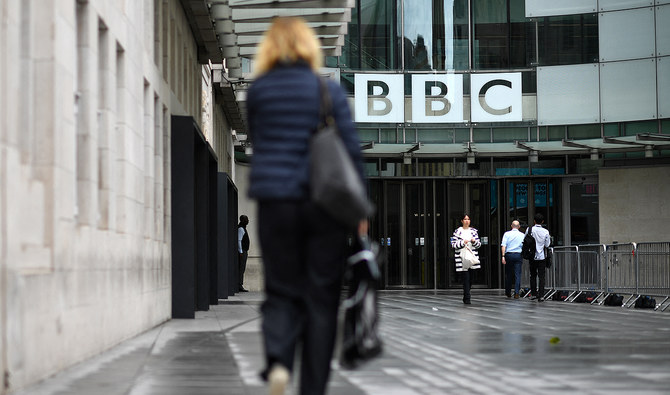
In this file photo taken on July 2, 2020, people walk outside the BBC headquarters in Portland Place, London. (Photo courtesy: AFP/File)
Short Url
Updated 28 January 2023
Follow

End of an Era: BBC Arabic Radio goes off air after 85 years

  • The station launched in early 1938 as the BBC Empire Service’s first foreign language radio broadcast
  • Many journalists and public figures express grief and share fond memories of BBC’s Arabic radio station

LONDON: “Tears in my eyes as I listen to the last broadcast by BBC Arabic, closing down after 85 years. It meant so much to so many people here over the decades,” tweeted British journalist Jim Muir, Middle East correspondent for the BBC News, “Now the airwaves are dead. End of an era.”

BBC’s Arabic radio service officially ended its decades-long broadcast on Friday, leaving behind a legacy that many believe to be everlasting. 

The station launched in early 1938 as the BBC Empire Service’s first foreign language radio broadcast.

Many journalists and public figures took to Twitter to express grief and share fond memories of BBC’s Arabic radio station. Some believed the event marked a decline in the United Kingdom’s soft power while others recalled their days at the studios. 

“It's far beyond sad and painful to see BBC Arabic radio shutting down today,” wrote Egypt-based BBC Arabic correspondent Sally Nabil on Twitter. 

“It's incredibly difficult to describe how we feel!” She added. 

Amal Mudallali, former permanent representative of Lebanon to the UN, said: “As someone who worked for the BBC Arabic, I do not understand the decision.

“It is the only thing people know and remember about Britania, as we call it, in the region for generations.”

The final words and signature statement of BBC Arabic radio presenter Mahmoud Almossallami, “Huna London” (This is London), seems to have brought tears to many eyes. 

Almousallami’s daughter, Osha, wrote: “I grew up listening to my dad presenting on BBC Arabic, and now here he is, presenting the final hour of BBC Arabic before it's closed and taken off the air.

“It really is the end of an era.”

The head of David Nott Foundation, Elly Nott, wrote: “Huna London no more,” hailing BBC Arabic radio for helping her to learn its language. 

BBC News Lead Technical Operator Jack Mooney shared a footage showing the last moments as the Arabic news network went off the air, while sound producer Tome Roles wrote: “I’ll always treasure the magic of sitting in a tiny studio at 3 am in London, picturing the sun rising thousands of miles away, and wondering about the lives of those tuning in.”

“It’s a painful moment,” wrote photographer Ali Al-Baroodi. 

“BBC Arabic was one of few windows to the world in the time of the economic blockade (in the) 1990s (and) ISIS occupation,” he added, “Iraq was under (a) huge blackout. My father used to stock batteries for his radio in prep for the tough times.”

BBC correspondent Emir Nader shared the last two minutes of the Arabic radio’s final broadcast and wrote: “Today is a tragic day for Arab media… One of many huge losses following cuts in BBC World Service's budget.”


BBC slammed for ‘shameful’ cut to ‘free Palestine’ comment at BAFTA Awards

Updated 24 February 2026
Follow

BBC slammed for ‘shameful’ cut to ‘free Palestine’ comment at BAFTA Awards

  • Broadcaster removes from broadcast part of filmmaker Akinola Davies Jr.’s acceptance speech at the British Academy Film Awards
  • Amnesty UK praises filmmaker for speaking up for those ‘facing and fleeing from persecution and mass atrocities’

LONDON: The BBC was accused on Monday of a “shameful” decision after it cut part of an acceptance speech at the previous night’s British Academy Film Awards in which a filmmaker uttered the phrase “free Palestine.”

British-Nigerian director and co-writer Akinola Davies Jr. and his brother, co-writer Wale Davies were collecting the award for outstanding debut by a British writer, director or producer for their film “My Father’s Shadow” when the former made the comment.

The BBC chose not to include the final part of his speech when it broadcast the BAFTAs ceremony later in the evening. However, the corporation did broadcast an inadvertent racist slur shouted by a person with Tourette syndrome while Black actors Michael B. Jordan and Delroy Lindo were presenting an award.

Akinola thanked industry figures and family for their support as he accepted the award, before dedicating it to “all those whose parents migrated to obtain a better life for their children.”

In the final part of his speech, cut by the BBC, he said: “To the economic migrant, the conflict migrant, those under occupation, dictatorship, persecution and those experiencing genocide, you matter and your stories matter more than ever.

“Your dreams are an act of resistance. To those watching at home, archive your loved ones, archive your stories yesterday, today and forever. For Nigeria, for London, Congo, Sudan, free Palestine. Thank you.”

The BBC, which broadcast the ceremony with a two-hour time delay, said the cut was made for timing reasons.

A spokesperson told Deadline: “The live event is three hours, and it has to be reduced to two hours for its on-air slot. The same happened to other speeches made during the night, and all edits were made to ensure the program was delivered to time. All winners’ speeches will be available to watch via BAFTA’s YouTube Channel.”

Human rights campaign group Amnesty UK described the decision by the BBC to cut part of the speech as “shameful.”

It added: “Thank you Akinola Davies Jr. for using your platform to speak out for the rights of migrants and people facing and fleeing from persecution and mass atrocities, from the Congo to Sudan to Palestine.”

In June last year, the BBC was at the center of a row after it broadcast a Glastonbury Festival performance by the duo Bob Vylan, during which the lead singer chanted “death to the IDF” in protest against the Israeli Defense Forces’ assault on Gaza.