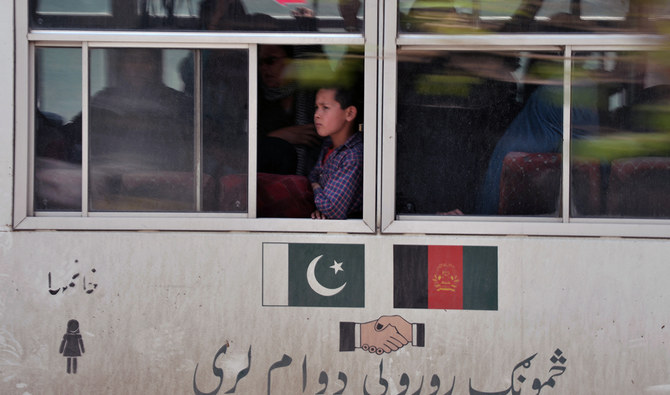
PESHAWAR: Pakistan and Afghanistan have “agreed in principle” to resume a bus service between Peshawar and Jalalabad cities to intensify bilateral business activities and facilitate movement of people via Torkham border crossing, said a senior administration official in northwestern Khyber Pakhtunkhwa province on Friday.
The decision comes at a time when Pakistani officials have blamed armed factions on the Afghan side for targeting its security personnel along the frontier separating the two countries. Pakistan also shut down Chaman border crossing in southwestern Balochistan province last year after one of its border checkpoints was targeted.
The “dosti” -- or friendship -- bus service was also suspended between the two sides in 2016 following an armed clash between their border security officials. However, Pakistani and Afghan officials have held a series of meetings since last August to reach an agreement over its resumption.
“Both sides have agreed in principle to resume the service without further delay and I am sure it will begin within two months,” said Shah Fahad, the top administration official in Khyber tribal district bordering Afghanistan, while speak to Arab News. “Initially, 40 buses will ply between Pakistan’s Peshawar and Afghanistan’s Jalalabad cities.”
Fahad said a bus terminal was already under construction at Torkham border on Pakistan’s side to resume the service, adding officials were also negotiating with a local tribe to procure more land for the facility.
An Afghan transport ministry official, Emam Ahmadi, did not share any definitive information on the issue, however, when contacted by Arab News.
“Our delegation is on its way back from Pakistan after holding a discussion on this,” he said. “I will share details tomorrow regarding the resumption of the bus service.”
Meanwhile, representatives of business community in both countries expressed optimism that the planned service would facilitate passengers and give a much-needed impetus to bilateral trade.
Haji Usman, who is part of the Nangarhar Chamber of Commerce and Industry in Afghanistan, said resumption of the bus service was an excellent idea, though he also maintained that Pakistan should ease visa procedures for Afghan nationals.
“The bus service will yield great results if Pakistan relaxes visa for Afghans,” he said. “Currently, it takes about two months to get a Pakistani visa, affecting the elderly people, patients and business community equally.”
Senior vice president of Pakistan's Sarhad Chamber of Commerce and Industry Shahid Hussain told Arab News the bus service would bolster business and commerce while increasing the quantum of bilateral trade.
“The trade volume between the two countries was $700 million last year,” he said. “It stood at $900 million in 2021, and I am sure it can go as high as $5 billion if Pakistan eases its visa regime for Afghan businesspeople.”


![]()

Afghanistan, Pakistan ‘agree in principle’ to resume friendship bus service
Short Url
https://arab.news/mpknz
Afghanistan, Pakistan ‘agree in principle’ to resume friendship bus service
- The decision comes at a time when Pakistan has blamed armed groups in Afghanistan for targeting border guards
- A senior local administration official in Pakistan says buses will soon begin to travel between Peshawar and Jalalabad
Latest updates


© 2026 SAUDI RESEARCH & PUBLISHING COMPANY, All Rights Reserved And subject to Terms of Use Agreement.