
RAMALLAH: Israeli forces killed nine Palestinians, including an elderly woman, and wounded 20, four of them seriously, during a raid in Jenin refugee camp on Thursday, the Palestinian Ministry of Health said.
Meanwhile, Youssef Muheisen, 22, died after being shot by Israeli soldiers during clashes in Al-Ram, in Jerusalem governorate, raising the day’s death toll to 10.
The bloodshed, which marked the West Bank’s deadliest day in more than a year, brought to 30 the total number of Palestinians killed this year by Israeli operations.
Security forces said they entered the camp to apprehend three Palestinian militants from the Islamic Jihad organization who, according to intelligence information, intended to carry out a significant attack against an Israeli target.
The Palestinian Red Crescent said Israeli officials initially prevented medics from entering the camp, making it difficult to reach the injured, four of whom were in critical condition. It said Israeli forces had fired tear gas canisters at the Jenin Government Hospital, resulting in inhalation injuries among children.
Palestinian Prime Minister Mohammed Shtayyeh called on the UN and international human rights organizations to “intervene urgently to provide protection … and stop the bloodshed of children, youth and women.” He added that the occupying forces continue to commit killings and executions with impunity.
Tor Wennesland, the UN’s special coordinator for the Middle East peace process, said: “I am deeply alarmed and saddened by the continuing cycle of violence in the occupied West Bank. Today’s deaths of nine Palestinians, including militants and one woman, during an Israeli arrest operation in Jenin is another stark example.”
He urged the Israeli and Palestinian authorities to de-escalate tensions, restore calm and avoid further conflict.
A general strike was called in the West Bank to mourn the dead. Large crowds attended the funerals of the nine victims, amid calls for revenge. Palestinian President Mahmoud Abbas announced three days of mourning, during which flags will fly at half-mast.
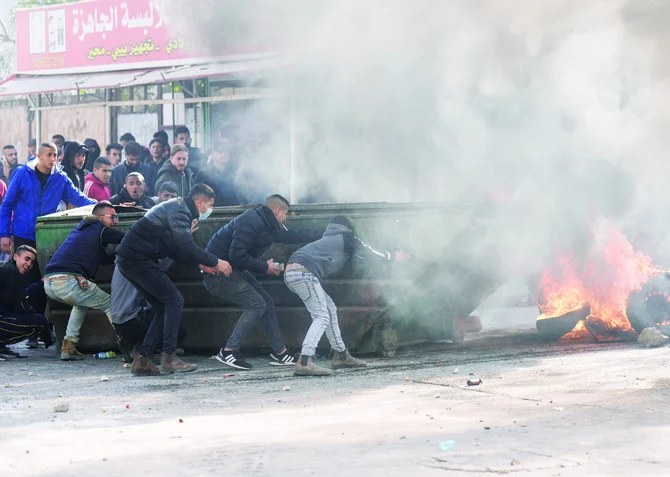
Separately, nine people were injured during clashes that broke out between dozens of Palestinians and Israeli forces near Bethlehem and Ramallah, during which live bullets and tear gas canisters were used to disperse crowds throwing stones.
An EU official in Jerusalem described the situation in the West Bank as complex and heading toward a dangerous curve. The official added that the EU has consistently called for immediate investigations into military operations that result in civilian casualties and for the results of such probes to be publicly announced.
The Palestinian Ministry of Foreign Affairs said: “If the international community and the US administration do not move now, when these brutal crimes are committed by the occupying forces, then when will they move?”
Maj. Gen. Akram Rajoub, the governor of Jenin, described the Israeli operation at the camp there as “the bloodiest and most violent in more than a year.”
He said great sadness, pain and anger prevails in the city and the camp, and the repeated Israeli incursions are weakening the roles of the Palestinian security services and the Palestinian Authority.
A Palestinian security officer at the Jenin camp, who asked to remain anonymous, told Arab News that a dairy truck with Palestinian number plates had arrived at about 7 a.m. on Thursday. Inside, there were about 30 members of the Israeli Special Forces. When young residents of the camp spotted the hidden force they attacked it with a barrage of stones, he said. Then reinforcements arrived, including more than 80 Israeli military vehicles and bulldozers, and a drone to monitor the camp.
He said the operation continued for more than four hours, during which the forces surrounded houses and targeted them with heavy gunfire and rockets.
“The camp was like a battlefield and reminded us of what happened in 2002,” the source said.
Following the operation in Jenin, Israeli troops in the West Bank and along the borders with Gaza were put on high alert amid fears of Palestinian retaliation, Israeli defense forces said.
Nabil Aburudeineh, spokesperson for the Palestinian presidency, described the killings as a “massacre” and condemned the silence of the international community over such incidents, “which encourages the Israeli government to commit more massacres against the Palestinian people and continue the escalation policy.”
Abdullatif Al-Qanou, who belongs to Hamas, the organization that rules Gaza, said: “The behavior of the extremist occupation government, the escalation of its crimes, and its transgression against our people will inevitably lead us to the battle of Jerusalem to defend our land, our families and our sanctities.”
Daoud Shehab, a senior leader of Islamic Jihad, said: “The Jenin camp is the most prominent address of challenge and steadfastness throughout Palestine, and Jenin affirms that the resistance continues despite the arrogance and crimes of the occupation.”
Islamic Jihad is a powerful presence in the Jenin camp, where it operates a “Jenin Brigade” of about 300 well-trained fighters that coordinate with all other Palestinian militants in the camps.
US Secretary of State Antony Blinken is due to visit Egypt, Israel and the West Bank this weekend amid the escalation in Israeli-Palestinian violence and American concerns about Israeli Prime Minister Benjamin Netanyahu’s new, far-right government.