

Canada names first anti-Islamophobia adviser

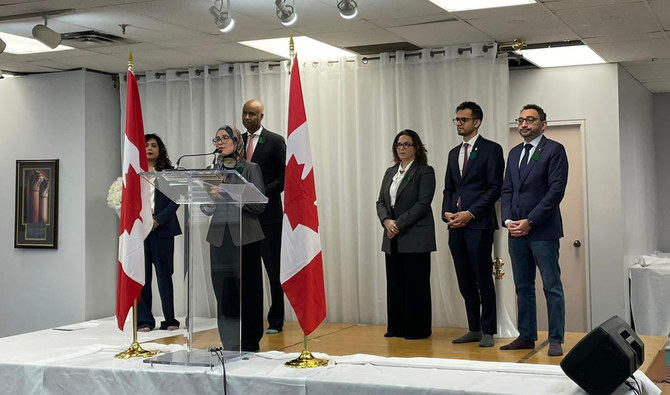
Journalist and activist, Amira Elghawaby (second left) delivers a speech after being appointed as Canada's special representative on combatting Islamophobia in Ottawa, Canada, on January 26, 2023. (Photo courtesy: @OmarAlghabra/Twitter)
Short Url
Updated 27 January 2023
Follow

Canada names first anti-Islamophobia adviser

  • Journalist Amira Elghawaby will fill post to help Canadian government fight racism and intolerance 
  • Over the past few years, a series of deadly attacks have targeted Canada’s Muslim community

MONTREAL: Canada on Thursday appointed its first special representative on combatting Islamophobia, a position created following several recent attacks on Muslims in the country.

Journalist and activist Amira Elghawaby will fill the post to “serve as a champion, adviser, expert, and representative to support and enhance the federal government’s efforts in the fight against Islamophobia, systemic racism, racial discrimination, and religious intolerance,” a statement by the prime minister’s office said.

An active human rights campaigner, Elghawaby is the communications head for the Canadian Race Relations Foundation and a columnist for the Toronto Star newspaper, having previously worked for more than a decade at public broadcaster CBC.

Prime Minister Justin Trudeau praised Elghawaby’s appointment as “an important step in our fight against Islamophobia and hatred in all its forms.”

“Diversity truly is one of Canada’s greatest strengths, but for many Muslims, Islamophobia is all too familiar,” he added.

Over the past few years, a series of deadly attacks have targeted Canada’s Muslim community.

In June 2021, four members of a Muslim family were killed when a man ran them over with his truck in London, Ontario. 

Four years earlier, six Muslims died and five were injured in an attack on a Quebec City mosque.

In a series of tweets Thursday, Elghawaby listed the names of those killed in the recent attacks, adding: “We must never forget.”

The creation of the new job had been recommended by a national summit on Islamophobia organized by the federal government in June 2021 in response to the attacks.


Thailand-Cambodia fighting rages on as Trump signals intent to intervene 

Updated 5 sec ago
Follow

Thailand-Cambodia fighting rages on as Trump signals intent to intervene 

  • Clashes raged at more than a dozen locations along their 817-km border
  • “I hate to say this one, named Cambodia-Thailand, and it started up today, and tomorrow I am going to have to make a phone call,” Trump said

BANGKOK/PHNOM PENH: Thailand and Cambodia traded accusations of targeting civilians in artillery and rocket attacks on Wednesday, as US President Donald Trump said he would try to intervene to stop the fighting and salvage a ceasefire he brokered earlier this year.
Clashes raged at more than a dozen locations along their 817-km (508-mile) border in some of the most intense fighting since a five-day battle in July, which Trump stopped with calls to both leaders to halt their worst conflict in recent history.
The Southeast Asian neighbors have blamed each other for the clashes that started on Monday.

’IT CANNOT BE AS SIMPLE AS PICKING UP THE PHONE’
Trump at a rally in Pennsylvania late on Tuesday said he would try to stop the renewed hostilities, after enumerating the conflicts he said he had helped stop, such as those between Pakistan and India, and Israel and Iran.
“I hate to say this one, named Cambodia-Thailand, and it started up today, and tomorrow I am going to have to make a phone call,” he said.
“Who else could say, ‘I’m going to make a phone call and stop a war of two very powerful countries, Thailand and Cambodia?’“
Thailand’s army has made clear it wants to cripple Cambodia’s military capabilities and Prime Minister Anutin Charnvirakul on Tuesday said operations would not stop.
He declined to comment on Wednesday on what the military’s end-game was. Asked about Trump’s remarks, he said the conflict was a matter between the two countries involved.
“Other national leaders may have good intentions in wanting peace,” Anutin told reporters. “It cannot be as simple as picking up the phone and calling. There must be proper appointment and agreed talking points. We still have time to prepare these issues if such discussions are to take place.”
Cambodian government spokesperson Pen Bona said Phnom Penh’s position was that it wanted only peace and had acted in self-defense. A top adviser to Cambodia’s prime minister has signalled the country was ready to negotiate.
Malaysian Prime Minister Anwar Ibrahim, who helped Trump broker the ceasefire, said he had spoken with leaders of Thailand and Cambodia on Tuesday and, though no definitive resolution was reached, he appreciated “the openness and willingness of both leaders to continue negotiations in order to ease tensions.”

ROCKETS, JETS AND DRONE-BOMBS
Thailand’s army said fighting took place on 16 different fronts on Wednesday, including both ends of the border. It reported an onslaught of BM-21 rockets fired by Cambodian forces, some of which it said landed near a hospital in Surin province, forcing the evacuation of patients and staff.
The army said Cambodian drones were being used to drop bombs and BM-21 rockets, and tanks were used at other border areas, including near the contested 11th Century Preah Vihear temple, a flashpoint for previous diplomatic and military conflicts.
Cambodia’s military said Thailand used artillery fire and armed drones and fired mortars into homes, while F-16 fighter jets had entered Cambodian airspace on multiple occasions, some dropping bombs near civilian areas.
“Cambodian forces have been fighting fiercely against the advancing enemy and have stood firm in their role of protecting Cambodia’s territorial integrity,” the defense ministry said in a statement.
In July, Trump used the leverage of trade negotiations to broker a ceasefire. Thai Foreign Minister Sihasak Phuangketkeow on Tuesday told Reuters that tariff threats should not be used to pressure his country into talks.
Last month, Thailand suspended de-escalation measures, agreed at an October summit in Trump’s presence, after a Thai soldier was maimed by a land mine that Bangkok said was newly laid by Cambodia, which rejects the accusation.

HEAVY TOLL ON CIVILIANS
The three days of clashes have taken a heavy toll on civilians, with nine people killed in Cambodia, including an infant, and 46 people wounded, according to its government. Five Thai soldiers had been killed in the fighting and 68 people were wounded, the Thai army said.
On Wednesday, Cambodia withdrew its athletes from the Southeast Asian Games in Thailand, citing safety reasons and their families’ concern.
Hundreds of thousands of people have been evacuated from border areas, though some people have chosen not to leave.
“I have to stay behind,” said Wuttikrai Chimngarm, as he hunkered down behind a makeshift bunker of tires stacked six high while shelling shook Thailand’s border province of Buriram.
“I’m the head of the village, if not me, then who? Who will be safeguarding the houses and belongings of the villagers from looters?“
As soon as Monday’s fighting erupted, residents fled the disputed village of Kaun Kriel, about 25 km (15 miles) northwest of Cambodia’s city of Samraong.
“This is my second run because the place I live ... was under attack both times,” said Cambodian Marng Sarun, a 31-year-old harvester, who left with his wife and two children.