

'Double delight': Babar Azam bags ICC's Player, ODI Cricketer of the Year awards

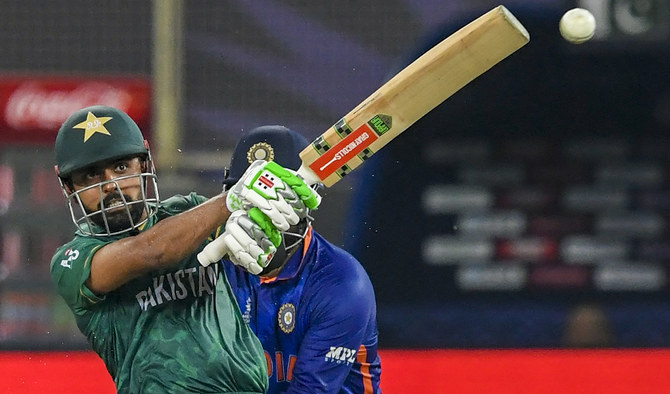
Pakistan's captain Babar Azam plays a shot during the ICC men’s Twenty20 World Cup cricket match between India and Pakistan at the Dubai International Cricket Stadium in Dubai on October 24, 2021. (AFP)
Short Url
Updated 26 January 2023
Follow

'Double delight': Babar Azam bags ICC's Player, ODI Cricketer of the Year awards

  • Babar Azam also retains ICC's Men's ODI Player of the Year Award for second time in a row
  • Azam scored an impressive 2,598 runs in 44 matches, scoring eight centuries at 54.12 average

ISLAMABAD: Pakistan skipper Babar Azam continued to win accolades on Thursday when the International Cricket Council (ICC) awarded him the prestigious Sir Garfield Sobers Trophy for the ICC Men's Cricketer of the Year 2022, a testament to the batter's sheer dominance in all formats of the game throughout the year. 

Azam, who is currently the number one ranked batter in ODIs, scored a staggering 2,598 runs from 44 matches in 2022 in all three formats. His average, helped by eight centuries and 15 half-centuries, has been 54.12 throughout the year.

Azam continued to dominate in all three formats of the game, becoming the only player to breach the 2,000-run barrier during the calendar year in Tests, ODI and T20I formats. 

As far as ODIs are concerned, the batter scored an imposing 679 runs in nine matches, his performances being so consistent that it helped him register scores of 50 or more in eight of those innings. 

Not only does he continue to hold on to his top spot in the MRF Tyres ICC Men's ODI Player Rankings, but the 28-year-old was also crowned the ICC Men's ODI Player of the Year for a second consecutive year by the ICC. 

In Tests this year, Azam accumulated 1,184 runs from just nine matches and did the bulk of the heavy lifting for Pakistan in the longer format. The results in most of these matches, however, did not go in Pakistan's favor as the hosts were unable to win even a single Test at home. 

"I cannot explain my happiness [after winning the ICC Player of the Year Award]," Azam said in a video message shared by the PCB. "When you win such awards, you feel honored but the main thing is that Pakistan's name shines and at the end of the day, I play for Pakistan," he added. 

Azam cited his most memorable performance throughout the year against Australia in the Karachi Test match when Pakistan were headed for a certain defeat if it were not for his match-saving innings. In walked Azam when the green shirts were hobbling after a poor start and stayed at the crease for 10 hours, amassing 196 on the scoreboard and saving his team from imminent defeat. 

He also spoke of his century against England in a T20I match last year, citing it as his most memorable performance of the year in white-ball cricket. "The most important thing for me was that I performed in front of the fans on my home soil," he said. 

Najam Sethi, chair of the Pakistan Cricket Board's (PCB) Managing Committee, said Azam's dedication and skill were the main reasons that helped him win the award. 

"Babar Azam made Pakistan proud by winning the most important ICC awards," Sethi added. 


Pakistan army chief says future warfare will rely on technology over battlefield maneuvers

Updated 8 sec ago
Follow

Pakistan army chief says future warfare will rely on technology over battlefield maneuvers

  • Asim Munir cites drones, electronic warfare and surveillance as central to future war operations
  • Remarks follow Pakistan’s 2025 military conflict with India that highlighted role of technology

ISLAMABAD: Pakistan’s army chief said on Thursday future conflicts would be shaped more by technology than traditional battlefield maneuvers, as the military accelerates its shift toward drone warfare, electronic systems and networked command structures, according to a statement issued by the Pakistan military.

Field Marshal Syed Asim Munir, who also serves as Chief of Defense Forces, made the remarks while visiting the Bahawalpur Garrison in southern Punjab, where he observed a high-intensity field exercise focused on integrating new technologies into conventional military operations, the Inter-Services Public Relations (ISPR) said.

The exercise, titled Steadfast Resolve, involved unmanned aerial systems, advanced surveillance assets, electronic warfare capabilities and modern command-and-control mechanisms, reflecting what the military described as a move toward “technology-enabled multi-domain operations.”

“Character of war has evolved massively, with technological advancements driving the evolution, dictating huge mental transformation at all tiers,” Munir said while addressing troops, according to the ISPR statement.

“In future, technological maneuvers will replace physical maneuvers and will fundamentally alter the way offensive and defensive operations are undertaken,” he added.

Militaries worldwide are reassessing combat doctrine as drones, electronic warfare and real-time data increasingly shape outcomes on modern battlefields. In South Asia, those shifts gained renewed attention following military exchanges between Pakistan and India in May 2025, when both sides employed surveillance, electronic countermeasures and precision capabilities alongside conventional forces, underscoring the growing role of non-kinetic domains.

Munir said the Pakistan army was “embracing and absorbing technology at a rapid pace,” adding that “innovation, indigenization and adaptation shall remain fundamental” as the military prepares for future battlefield and security challenges.

The army chief also reiterated that Pakistan’s armed forces remained prepared to defend the country’s sovereignty and territorial integrity, while emphasizing the need to maintain readiness as warfare increasingly expands across physical, cyber and electronic domains.