

‘Not the time’ to increase economic activity with Russia, US says on Pakistan energy deal

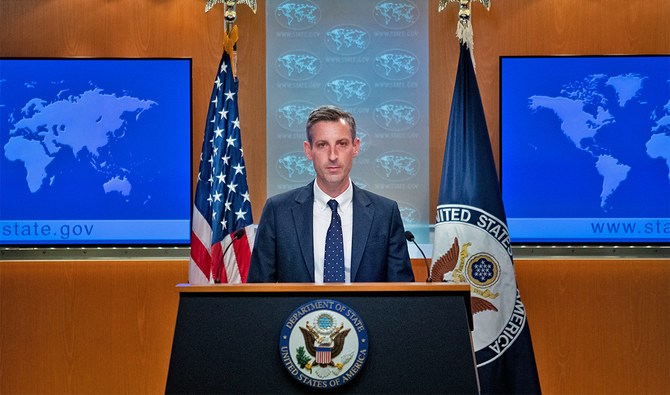
US State Department Spokesperson Ned Price speaks during a news conference at the State Department in Washington, DC, on February 23, 2022. (AFP/File)
Short Url
Updated 25 January 2023
Follow

‘Not the time’ to increase economic activity with Russia, US says on Pakistan energy deal

  • Moscow has said it could start exporting oil to energy-starved Pakistan after March if terms are agreed
  • US says price cap allows energy markets to continue to be resourced while depriving Moscow of revenue

ISLAMABAD: US State Department Spokesperson Ned Price has said “now is not the time” to bolster economic ties with Russia, as Moscow plans to start exporting oil to energy-starved Pakistan after March if terms are agreed.

Last week, Pakistani officials and Russian Energy Minister Nikolay Shulginov, who was in Islamabad for an annual inter-governmental commission on trade and economy, said key elements of an energy deal had yet to be agreed but the two sides had “conceptually” decided to sign an agreement that would determine and resolve all issues of logistics, insurance, payment and volumes.

Historically Pakistan has had no major commercial relations with Moscow, unlike neighboring India, and as a traditional US ally, it had also been hesitant to do trade or any business with Moscow in the past.

It currently depends on oil from Gulf countries, which often extend facilities such as deferred payments and can supply with lower transport costs, given Pakistan’s relative proximity.

“We have been very clear that now is not the time to increase economic activity with Russia,” Price said on Tuesday night in response to a question about Islamabad buying oil products from Moscow.

“But we understand the imperative of keeping global energy markets well resourced, well supplied, and the price cap, we believe, provides a mechanism to do that.”

The G7 economies, the European Union and Australia agreed to a $60-per-barrel price cap on Russian seaborne crude oil effective from Dec. 5 over Moscow’s “special military operation” in Ukraine.

“Our approach to this is [Islamabad-Moscow deal] – has been laid out in the price cap mechanism that we worked out with other countries around the world, including the G7,” Price said.

“And the virtue of the price cap is that it allows energy markets to continue to be resourced while depriving Moscow of the revenue it would need to continue to propagate and fuel its brutal war against Ukraine.”

“We have made the point that we have very intentionally not sanctioned Russian oil. Instead, it’s now subject to the price cap. So we have encouraged countries to take advantage of that, even those countries that have not formally signed on to the price cap, so that they can acquire oil in some cases at a steep discount from what they would otherwise acquire from, in this case, Russia.”

Pakistan has not specified the price of the oil it will get from Russia or said whether the imports would comply with the $60 per barrel cap. Moscow has said it will not sell to countries that comply with the cap.

Pakistan has been unable to procure LNG from the international market because spot prices remain out of its range and shipments under long-term deals remain insufficient to match rising demand.

With dwindling local gas reserves, the country has begun to ration supplies to residential and commercial consumers. Local media has also reported that oil supplies remain tenuous owing to difficulties in paying for imports.

Oil and energy make up the largest portion of Pakistan’s imports bill.


Pakistani minister urges universal rights, dialogue at UN civilizations forum in Riyadh

Updated 14 sec ago
Follow

Pakistani minister urges universal rights, dialogue at UN civilizations forum in Riyadh

  • Musadik Malik warns selective application of human rights and weakening multilateralism risk deepening global divisions
  • The minister also mentions water rights and urges equitable sharing by upper riparian states to support regional stability

ISLAMABAD: Pakistan’s climate change minister said principles of justice and human rights must be applied universally, according to an official statement released on Monday, warning against selective enforcement as he addressed a United Nations forum in Saudi Arabia focused on dialogue among civilizations.

The remarks came at the 11th Global Forum of the United Nations Alliance of Civilizations (UNAOC), held in Riyadh to mark the body’s 20th anniversary. The forum brings together political leaders, policymakers, and civil society groups to promote dialogue, mutual understanding, and cooperation across cultures and religions.

Its latest edition comes at a time of growing geopolitical fragmentation and conflict.

“I am firmly committed to women’s rights, minority rights, environmental rights, and children’s rights,” Musadik Malik said while addressing the gathering. “These rights are fundamental and non-negotiable.”

He said the global order was increasingly marked by weakening multilateralism, rising conflicts, and declining international funding for development and environmental priorities, cautioning that unilateral actions were replacing collective approaches with consequences for global peace and justice.

Malik questioned what he described as the selective application of human rights principles, drawing attention to the situations in Palestine and Kashmir, and said the rights of people in those regions must be recognized and protected in line with international norms.

The minister also highlighted water rights as a growing source of regional tension, emphasizing the responsibility of upper riparian states to ensure equitable and just sharing of water resources with downstream countries to support stability and sustainable development.

His statement comes months after India said unilaterally it was holding the Indus Waters Treaty “in abeyance,” a move described as illegal by the administration in Islamabad and as “an act of war.”

The 1960 agreement between India and Pakistan, brokered by the World Bank, divides the rivers of the Indus basin between the two countries and sets rules for how they can use and manage shared water resources to avoid conflict.

Malik said the UNAOC’s 20th anniversary was a timely reminder of the need to recommit to dialogue, peace, and mutual respect in an increasingly divided world.