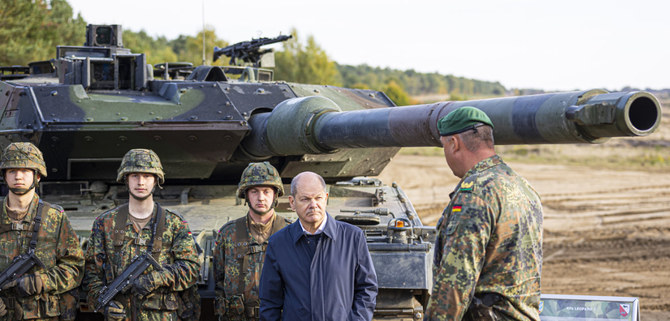
BERLIN: Germany on Tuesday said it would decide “shortly” whether to authorize the export of powerful German-made Leopard battle tanks long sought by Kyiv and encouraged allies to start training Ukrainian forces to use them.
While Western nations have pledged ever more sophisticated military hardware in recent weeks to help Ukraine repel Russia’s invasion, all eyes in Kyiv are on the battle tanks.
Berlin stopped short of a final green light on Tuesday, but German media including newspaper Der Spiegel and news channel NTV reported late in the evening that Chancellor Olaf Scholz would grant approval.
The announcement would probably come Wednesday and would also include permission for other countries, including Poland, to transfer their Leopard tanks to Ukraine, the outlets reported.
The Free Democratic Party, a member of Germany’s ruling political coalition, tweeted Tuesday night: “Germany sends Leopard-Panzer tanks to Ukraine!“
But in Kyiv, Ukrainian President Volodymyr Zelensky was battling a deepening corruption scandal within his government, sacking several officials over graft while others resigned.
Ukraine and several of its allies have been urging Germany for weeks to allow the delivery of the Leopards, but a US-led meeting of Kyiv’s allies in Germany last week failed to yield a decision.
German Defense Minister Boris Pistorius indicated on Tuesday that the moment of truth could be imminent, saying he had “expressly encouraged partner countries that have Leopard tanks that are ready for deployment to train Ukrainian forces on these tanks.”
“I expect a decision to be made shortly,” he added following talks with NATO Secretary General Jens Stoltenberg in Berlin.
“We must provide heavier and more advanced systems to Ukraine, and we must do it faster,” Stoltenberg said, adding that he expected a decision by Berlin “soon.”
Kremlin spokesman Dmitry Peskov said the delivery of the tanks would “bring nothing good to the future relationship” between Berlin and Moscow.
“They will leave a lasting mark,” he warned.
Under Germany’s war weapons control rules, countries using German-made armaments are required to seek Berlin’s permission if they wish to transfer them to a third party.
Poland, one of the loudest voices calling for permission to send Leopard tanks, said earlier this month it was ready to deliver 14 of them to Kyiv within the framework of an international coalition of countries.
Defense Minister Mariusz Blaszczak on Tuesday said the country had now sent in a formal request.
Confirming receipt, a German government spokesman said it would be examined “with necessary urgency.”
Polish Prime Minister Mateusz Morawiecki said he was counting on a “quick” response, accusing the Germans of “dragging their feet, dithering and behaving in a manner that is difficult to understand.”
Zelensky, in his evening address, said that discussions over the tank transfers “must end with decisions,” and that “allies have the required number of tanks” Ukraine has been demanding.
Germany’s Pistorius had earlier defended Scholz against accusations of dithering on whether to approve the delivery of Leopards and insisted there was no division among Ukraine’s Western allies.
As Ukraine marked 11 months since the start of the war on Tuesday, Zelensky urged his troops to keep up the fight against Russia.
But the comments came with Zelensky battling a widening corruption scandal as his defense ministry was shaken by accusations of food procurement fraud.
Local media reports last week accused the ministry of having signed a deal at prices “two to three times higher” than current rates for basic foodstuffs.
Several officials resigned on Tuesday over the allegations, including a deputy defense minister, two deputy ministers of development of communities and territories, and a deputy minister of social policy.
Ukraine has a history of endemic corruption, including among the political elite, but efforts to stamp out graft have been overshadowed by the war.
Kyiv’s Western allies, who have allocated billions of dollars in financial and military support, have been pushing for anti-corruption reforms for years, sometimes as a precondition for aid.
Meanwhile 25 people have been killed and more than 90 injured in Russia’s border region of Belgorod since the start of the war, its governor told President Vladimir Putin in a first such announcement of an official death toll.
Governor Vyacheslav Gladkov also said around 6,500 people had to be evacuated from border villages and were essentially “refugees.”
The Belgorod region, including the city of the same name, has been repeatedly hit by shelling since Putin sent troops to Ukraine on February 24 last year.

Germany promises swift answer on battle tanks for Ukraine
Short Url
https://arab.news/6acqg
Germany promises swift answer on battle tanks for Ukraine
- Ukraine and several of its allies have been urging Germany for weeks to allow the delivery of the Leopards, but a US-led meeting of Kyiv’s allies in Germany last week failed to yield a decision
Poland withdraws from treaty banning antipersonnel mines and will use them to defend against Russia
- 1997 Anti-Personnel Mine Ban Treaty prohibits signatories from keeping or using antipersonnel mines
- Poland will begin domestic production of both antipersonnel and anti-tank land mines
WARSAW: Poland will use antipersonnel as well as anti-tank land mines to defend its eastern border against the growing threat from Russia, Poland’s deputy defense minister said on Friday as the country officially left an international convention banning the use of the controversial weapons.
The 1997 Anti-Personnel Mine Ban Treaty, also known as the Ottawa Convention, prohibits signatories from keeping or using antipersonnel mines, which can last for years and are known for having caused large-scale suffering among civilians in former conflict zones in countries including Cambodia, Angola and Bosnia and Herzegovina.
Poland, which ratified the document in 2012 and completed the destruction of its domestic anti-personnel mine stockpile in 2016, withdrew from the treaty on Friday and says it plans to renew manufacturing weapons.
“These mines are one of the most important elements of the defense structure we are constructing on the eastern flank of NATO, in Poland, on the border with Russia in the north and with Belarus in the east,” Paweł Zalewski, Poland’s deputy defense minister, said.
He said Poland needed to defend itself against Russia, a country which “has very aggressive intentions vis a vis its neighbors” and which itself never committed to the international land mine ban treaty.
Since Russia’s full-scale invasion of Ukraine, nearby countries have been reassessing their participation in the international treaty. Last year, Warsaw joined Finland, the three Baltic states of Estonia, Latvia and Lithuania, and Ukraine to announce it would leave the treaty.
Russia is one of nearly three dozen countries that have never acceded to the Ottawa treaty, alongside the United States.
Poland vows to make its own mines
Zalewski said that Poland will begin domestic production of both antipersonnel and anti-tank land mines, adding that the government would cooperate with Polish producers. He said Poland was aiming for self-sufficiency.
Land mines are an explosive weapon that’s placed on or just under the ground and blows up when a person or a vehicle crosses over them. Anti-tank mines, which are designed not to be triggered by a person’s weight, are not forbidden by the Ottawa Convention.
Speaking on Thursday after attending a demonstration of Bluszcz, an unmanned vehicle designed to distribute anti-tank mines produced by Polish company Belma SA and a military research institute, Polish Prime Minister Donald Tusk said Poland would “soon” have the ability to mine its eastern borders within 48 hours in case of a threat.
Given the length of the country’s eastern borders, he said, “a lot” of land mines will be needed.
Poland says it will only use mines in case of ‘realistic threat of Russian aggression’
Poland plans to prepare mine stockpiles as part of the so-called Eastern Shield, a system of enhanced fortifications Poland has been building on its borders with Belarus and Russia since 2024, Zalewski said.
But he said that Poland would only deploy the mines along its borders “when there is a realistic threat of Russian aggression.”
“We very much respect our territory and we don’t want to exclude it from day to day use for the Polish citizens,” Zalewski said.
Human rights groups have condemned moves to withdraw from the Ottawa Convention, arguing that anti-personnel mines are too dangerous to civilians.
But Zalewski responded that the country is striking a balance by keeping the mines in reserve unless the country faces attack.
“We are not an aggressive country,” he said, “but we have to use all means to deter Russia.”
The 1997 Anti-Personnel Mine Ban Treaty, also known as the Ottawa Convention, prohibits signatories from keeping or using antipersonnel mines, which can last for years and are known for having caused large-scale suffering among civilians in former conflict zones in countries including Cambodia, Angola and Bosnia and Herzegovina.
Poland, which ratified the document in 2012 and completed the destruction of its domestic anti-personnel mine stockpile in 2016, withdrew from the treaty on Friday and says it plans to renew manufacturing weapons.
“These mines are one of the most important elements of the defense structure we are constructing on the eastern flank of NATO, in Poland, on the border with Russia in the north and with Belarus in the east,” Paweł Zalewski, Poland’s deputy defense minister, said.
He said Poland needed to defend itself against Russia, a country which “has very aggressive intentions vis a vis its neighbors” and which itself never committed to the international land mine ban treaty.
Since Russia’s full-scale invasion of Ukraine, nearby countries have been reassessing their participation in the international treaty. Last year, Warsaw joined Finland, the three Baltic states of Estonia, Latvia and Lithuania, and Ukraine to announce it would leave the treaty.
Russia is one of nearly three dozen countries that have never acceded to the Ottawa treaty, alongside the United States.
Poland vows to make its own mines
Zalewski said that Poland will begin domestic production of both antipersonnel and anti-tank land mines, adding that the government would cooperate with Polish producers. He said Poland was aiming for self-sufficiency.
Land mines are an explosive weapon that’s placed on or just under the ground and blows up when a person or a vehicle crosses over them. Anti-tank mines, which are designed not to be triggered by a person’s weight, are not forbidden by the Ottawa Convention.
Speaking on Thursday after attending a demonstration of Bluszcz, an unmanned vehicle designed to distribute anti-tank mines produced by Polish company Belma SA and a military research institute, Polish Prime Minister Donald Tusk said Poland would “soon” have the ability to mine its eastern borders within 48 hours in case of a threat.
Given the length of the country’s eastern borders, he said, “a lot” of land mines will be needed.
Poland says it will only use mines in case of ‘realistic threat of Russian aggression’
Poland plans to prepare mine stockpiles as part of the so-called Eastern Shield, a system of enhanced fortifications Poland has been building on its borders with Belarus and Russia since 2024, Zalewski said.
But he said that Poland would only deploy the mines along its borders “when there is a realistic threat of Russian aggression.”
“We very much respect our territory and we don’t want to exclude it from day to day use for the Polish citizens,” Zalewski said.
Human rights groups have condemned moves to withdraw from the Ottawa Convention, arguing that anti-personnel mines are too dangerous to civilians.
But Zalewski responded that the country is striking a balance by keeping the mines in reserve unless the country faces attack.
“We are not an aggressive country,” he said, “but we have to use all means to deter Russia.”
© 2026 SAUDI RESEARCH & PUBLISHING COMPANY, All Rights Reserved And subject to Terms of Use Agreement.


