

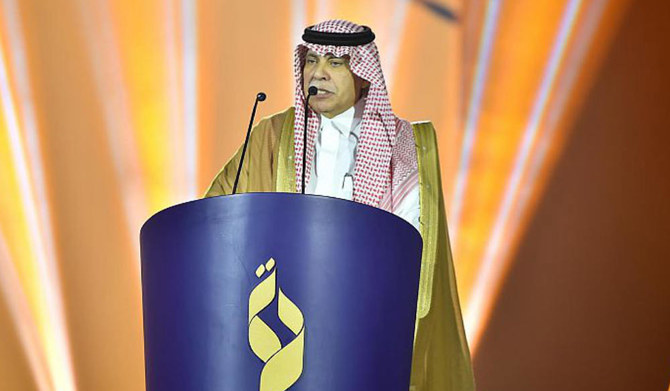
World’s media leaders to gather in Saudi Arabia for major industry forum

Majid Al-Qasabi. (SPA)
Short Url
Updated 25 January 2023
Follow

World’s media leaders to gather in Saudi Arabia for major industry forum

  • Mohammed Fahad Al-Harthi: The meeting sought to create 'a competitive environment in media work, to be a motivation for specialized institutions & professionals in delivering distinctive works worthy of celebration and honor'

RIYADH: Around 1,500 media sector leaders from around the world will next month gather in Saudi Arabia for a major two-day industry conference.

The second Saudi Media Forum will take place in Riyadh on Feb. 20 and 21 and will focus on the latest and future developments in audiovisual, print, and digital media.
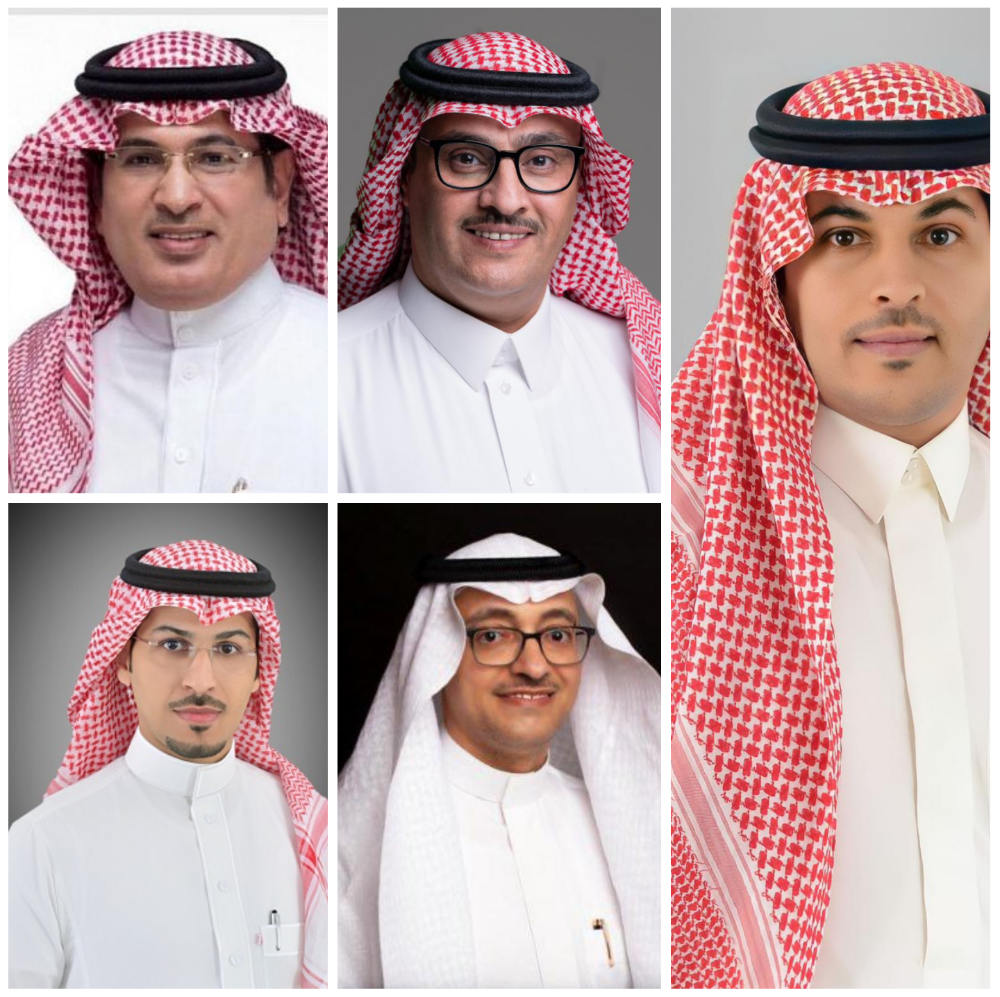


(Clock-wise) Mohammed Fahad Al-Harthi, Turki Al-Sahli, Abdullah Al-Humaidani, Mohammed Amer and Ahmed Al-Muyidi. (Supplied)

Being staged under the title “Media in a World Being Formed,” the forum will also cover the important role played by the industry in relation to social, political, and economic issues.

BACKGROUND

The first edition of the forum was held in Riyadh toward the end of 2019 under the umbrella of the Saudi Journalists Authority, with more than 1,000 regional and international delegates in attendance from 32 countries.

Mohammed Fahad Al-Harthi, chief executive officer of the Saudi Broadcasting Authority, said the meeting sought to create “a competitive environment in media work, to be a motivation for specialized institutions and professionals in delivering distinctive works worthy of celebration and honor.”

An awards ceremony will include categories such as best of print and electronic journalism, audiovisual production, Twitter content, media entrepreneurship, and personality of the year.

The first edition of the forum was held in Riyadh toward the end of 2019 under the umbrella of the Saudi Journalists Authority, with more than 1,000 regional and international delegates in attendance from 32 countries.

Al-Harthi, who also chairs the forum, noted that the event coincided with a boom time in the Saudi media sector.

Saudi journalist Turki Al-Sahli said the Kingdom’s media organizations needed “talented, qualified, and passionate” journalists to ensure levels of quality and ethical journalism were maintained, adding that a key challenge for the sector was meeting the demands of the digital age.

Mohammed Amer, deputy editor-in-chief of Al-Mowaten newspaper, pointed out that Saudi Arabia was under the global spotlight due to the transformations taking place in the country as part of Vision 2030, and said its media was well placed to influence changes taking place around the world.

Ahmed Al-Muyidi, assistant professor of media and communication at King Saud University, said the forum provided an important platform for media experts to brainstorm, share experiences, and discuss the latest technological developments in the industry.

He noted that the Saudi labor market would benefit from the implementation of media training programs and professional qualifications.

Digital media researcher Abdullah Al-Humaidani, said: “I think we will see an unprecedented surge in media attendance, especially digital content and its tools, and we still need to raise the pace of attendance in conjunction with the renaissance that the Kingdom is experiencing.”

He pointed out that there was still work to be done in the region in bringing traditional media models up to speed with new production and creative processes.

“Institutions should adopt and invest in modern creative models such as the design thinking model that is now applied in American journalism, which is flexible, codified, and creative, and helps to market and refine the material and get closer to the public,” he added.

While the Kingdom’s media sector was taking positive steps in the right direction, Al-Humaidani said: “It must be faster, especially with the recent sporting marketing movement … and highlighting the Kingdom’s success story of transformation in all areas.”


Western media refute Trump’s claims Iran possesses Tomahawk missiles

Updated 10 March 2026
Follow

Western media refute Trump’s claims Iran possesses Tomahawk missiles

  • Speaking to journalists, Trump suggested Tehran used US-made cruise missile in school attack that killed over 170, calling the weapon ‘very generic’
  • CNN, Sky News and analysts said that ‘neither Israel nor Iran use Tomahawk missiles,’ urged accurate identification to ensure credibility in public discourse

LONDON: Western media outlets and defense analysts have pushed back against claims by US President Donald Trump that Iran possesses Tomahawk cruise missiles, after he raised the possibility while discussing a recent strike on an Iranian school that has drawn international scrutiny.

Speaking to reporters on Monday, Trump suggested Iran may have used Tomahawks in the attack, calling the weapon “very generic” and implying that multiple countries, including Iran, could have access to the system.

However, journalists and weapons experts swiftly disputed that assertion. They noted that Tomahawk missiles are US-manufactured cruise missile systems that Washington supplies only to a small number of close allies, primarily the UK and Australia. There is no credible evidence that Iran has ever obtained the weapon.

CNN anchor Erin Burnett referenced an investigation by correspondent Isobel Yeong that concluded “neither Israel nor Iran use Tomahawk missiles, according to experts.” Sky News and other Western outlets also challenged Trump’s remarks.

Analysts pointed out that Iran has developed its own domestic cruise missile systems, such as the Soumar and Hoveyzeh, which are believed to be based partly on older Soviet-era designs.

While these systems resemble cruise missiles in concept, experts say they differ significantly from the Tomahawk in design, propulsion configuration and operational characteristics.

While Iran has made substantial advances in ballistic and domestically produced cruise missiles over the past two decades, defense analysts said there is no verified evidence that Tehran holds the American-made system.

The episode reflects a broader pattern in which statements about military technology are rapidly scrutinized by open-source investigators and defense experts.

Experts say the distinction is important: accurately identifying the type of missile used in a strike can provide clues about the likely actor responsible, the launch platform involved and the broader geopolitical consequences of a strike.

Analysts also say that accurate identification of military systems remains essential for avoiding misinformation and for maintaining credibility in public discourse surrounding regional security.

Despite the growing body of evidence, the precise circumstances of the school attack nonetheless remain unclear, with investigators hampered by a lack of weapons fragments and limited access to the site.

Norway-based rights group Hengaw said the school was holding its morning session at the time of the reported attack and had at least 168 children and 14 teachers.

Trump said the US was continuing to investigate the incident. “Whatever the report shows, I’m willing to live with that report,” he said.