

US ties with Pakistan and India ‘stand on their own’ — State Department 

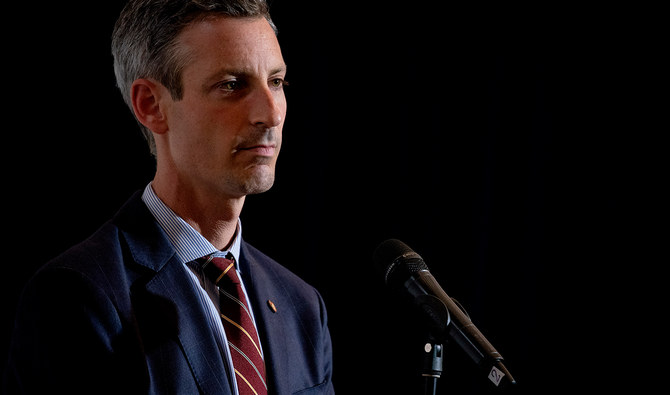
US State Department spokesman Ned Price during a press conference in Bangkok on July 10, 2022. (Photo courtesy: AFP/FILE)
Short Url
Updated 24 January 2023
Follow

US ties with Pakistan and India ‘stand on their own’ — State Department 

  • Pakistan PM recently offered India ‘sincere’ talks over Kashmir and other outstanding issues 
  • State Department says any dialogue between India, Pakistan is a matter between two states 

ISLAMABAD: The United States (US) relations with Pakistan and India “stand on their own” despite the fact that Washington has long called for regional stability in South Asia, the State Department said on Monday, more than a week after Prime Minister Shehbaz Sharif offered “sincere” talks to India on all issues. 

PM Sharif this month told Al Arabiya News Channel he had recently requested the United Arab Emirates (UAE) to facilitate Islamabad’s talks with India over Kashmir and all other outstanding issues, adding that Pakistan had “learnt its lesson” and wanted to “live in peace with India.” 

The Indian foreign ministry responded to Sharif’s offer and said it was ready to normalize relations with Pakistan, given a “conducive atmosphere free of terror, hostility, or violence.” 

On Monday, State Department spokesman Ned Price said while the US wanted to see stability in the region, any dialogue between India and Pakistan was a matter between the two nuclear-armed arch-rivals. 

“We have – you’re right, we’ve long called for regional stability in South Asia. That’s certainly what we want to see. We want to see it advanced. When it comes to our partnership – our partnerships with India and Pakistan, these are relationships that stand on their own,” Price said at a weekly press briefing. 

“We do not see these relationships as zero-sum. They stand on their own. We have long called for regional stability in South Asia, but the pace, the scope, the character of any dialogue between India and Pakistan is a matter for those two countries, India and Pakistan.” 

The Muslim-majority Himalayan region of Kashmir has been a flashpoint between Pakistan and India since their independence from the British rule in 1947. Both countries rule parts of the territory, but claim it in full and have fought two of their four wars over the disputed region. 

Relations between bitter rivals India and Pakistan hit a new low on August 5, 2019 after New Delhi revoked Kashmir’s special status, taking away the territory’s autonomy and dividing it into three federally administered territories. 

The two nations were last engaged in a dialogue during the tenure of former premier Nawaz Sharif, the elder brother of PM Sharif. 


Pakistan, seven Muslim nations back Palestinian technocratic body, stress Gaza-West Bank unity

Updated 15 January 2026
Follow

Pakistan, seven Muslim nations back Palestinian technocratic body, stress Gaza-West Bank unity

  • The National Committee for the Administration of the Gaza Strip was announced on January 14
  • Muslim nations call for consolidation of the ceasefire and unimpeded humanitarian aid into Gaza

ISLAMABAD: Pakistan and seven other Muslim-majority countries on Thursday welcomed the formation of a temporary Palestinian technocratic body to administer Gaza, stressing that it must manage daily civilian affairs while preserving the institutional and territorial link between the Gaza Strip and the West Bank amid the ongoing peace efforts.

In a joint statement, the foreign ministers of Pakistan, Egypt, Jordan, Saudi Arabia, Qatar, Türkiye, Indonesia and the United Arab Emirates said the newly announced National Committee for the Administration of the Gaza Strip would play a central role during the second phase of a broader peace plan aimed at ending the war and paving the way for Palestinian self-governance.

“The Ministers emphasize the importance of the National Committee commencing its duties in managing the day-to-day affairs of the people of Gaza, while preserving the institutional and territorial link between the West Bank and the Gaza Strip, ensuring the unity of Gaza, and rejecting any attempts to divide it,” the statement said.

The committee, announced on Jan. 14, is a temporary transitional body established under United Nations Security Council Resolution 2803 and is to operate in coordination with the Palestinian Authority, the ministers said.

The statement said the move forms part of the second phase of US President Donald Trump’s Comprehensive Peace Plan for Gaza, which the ministers said they supported, praising Trump’s efforts to end the war, ensure the withdrawal of Israeli forces and prevent the annexation of the occupied West Bank.

The top leaders of all eight Muslim countries attended a meeting with Trump in New York last September, shortly before he unveiled the Gaza peace plan.

The ministers also called for the consolidation of the ceasefire, unimpeded humanitarian aid into Gaza, early recovery and reconstruction and the eventual return of the Palestinian Authority to administer the territory, leading to a just and sustainable peace based on UN resolutions and a two-state solution on pre-1967 lines with East Jerusalem as the Palestinian capital.