

Amid surge in attacks, top Pakistani cleric declares TTP activities ‘haram’ under Islamic law

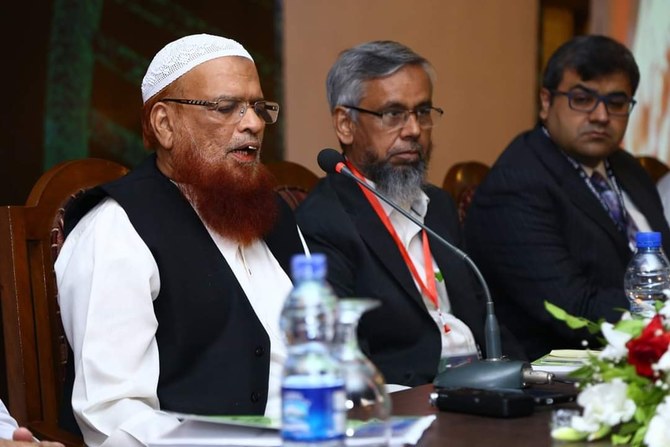
Pakistan’s planning minister Ahsan Iqbal (center) gestures during a national conference on extremism, radicalism and hate speech in Islamabad on January 23, 2022. (Photo courtesy: Twitter/betterpakistan)
Short Url
Updated 24 January 2023
Follow

Amid surge in attacks, top Pakistani cleric declares TTP activities ‘haram’ under Islamic law

  • The decree comes as Pakistan has witnessed a rise in attacks by TTP militants
  • Noted scholar Mufti Taqi Usmani says anti-state activities have 'nothing to do with jihad'

ISLAMABAD: Noted Pakistani religious scholar Mufti Taqi Usmani has issued an edict saying armed activity against the state was “rebellion and haram according to Islamic law,” Radio Pakistan reported on Tuesday, as the South Asian country witnesses a surge in militant attacks.

Attacks, a majority of which have been claimed by the Pakistani Taliban, increased after the outlawed group in November ended a ceasefire with the Pakistani government that was brokered by the Afghan Taliban last May. 

The Pakistani Taliban, or the Tehreek-e-Taliban Pakistan (TTP), have waged an insurgency in Pakistan for more than 15 years, fighting for a stricter enforcement of Islamic law, the release of their members in government custody and a reduction in the Pakistani military’s presence in the country’s tribal districts that border Afghanistan. 

Usmani's decree was adopted by scholars from all schools of thought at a national conference on ‘countering violent extremism, radicalism and hate speech’ held in Islamabad. 

"The Tehreek-e-Taliban Pakistan, who are fighting against Pakistan Army and are involved in anti-state activities, are rebels," the noted scholar was quoted as saying by the state-run Radio Pakistan broadcaster.


In this file photo taken on October 21, 2018, Mufti Muhammad Taqi Usmani (left) addresses a conference in Karachi (Photo courtesy: Jamia Dar-ul-Uloom Karachi/File)

"Fighting against national security agencies and carrying out anti-state activities come under mutiny and it has nothing to do with Jihad."

“Any armed activity against the state of Pakistan is a rebellion and haram according to Islamic law,” the report added.

The statement comes days after militants attacked a police checkpoint in northwestern Pakistan, killing two officers and wounding another late Saturday. In December, TTP fighters detained at a counter-terrorism facility in Bannu seized the compound and took staff hostage. The Pakistani army launched an operation to retake the centre, saying it killed 25 militants in the process.

Since the TTP surge, Pakistan has ruled out negotiations with militants and called on the Afghan Taliban to keep militant groups from reorganizing on its soil and abide by its commitments to the international community not to allow its territory to be used by terror groups.


Pakistan PM calls for faster CPEC implementation, pledges security for Chinese workers

Updated 27 February 2026
Follow

Pakistan PM calls for faster CPEC implementation, pledges security for Chinese workers

  • Shehbaz Sharif pushes expanded cooperation in agriculture, IT and mining under CPEC phase two
  • Chinese envoy reaffirms Beijing’s support for Pakistan’s sovereignty and economic development

ISLAMABAD: Prime Minister Shehbaz Sharif on Friday called for speeding up projects under the China-Pakistan Economic Corridor (CPEC) and pledged stronger security guarantees for Chinese workers and investments, during a meeting with China’s ambassador in Islamabad.

Sharif made the remarks as the two countries strive to launch the second phase of CPEC, a multibillion-dollar infrastructure and energy initiative launched in 2015 as part of China’s Belt and Road Initiative (BRI).

CPEC’s first phase focused largely on power generation and transport infrastructure aimed at easing Pakistan’s chronic energy shortages and improving connectivity. The second phase seeks to expand cooperation into industrial development, with an emphasis on special economic zones and export-oriented growth.

“While highlighting the importance of accelerating ongoing CPEC projects, the Prime Minister stressed on the need to enhance cooperation in agriculture and IT and mining & minerals,” said a statement circulated by the PM Office after the meeting.

“He also underscored Pakistan’s resolve to provide a secure and conducive environment for Chinese personnel, investments, and institutions in Pakistan,” it added.

Chinese nationals and projects in Pakistan have faced security threats in the past, including attacks by militant groups targeting infrastructure sites and convoys. Islamabad has repeatedly vowed to tighten security and has deployed special protection units for Chinese workers.

China is Pakistan’s closest ally in the region and a key economic partner, with CPEC widely regarded by Islamabad as central to long-term economic growth.

During the meeting, the prime minister conveyed greetings to Chinese President Xi Jinping and Premier Li Qiang, particularly on the occasion of the Chinese New Year.

China’s Ambassador to Pakistan, Jiang Zaidong, reiterated Beijing’s support for Pakistan’s sovereignty and socioeconomic development, according to the statement. Both sides also exchanged views on regional and international issues and agreed to maintain close coordination.