

Amid surge in attacks, top Pakistani cleric declares TTP activities ‘haram’ under Islamic law

Pakistan’s planning minister Ahsan Iqbal (center) gestures during a national conference on extremism, radicalism and hate speech in Islamabad on January 23, 2022. (Photo courtesy: Twitter/betterpakistan)
Short Url
Updated 24 January 2023
Follow

Amid surge in attacks, top Pakistani cleric declares TTP activities ‘haram’ under Islamic law

  • The decree comes as Pakistan has witnessed a rise in attacks by TTP militants
  • Noted scholar Mufti Taqi Usmani says anti-state activities have 'nothing to do with jihad'

ISLAMABAD: Noted Pakistani religious scholar Mufti Taqi Usmani has issued an edict saying armed activity against the state was “rebellion and haram according to Islamic law,” Radio Pakistan reported on Tuesday, as the South Asian country witnesses a surge in militant attacks.

Attacks, a majority of which have been claimed by the Pakistani Taliban, increased after the outlawed group in November ended a ceasefire with the Pakistani government that was brokered by the Afghan Taliban last May. 

The Pakistani Taliban, or the Tehreek-e-Taliban Pakistan (TTP), have waged an insurgency in Pakistan for more than 15 years, fighting for a stricter enforcement of Islamic law, the release of their members in government custody and a reduction in the Pakistani military’s presence in the country’s tribal districts that border Afghanistan. 

Usmani's decree was adopted by scholars from all schools of thought at a national conference on ‘countering violent extremism, radicalism and hate speech’ held in Islamabad. 

"The Tehreek-e-Taliban Pakistan, who are fighting against Pakistan Army and are involved in anti-state activities, are rebels," the noted scholar was quoted as saying by the state-run Radio Pakistan broadcaster.
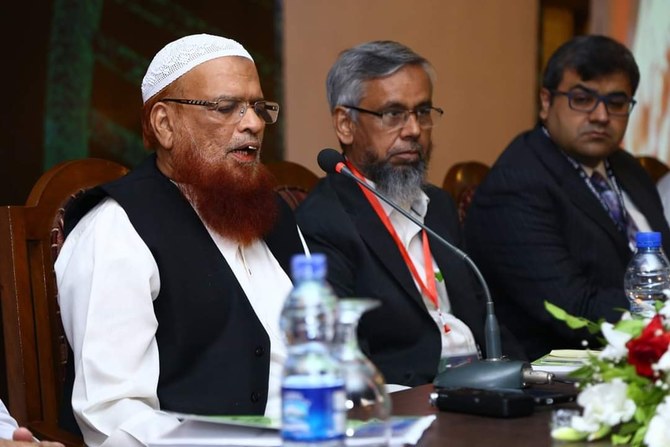


In this file photo taken on October 21, 2018, Mufti Muhammad Taqi Usmani (left) addresses a conference in Karachi (Photo courtesy: Jamia Dar-ul-Uloom Karachi/File)

"Fighting against national security agencies and carrying out anti-state activities come under mutiny and it has nothing to do with Jihad."

“Any armed activity against the state of Pakistan is a rebellion and haram according to Islamic law,” the report added.

The statement comes days after militants attacked a police checkpoint in northwestern Pakistan, killing two officers and wounding another late Saturday. In December, TTP fighters detained at a counter-terrorism facility in Bannu seized the compound and took staff hostage. The Pakistani army launched an operation to retake the centre, saying it killed 25 militants in the process.

Since the TTP surge, Pakistan has ruled out negotiations with militants and called on the Afghan Taliban to keep militant groups from reorganizing on its soil and abide by its commitments to the international community not to allow its territory to be used by terror groups.


Pakistan says defense pact with Saudi Arabia elevated brotherly ties to ‘new heights’

Updated 25 February 2026
Follow

Pakistan says defense pact with Saudi Arabia elevated brotherly ties to ‘new heights’

  • Pakistan, Saudi Arabia signed strategic defense pact last year pledging aggression against one will be treated as attack on both
  • Deputy PM Ishaq Dar says enduring bonds with Islamic and Arab nations form vital pillar of Pakistan’s foreign policy 

ISLAMABAD: Deputy Prime Minister Ishaq Dar said on Wednesday that Pakistan’s defense pact with Saudi Arabia elevated its brotherly ties with the Kingdom to “new heights,” stressing that close ties with Arab and Islamic nations form a key pillar of Islamabad’s foreign policy. 

Pakistan and Saudi Arabia signed a Strategic Mutual Defense Agreement on Sept. 17 last year, pledging that aggression against one country would be treated as an attack on both, enhancing joint deterrence and formalizing decades of military and security cooperation.

Both nations agreed in October 2025 to launch an economic cooperation framework to strengthen trade and investment ties. 

“In the Middle East, our landmark Strategic Mutual Defense Agreement with Saudi Arabia has elevated our brotherly ties to new heights,” Dar said while speaking at the Pakistan Governance Forum 2026 event in Islamabad. 

The Pakistani deputy prime minister was speaking on the topic “Navigating International Relations Amidst Changing Geo-Politics.”

Dar noted that Pakistan has reinforced partnerships with other Middle Eastern nations such as the UAE, Qatar, Jordan, Oman, Egypt and Bahrain. He said these partnerships have yielded “concrete agreements” in investment, agriculture, infrastructure, and energy sectors. 

“Our enduring bonds with Islamic and Arab nations form a vital pillar of our foreign policy, and we will continue to expand our partnerships across Asia, Latin America, and Africa,” he said. 

Dar pointed out that the presidents of Kazakhstan, Uzbekistan and Kyrgyzstan have undertaken visits to Pakistan in recent months, reflecting Central Asian nations’ desire to boost cooperation with Islamabad.

On South Asia, the Pakistani deputy PM said Pakistan has successfully transformed its fraternal ties with Bangladesh into “a substantive partnership.”

“Similarly, the trilateral mechanism involving China, Pakistan, and Bangladesh has been launched with a view to expanding and deepening regional cooperation and synergy,” the Pakistani minister said. 

He said Islamabad has strengthened its “all-weather” partnership with China via the second phase of the multi-billion-dollar China-Pakistan Economic Corridor agreement and “unwavering support” from both sides for each other’s core interests. 

Dar said Pakistan had also reinvigorated its partnership with the US, advancing cooperation in trade, technology, investment, and regional stability. 

“This calibrated approach has enhanced our ability to navigate complexity with skill and confidence, ensuring that our national interests are served without compromising our core foreign policy principles,” he said.