
Jordanian crown prince and Saudi fiancee visit the visually impaired in second official outing 

Jordan’s Crown Prince Hussein bin Abdullah II and Saudi Arabia's Rajwa Khalid Al-Saif visit the Fragrance of Colors initiative in Amman. (Instagram)
Short Url
Updated 10 May 2023
Follow

Jordanian crown prince and Saudi fiancee visit the visually impaired in second official outing 

DUBAI: In their second official appearance together since their engagement, Jordan’s Crown Prince Hussein bin Abdullah II and Saudi Arabia's Rajwa Khalid Al-Saif visited the Fragrance of Colors initiative in Amman, which aims to teach the blind and visually impaired to draw by identifying colors through the sense of smell.  

"Rajwa and I were truly privileged today to meet with a group of inspiring young artists who have conquered their visual disability through their exceptional talents and artistic sensitivities. It was heartwarming to witness their insightful and immense creativity firsthand," shared Crown Prince Hussein on his social media.

The couple, who are tying the knot this summer on June 1, were briefed on the creative works of students during a workshop at Darat Suheil by artist Suheil Baqaeen in Jabal Luweibdeh in Amman. 

Crown Prince Hussein got engaged officially in August to Saudi citizen Al-Saif in a ceremony which was held in the presence of King Abdullah II, Queen Rania and the bride-to-be’s family in Riyadh. 
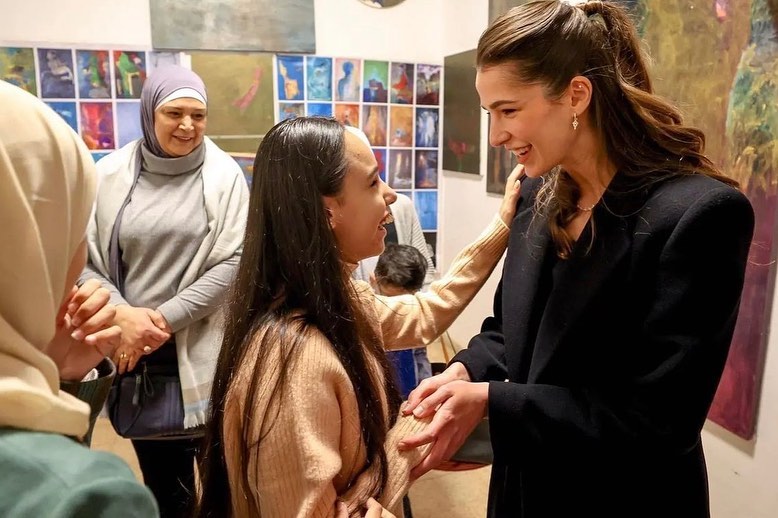


Saudi Arabia's Rajwa Khalid Al-Saif (right) visits the Fragrance of Colors initiative in Amman. (Instagram)

“I didn’t think it was possible to hold so much joy in my heart! Congratulations to my eldest Prince Hussein and his beautiful bride-to-be, Rajwa,” Queen Rania wrote at the time on Instagram to mark her eldest son’s engagement. 

Al-Saif is the daughter of Saudi businessman Khalid Al-Saif and was educated in Saudi Arabia before moving to the US, where she studied architecture at Syracuse University. 

Ramadan routines around the Kingdom 

Updated 26 February 2026
Follow

Ramadan routines around the Kingdom 

RIYADH: Saudi Arabia is home to a diverse array of Ramadan customs, with each region boasting time-honored traditions. Here  is how the holy month is celebrated in various parts of Saudi Arabia.

NAJD 

One of the most significant Ramadan traditions in parts of Najd is Isha Al-Walidayn (the ‘parents’ dinner’), in which families prepare meals that are shared with relatives, neighbors and those in need. Often organized by neighborhood groups, the gatherings take place during iftar or after taraweeh. Families either invite relatives, neighbors and passersby to share the meal at home or send dishes to surrounding households and those in need. 

While rooted in charity, the tradition is equally about memory and community, offering a way to honor loved ones while strengthening social ties.  

In places including Qassim, the practice may be repeated several times throughout the month. The custom has been passed down through generations and remains part of Najd’s social fabric, reflecting the family-centered rhythm of Ramadan in the area.  

Hajar Alqusayer 

HIJAZ 

For more than a century, the chant of “Sidi Shaheen” has echoed through the narrow alleys of Madinah, marking the approach of Ramadan and signaling one of Hijaz’s most cherished folk traditions. Observed in the second half of Sha’ban — the month preceding Ramadan — the custom sees groups of boys walking through neighborhoods, singing traditional verses in celebration of the holy month’s imminent arrival. The practice remains particularly strong in Madinah, though it is also known across the wider Hijaz region. 

As part of the tradition, children carry a small container known as a quff, used to collect sweets, nuts and coins offered by households they visit. Moving from door to door, they chant in unison, their songs met with open doors and generous smiles. 

In preparation, families stock up on treats — particularly nuts and traditional sweets such as mushabak (pictured) — ensuring they are ready to share in the joy. 

Nada Hameed 

EASTERN PROVINCE 

Gargee’an is a traditional festival which is primarily celebrated mid-Ramadan in Gulf countries; specifically Kuwait, Bahrain, Iraq, the UAE, and in Saudi Arabia’s Eastern Province. It is not commonly observed in other parts of the Kingdom.  

Traditionally, boys in crisp white thobes and girls adorned in intricate jalabiyas go door-to-door in their neighborhoods and collect sweets and goodies in their handwoven baskets. It is a chance for them to reconnect with the community and spread colorful cheer. 

In recent years, however, the King Abdulaziz Center for World Culture (Ithra) in Dhahran has staged its own Gargee’an, providing candies for the kids as well as numerous indoor and outdoor activities for youngsters of all ages — including the young at heart — alongside performances of traditional folk songs and other live shows. 

The main plaza at Ithra, the Library and Energy Exhibit will each have Instagram-worthy moments. Entry to the center is free, though certain events — such as those at The Children’s Museum — require you to purchase tickets on the premises. 

Jasmine Bager 

JAZAN 

In Jazan, Ramadan is scented with wood smoke and freshly baked bread. Across villages and coastal towns, families still use the traditional mifa — a clay oven — to prepare corn and millet breads to eat at iftar. A staple of the season is mafalt (pictured), a creamy mixture of flour and milk often eaten at suhoor, valued for its simplicity and ability to sustain you through long fasting hours.  

Another distinctive feature of Ramadan in Jazan is the communal spirit of preparation. Neighbors exchange dishes before sunset, ensuring no table is without the region’s signature flavors. Evenings often extend into open-air gatherings where stories are shared and elders recount how Ramadan was observed generations ago. In Jazan, the holy month is less about extravagance and more about preserving culinary heritage and close-knit community bonds.  

Rahaf Jambi 

HAIL 

Since Ramadan this year is taking place while the weather in Hail is still relatively cool, it has been common to see dozens of people gathering along the banks and beds of nearby valleys — particularly in Mashar, Tuwaren, and Naqbin in the late afternoon, setting up seating and making arrangements for iftar. 

Coffee and tea are typically brewed over a fire, and participants often bring homemade dishes including lamb or chicken soups, vegetable or meat pastries, and Hail-style keubaiba —square-folded vine leaves filled with rice and a blend of spices, including cumin, black pepper, and dried lime. Sometimes, participants pool resources to buy a young lamb to eat. The liver is seasoned and cooked with onions, while the rest of the meat is prepared with rice for consumption at suhoor. 

Between iftar and suhoor, people socialize or play volleyball — a favorite activity for many Saudis during Ramadan. 

Hebshi Alshammari 

QATIF 

On the fifteenth night of Sha’ban, and again in the middle of Ramadan, children run through the streets of Qatif in traditional dress, going from house to house in celebration of Nasfa, a holiday celebrated in cities across the Arab world, but, in Saudi Arabia, only in Qatif (although it is practically identical to Gargee’an).  

“This celebration is not a fleeting ritual; it is a collective memory, a bridge connecting past to present,” Ismail Hejles, a Saudi researcher of traditional architecture from Qatif, told Arab News. “It teaches that religion was never meant to be stern, and that joy can be part of worship when it is pure.” 

Historians suggest the custom of children going door to door to receive gifts developed in tightly knit urban neighborhoods, where strong community bonds allowed the practice to flourish. And Nasfa is not just a distribution of sweets; it is a distribution of joy.  

“On that night, homes are equal,” Hejles said. “The rich give, and the poor give. The child is not asked who they are or which family they belong to.” 

Tamara Aboalsaud