

Britain imposes new Iranian sanctions over ‘brutal repression’

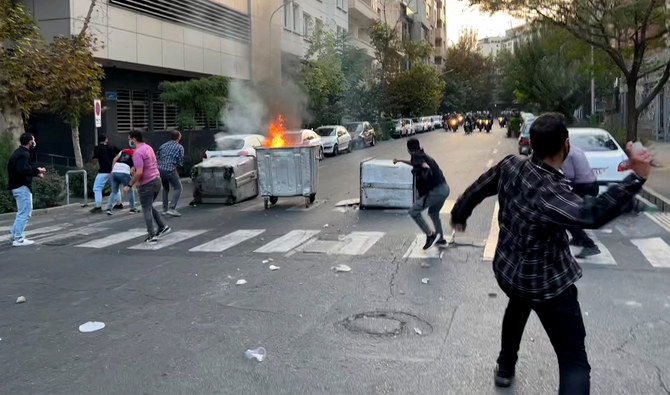
A file picture obtained by AFP outside Iran shows a bin burning in the middle of an intersection during a protest for Mahsa Amini, a woman who reportedly died after being arrested by the Islamic republic's "morality police", in Tehran on September 20, 2022. (AFP/File)
Short Url
Updated 23 January 2023
Follow

Britain imposes new Iranian sanctions over ‘brutal repression’

  • EU introduces new sanctions against Iran for “brutal and disproportionate use of force” against protesters
  • Britain has imposed 50 new sanctions against Iran since death of Mahsa Amini which sparked protests

LONDON: Britain sanctioned more Iranian individuals and entities on Monday over the country’s “brutal repression” of its people, including a crackdown on anti-government protests and the recent execution of British-Iranian dual national Alireza Akbari.

The sanctions included an asset freeze on Iranian deputy prosecutor general Ahmad Fazelian, who the British foreign office said was responsible for an unfair judicial system that used the death penalty for political purposes.

“Those sanctioned today, from the judicial figures using the death penalty for political ends to the thugs beating protesters on the streets, are at the heart of the regime’s brutal repression of the Iranian people,” British foreign minister James Cleverly said in a statement.

“The UK and our partners have sent a clear message through these sanctions that there will be no hiding place for those guilty of the worst human rights violations.”

The European Union also introduced new sanctions against Iran on Monday for a “brutal and disproportionate use of force” against protesters.

Widespread anti-government demonstrations erupted in Iran in September after the death in custody of Kurdish Iranian woman Mahsa Amini, who had been detained by morality police enforcing the Islamic Republic’s mandatory dress code for women.

Others sanctioned by Britain on Monday include Kiyumars Heidari, commander in chief of Iran’s ground forces; Hossein Nejat, deputy commander of the Islamic Revolutionary Guard Corps (IRGC); and the Basij Resistance Force and its deputy commander, Salar Abnoush.

The IRGC has an estimated 125,000-strong military with army, navy and air units, and commands the Basij religious militia often used in crackdowns.

The Basij Cooperative Foundation, linked to the Basij militia, and Qasem Rezaei, deputy commander of Iran’s law enforcement forces, were also sanctioned.

Britain has now imposed 50 new sanctions against Iran since Amini’s death, the foreign office said.


Arab and Islamic states reject Israel’s recognition of Somaliland

Updated 28 December 2025
Follow

Arab and Islamic states reject Israel’s recognition of Somaliland

  • Israel formally recognized Somaliland as an “independent and sovereign state” on Friday
  • Saudi Arabia on Friday expressed full support for sovereignty, unity, territorial integrity of Somalia

A group of foreign ministers from Arab and Islamic countries, alongside the Organisation of Islamic Cooperation (OIC), have firmly rejected Israel’s announcement of its recognition of the Somaliland region within Somalia.

In a joint statement issued on Saturday, the ministers condemned Israel’s decision, announced on December 26, warning that the move carries “serious repercussions for peace and security in the Horn of Africa and the Red Sea region” and undermines international peace and security, the Jordan News Agency reported.

The statement described the recognition as an unprecedented and flagrant violation of international law and the charter of the United Nations, which uphold the principles of state sovereignty, unity and territorial integrity, JNA added.

Israel formally recognized Somaliland as an “independent and sovereign state” and signed an agreement to establish diplomatic ties, as the region’s leader hailed its first-ever official recognition.

The ministers reaffirmed their full support for the sovereignty of Somalia, rejecting any measures that would undermine its unity or territorial integrity.

They warned that recognizing the independence of parts of states sets a dangerous precedent and poses a direct threat to international peace and security.

The statement also reiterated categorical opposition to any attempt to link the move with plans to displace the Palestinian people outside their land, stressing that such proposals are rejected “in form and substance.”

Alongside the Jordanian foreign ministry, the joint statement was issued by the foreign ministers of Egypt, Algeria, Comoros, Djibouti, The Gambia, Iran, Iraq, Kuwait, Libya, Maldives, Nigeria, Oman, Pakistan, Palestine, Qatar, Somalia, Sudan, Turkiye and Yemen, as well as the OIC.

Saudi Arabia on Friday expressed full support for the sovereignty, unity, and territorial integrity of Somalia, and expressed its rejection of the declaration of mutual recognition between Israel and Somaliland.