

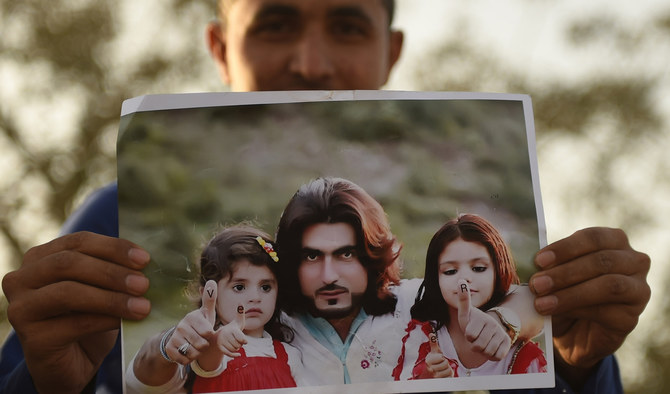

KARACHI: The family of Naqeebullah Mehsud, a Pashtun youth killed in a fake police encounter in Pakistan in 2018, on Sunday vowed to continue their fight for justice, a day before a Pakistani court is set to announce its verdict in a case that spotlighted extrajudicial killings in the South Asian country.
Mehsud, an aspiring model from the northwestern South Waziristan tribal region, was killed among four people in the southern Pakistani city of Karachi on January 13, 2018 by a team led by then senior superintendent of police (SSP), Rao Anwar. The police at the time declared Mehsud a militant affiliated with the Pakistani Taliban and other proscribed outfits.
Mehsud’s killing prompted a protest movement led by young ethnic Pashtuns from the tribal areas in the country’s northwest, where they say they have long been the targets of military operations, internal displacement, ethnic stereotyping and abductions by security forces. The protests transformed the Mehsud Tahaffuz Movement, formed in 2014, into a larger, socio-ethnic movement, the Pashtun Tahafuz Movement (PTM), which continues to operate to date and campaigns for Pashtun rights.
The massive protests forced authorities to investigate the killing and a team, led by Additional Inspector General (AIG) Sanaullah Abbasi, later declared the 2018 encounter a staged one. The inquiry committee probing the killing found out that Anwar and his team killed 444 people in 192 encounters during his service as a police officer in Karachi between 2011 and 2018.
In March 2019, an anti-terrorism court (ATC) framed charges on Anwar and his subordinates for the murder of Naqeebullah and implicating him in bogus cases. The case remained under trial for around five years and witnessed a number of turns and twists, until the court finally reserved its verdict on January 14, which will be announced on Monday.
“My father had been saying it time and again before his demise that he would not bargain on the death of his son. We stand firm over that will after a struggle of five years. We will not sit quietly till justice is served,” Alam Sher Mehsud, brother of Mehsud, told reporters outside the Karachi Press Club.
“We will continue to fight and seek justice for our brother,” said Alam, who was flanked by members of the Grand Mehsud Jirga that was formed to protect rights of the Mehsud tribes based in Pakistan’s militancy-hit northwest.
Jibran Nasir, who represents Mehsud's team of lawyers, said he had already disclosed two years ago that five important witnesses had withdrawn their testimonies in the case.
“They started contradicting each other and the prosecution, the state, deliberately weakened the case. I had foresaid it two years ago that the state had made arrangements to acquit Rao Anwar,” Nasir said.
He said the verdict would have far-reaching impact on the justice system of Pakistan.
“His [likely] acquittal is not an acquittal in this case alone, but also [in cases of] 444 [people killed in] other fake encounters he has carried out” Nasir said.
“We have been fighting and will fight for justice,” he added.


