
ISLAMABAD: Former prime minister Imran Khan’s Pakistan Tehreek-e-Insaf (PTI) opposition party announced on Friday it would not accept any caretaker setup installed without their consultation to hold general elections as the speaker of the lower house of Pakistan parliament accepted resignations of another 35 PTI lawmakers.
The National Assembly speaker has so far accepted 81 resignations of PTI lawmakers apparently to thwart the party’s move to return to the lower house to get its opposition leader appointed. As per the constitution, PM Shehbaz Sharif is bound to consult the opposition leader to finalize a nominee for the caretaker prime minister before the elections, which are scheduled to be held in the latter half of this year.
The current opposition leader in the National Assembly, Raja Riaz, is a PTI dissident who was appointed after the party resigned en masse from the assembly on April 11, a day after the ouster of Khan through a parliamentary vote of no-confidence. Riaz enjoys the support of at least 16 other PTI dissidents in the House.
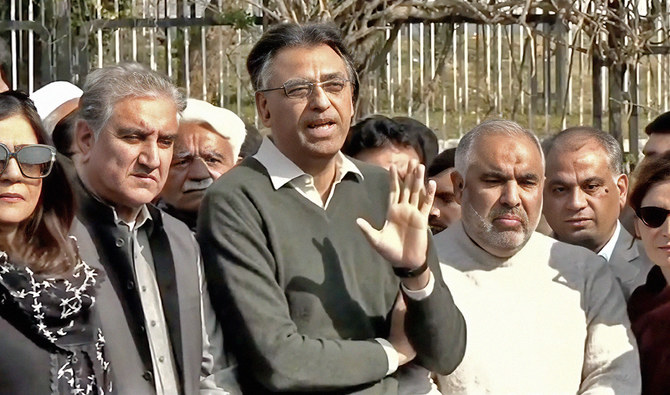
On Friday, 76 PTI lawmakers gathered in Islamabad for a parliamentary party meeting, presided over by PTI vice-chairman Shah Mahmood Qureshi, and later visited the speaker to confirm their resignations, but the speaker was not available. The PTI still has around 50 lawmakers in the assembly whose resignations have yet to be accepted.
“This is a joke. We condemn it,” Asad Qaiser, PTI lawmaker and former National Assembly speaker, told reporters about the acceptance of resignations of another 35 of his fellow lawmakers.
“If they think they will bring in their caretaker government, we will not accept their caretaker government at all.”
Khan’s party had decided to quit the National Assembly en masse after he was driven out of power last April in a parliamentary vote of no-confidence but the speaker, Raja Parvez Ashraf, did not accept the resignations and said he needed to individually verify if the lawmakers were resigning of their own accord.
In a surprise move, however, Ashraf, who is a close ally of PM Shehbaz Sharif, earlier this week accepted long pending resignations of 35 PTI lawmakers, after which the country’s election oversight body de-notified them. On Friday, another 35 resignations were accepted by the speaker.
Khan, who blames his ouster on a Washington-backed “foreign conspiracy,” has been campaigning for snap polls in the South Asian country. His party has also dissolved the Punjab and Khyber Pakhtunkhwa provincial assemblies, where it was in power, in its bid to force early elections.
Chaudhry Fawad Hussain, a close Khan aide, said elections were due on “64 percent seats of the provincial and national assemblies” following their resignations.
“Pakistan is facing a political and economic crisis due to this incompetent government,” he said.
“All our MNAs are here. We are here that resignations of all our members should be accepted immediately so that early elections could be held in the country.”
Qureshi said the speaker had accepted the resignations of 81 PTI lawmakers without any verification.
“They don’t want to face public; they want to run the system through an arrangement,” he said. “They are prioritizing personal agenda over the national interest.”
Earlier, the National Assembly speaker also postponed an assembly session, scheduled to be held today, for a week, without specifying the reason.