Philippines’ Marcos says South China Sea keeps him ‘up at night’

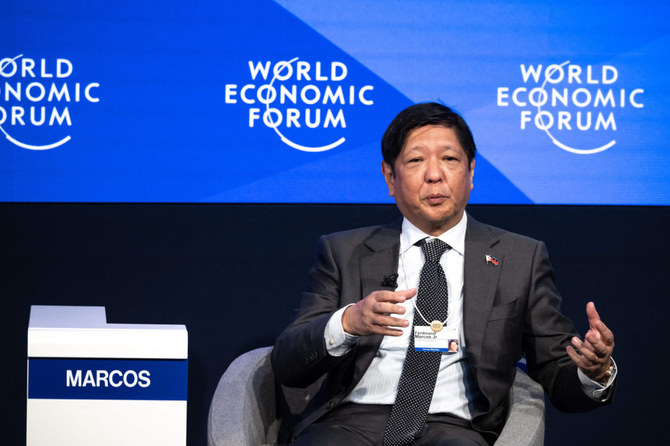
Philippine's President Ferdinand Marcos Jr. speaks during a session during the World Economic Forum (WEF) annual meeting in Davos on January 18, 2023. (Fabrice Coffrini / AFP)
Short Url
Updated 19 January 2023
Follow

Philippines’ Marcos says South China Sea keeps him ‘up at night’

  • Marcos discussed disputed maritime territory with China’s Xi in early January
  • At WEF in Davos, he said the situation was very complex and dynamic

MANILA: Tensions in the South China Sea keep Philippine President Ferdinand Marcos Jr. up at night, he told participants of the World Economic Forum in Davos, amid an increased presence of Chinese and US warships in the disputed region.

The South China Sea is a strategic and resource-rich waterway claimed by China almost in its entirety, despite a 2016 ruling by an international tribunal that dismissed Beijing’s claims. Other countries, including the Philippines, Vietnam, Malaysia and Brunei, also have overlapping claims.

“It’s very dynamic, it’s constantly in flux, so you have to pay attention to it,” Marcos said during a session with WEF President Borge Brende on Wednesday evening.

The situation, he said, “keeps you up at night, keeps you up in the day, keeps you up most of the time.”

Chinese activity in the area has recently increased and last month Manila boosted its military presence in the region after reports that China had started taking several unoccupied land features within Philippine waters.

The tensions come as China is at loggerheads with the US — a Philippine ally that is also trying to increase its influence in Southeast Asia.

“We’re at the very frontline and so whenever these tensions increase, when the ships come out, the Chinese and their coast guard vessels, the Americans answer…we’re watching as bystanders,” Marcos said.

“If something goes wrong here, we are going to suffer.”

He added, however, that the Philippine foreign policy was a “commitment to peace.”

When Marcos made his first state visit to Beijing earlier this month, the South China Sea issue was discussed in his meeting with Chinese President Xi Jinping, and they agreed to resolve maritime disagreements through “friendly consultations.”

“We cannot…sweep it under the rug and pretend it’s not happening because there are effects not only in the diplomatic sense, not only in the security sense but even in the livelihood of our citizens,” the Philippine president said.

Two weeks later in Davos, Marcos acknowledged that the situation was very dynamic and complex and that “there are no simple solutions.”

But the Philippines had “no conflicting claims with China,” he added.

“What we have is China making claims on our territory.” 


Cambodia shuts Thailand border crossings over deadly fighting

Updated 13 December 2025
Follow

Cambodia shuts Thailand border crossings over deadly fighting

  • Thai Prime Minister Anutin Charnvirakul said Trump “didn’t mention whether we should make a ceasefire” during their Friday phone call
  • Across the border, a Cambodian evacuee said she was “sad” the fighting hadn’t stopped despite Trump’s intervention

BANGKOK: Cambodia shut its border crossings with Thailand on Saturday, after Bangkok denied US President Donald Trump’s claim that a truce had been agreed to end days of deadly fighting.
Violence between the Southeast Asian neighbors, which stems from a long-running dispute over the colonial-era demarcation of their 800-kilometer (500-mile) border, has displaced around half a million people on both sides.
At least 25 people have died this week, including four Thai soldiers the defense ministry said were killed in the border area on Saturday.
The latest fatalities were followed by Phnom Penh announcing it would immediately “suspend all entry and exit movements at all Cambodia-Thailand border crossings,” the interior ministry said.
Each side blamed the other for reigniting the conflict, before Trump said a truce had been agreed.
Thai Prime Minister Anutin Charnvirakul said Trump “didn’t mention whether we should make a ceasefire” during their Friday phone call.
The two leaders “didn’t discuss” the issue, Anutin told journalists on Saturday.
Trump had hailed his “very good conversation” with Anutin and Cambodian Prime Minister Hun Manet on Friday.
“They have agreed to CEASE all shooting effective this evening, and go back to the original Peace Accord” agreed in July, Trump wrote on his Truth Social platform.
The United States, China and Malaysia, as chair of the regional bloc ASEAN, brokered a ceasefire in July after an initial five-day spate of violence.
In October, Trump backed a follow-on joint declaration between Thailand and Cambodia, touting new trade deals after they agreed to prolong their truce.
But Thailand suspended the agreement the following month after Thai soldiers were wounded by land mines at the border.
In Thailand, evacuee Kanyapat Saopria said she doesn’t “trust Cambodia anymore.”
“The last round of peace efforts didn’t work out... I don’t know if this one will either,” the 39-year-old told AFP.
Across the border, a Cambodian evacuee said she was “sad” the fighting hadn’t stopped despite Trump’s intervention.
“I am not happy with brutal acts,” said Vy Rina, 43.

- Trading blame over civilians -

Bangkok and Phnom Penh have traded accusations of attacks against civilians, with the Thai army reporting six wounded on Saturday by Cambodian rockets.
Cambodia’s information minister, Neth Pheaktra, meanwhile said Thai forces had “expanded their attacks to include civilian infrastructure and Cambodian civilians.”
A Thai navy spokesman said the air force “successfully destroyed” two Cambodian bridges used to transport weapons to the conflict zone.
Malaysian Prime Minister Anwar Ibrahim on Saturday urged both sides to “cease all forms of hostilities and refrain from any further military actions.”
Thailand has reported 14 soldiers killed and seven civilian deaths, while Cambodia said four civilians were killed earlier this week.
At a camp in Thailand’s Buriram, AFP journalists saw displaced residents calling relatives near the border who reported that fighting was ongoing.
Thailand’s prime minister has vowed to “continue to perform military actions until we feel no more harm and threats to our land and people.”
After the call with Trump, Anutin said “the one who violated the agreement needs to fix (the situation).”
Cambodia’s Hun Manet, meanwhile, said his country “has always been adhering to peaceful means for dispute resolutions.”