

Pakistan, China agree to temporarily reopen key border pass to facilitate traders

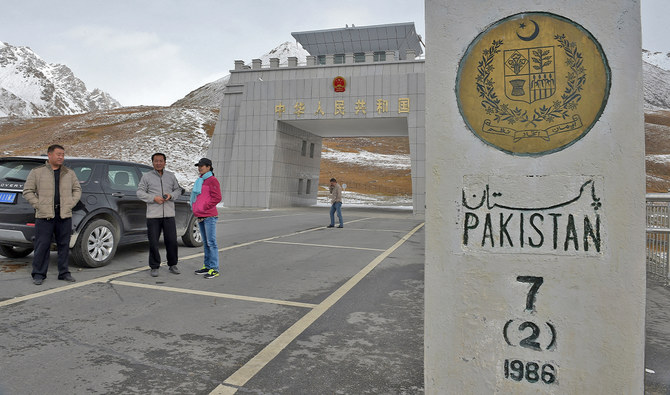
In this photograph taken on September 29, 2015, Chinese nationals arrive at the Pak-China Khunjerab Pass, the world's highest paved border crossing at 4,600 metres above sea level. (AFP/File)
Short Url
Updated 19 January 2023
Follow

Pakistan, China agree to temporarily reopen key border pass to facilitate traders

  • Foreign Office says border will open from January 19 and 20, and from end of January to early February
  • Pakistan forwarded 'special request' to China to reopen border, says Foreign Office

ISLAMABAD: Pakistan and China have agreed to temporarily reopen the border crossing between the two states to facilitate local traders, Pakistan’s foreign ministry spokesperson said on Thursday. 

The Khunjerab Pass, which is the highest paved international border crossing in the world, connects the northern border of Pakistan with southwestern China. 

While the pass usually remains open from May to November for trade and travel activities between the two countries, in November 2019, China ordered its closure to contain the coronavirus from spreading. As the transmission of the disease declined, the border was reopened last year.

The two countries, after a few years of talks, signed a Free Trade Agreement (FTA) in 2009. A second phase of the deal was signed in 2019 and implemented on January 1, 2022, enabling Pakistan to export over one thousand products to China on zero duty. 

China is Pakistan’s second-largest export destination, with an 11 percent share of Pakistan’s total exports in 2021, worth US$28.9 billion, according to the South China Morning Post. 

Pakistan's foreign ministry spokesperson said the border pass will reopen for trade in two phases.

“In the first phase, the Khunjerab Pass will open today for two days (January 19, 20) and again from [the end of] January 2023 to early February 2023, after the Chinese spring festival,” Foreign Office Spokesperson Mumtaz Zahra Baloch said during the weekly press briefing.

She added that Pakistan had forwarded a special request to China to reopen the border so that local traders could be facilitated. “We appreciate the special efforts on both sides to ensure smooth border operations despite inclement weather conditions,” Baloch said.


Pakistan organizes second phase of Hajj training for 2026 pilgrims in Islamabad

Updated 4 sec ago
Follow

Pakistan organizes second phase of Hajj training for 2026 pilgrims in Islamabad

  • Training sessions held to inform pilgrims of various stages of Hajj, precautionary measures, obligatory acts, says state media 
  • Pilgrims told to improve their physical fitness, keep essential travel documents and vaccination cards ready ahead of Hajj 2026

ISLAMABAD: Pakistan’s Ministry of Religious Affairs organized the second phase of Hajj training for 2026 pilgrims in Islamabad today, Sunday, state media reported. 

Pakistan’s religion ministry kicked off the first phase of the mandatory Hajj trainings last Sunday in Islamabad and other cities. The ministry said the trainings were made mandatory to ensure that intending pilgrims are fully aware of Hajj rituals and administrative procedures. 

“Ministry of Religious Affairs and Interfaith Harmony organized second phase of Hajj training session for pilgrims in Islamabad today,” state broadcaster Radio Pakistan reported. 

It said the primary objective of the program was to provide awareness about the various stages of the pilgrimage, necessary precautionary measures and the obligatory acts of both Hajj and Umrah.

“Pilgrims were advised to improve their physical fitness by walking 2 to 3 kilometers daily and keep essential travel documents including original passport, CNIC, flight ticket, visa copies and vaccination cards ready,” the state media said. 

Intending pilgrims were strictly warned against carrying prohibited items such as narcotics, naswar (smokeless tobacco), cigarettes and unverified medicines.

Saudi Arabia has allocated Pakistan a quota of 179,210 pilgrims for Hajj 2026, of which around 118,000 seats have been reserved under the government scheme while the remainder will be allocated to private tour operators.

Under Pakistan’s Hajj scheme, the estimated cost of the government package ranges from Rs1,150,000 to Rs1,250,000 ($4,049.93 to $4,236), subject to final agreements with service providers.