Pakistan still ‘ongoing nightmare’ for millions of children after floods — UN

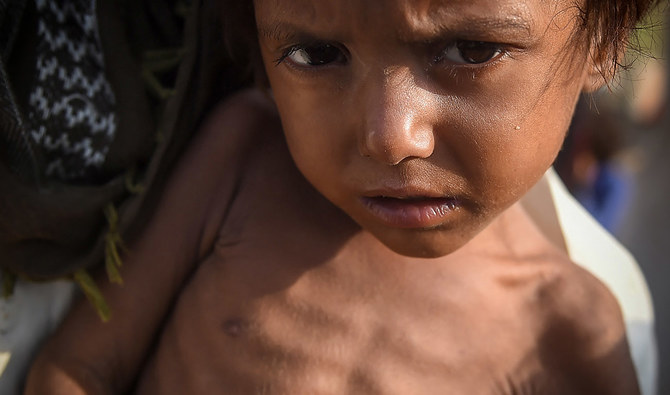
In this picture taken on September 26, 2022, a child belonging to an internally displaced flood-affected man looks on at camp in Jamshoro district of Sindh province, Pakistan. (AFP/FILE)
Short Url
Updated 18 January 2023
Follow

Pakistan still ‘ongoing nightmare’ for millions of children after floods — UN

  • In flood-affected districts, around 1.6 million children were already suffering from severe malnutrition
  • 27 thousand schools washed away, UNICEF’s current appeal of $173 million is less than half funded

ISLAMABAD: Four million children are fighting for survival near contaminated and stagnant flood waters in Pakistan, the United Nations Children’s Fund (UNICEF) has warned, as Islamabad seeks international aid and loans for a recovery bill amounting to $16.3 billion.

Waters are still receding from the floods caused by monsoon rains and melting glaciers that killed at least 1,700 people, displaced around 8 million and destroyed key infrastructure last summer. 

While “the rains have ended…to a great degree, so has media attention,” UNICEF Representative in Pakistan, Abdullah Fadil, told reporters in Geneva on Tuesday, adding that with homes destroyed, children were facing a “bitter winter, without decent shelter”.

Last summer’s flooding is widely regarded as Pakistan’s greatest climate disaster, with villages reportedly turned into islands and many children orphaned and families still living under scraps of plastic in freezing conditions.

In flood-affected districts, around 1.6 million children were already suffering from severe acute malnutrition, while another six million children suffered from stunting, a condition which can cause irreversible damage to children’s brains, bodies and immune systems.

Post floods, this situation is expected to worsen exponentially, Fadil warned.

“27 thousand schools have been washed away,” he said, but “UNICEF’s current appeal of $173 million is less than half funded”.

A total of $9 billion, pledged last week by international donors to help Pakistan recover from the catastrophe, was welcomed by Fadil, who emphasized that “children must be at the center of recovery, rehabilitation and reconstruction efforts.”

The UNICEF spokesperson said real economic recovery and sustained growth could only be achieved if the necessary investments to meet the immediate and longer-term needs of children were made, calling for investment in building human capital and resiliency, particularly in rural Sindh and Balochistan where much of the devastation occurred.

“Pakistan is a known climate hotspot, and it is only a matter of time before another large-scale climate disaster strikes the country’s children,” he warned.

Earlier this month, UN chief António Guterres reiterated the need to help developing countries such as Pakistan become more resilient to the impacts of climate change.

The UN chief insisted that the international banking system needs radical reform in favor of developing countries, to “right a fundamental wrong”.

The UN development agency, UNDP, has warned that an additional nine million people are at risk of being pushed into poverty, on top of the 33 million affected by last summer’s floods in Pakistan.



Pakistan PM calls for faster CPEC implementation, pledges security for Chinese workers

Updated 27 February 2026
Follow

Pakistan PM calls for faster CPEC implementation, pledges security for Chinese workers

  • Shehbaz Sharif pushes expanded cooperation in agriculture, IT and mining under CPEC phase two
  • Chinese envoy reaffirms Beijing’s support for Pakistan’s sovereignty and economic development

ISLAMABAD: Prime Minister Shehbaz Sharif on Friday called for speeding up projects under the China-Pakistan Economic Corridor (CPEC) and pledged stronger security guarantees for Chinese workers and investments, during a meeting with China’s ambassador in Islamabad.

Sharif made the remarks as the two countries strive to launch the second phase of CPEC, a multibillion-dollar infrastructure and energy initiative launched in 2015 as part of China’s Belt and Road Initiative (BRI).

CPEC’s first phase focused largely on power generation and transport infrastructure aimed at easing Pakistan’s chronic energy shortages and improving connectivity. The second phase seeks to expand cooperation into industrial development, with an emphasis on special economic zones and export-oriented growth.

“While highlighting the importance of accelerating ongoing CPEC projects, the Prime Minister stressed on the need to enhance cooperation in agriculture and IT and mining & minerals,” said a statement circulated by the PM Office after the meeting.

“He also underscored Pakistan’s resolve to provide a secure and conducive environment for Chinese personnel, investments, and institutions in Pakistan,” it added.

Chinese nationals and projects in Pakistan have faced security threats in the past, including attacks by militant groups targeting infrastructure sites and convoys. Islamabad has repeatedly vowed to tighten security and has deployed special protection units for Chinese workers.

China is Pakistan’s closest ally in the region and a key economic partner, with CPEC widely regarded by Islamabad as central to long-term economic growth.

During the meeting, the prime minister conveyed greetings to Chinese President Xi Jinping and Premier Li Qiang, particularly on the occasion of the Chinese New Year.

China’s Ambassador to Pakistan, Jiang Zaidong, reiterated Beijing’s support for Pakistan’s sovereignty and socioeconomic development, according to the statement. Both sides also exchanged views on regional and international issues and agreed to maintain close coordination.