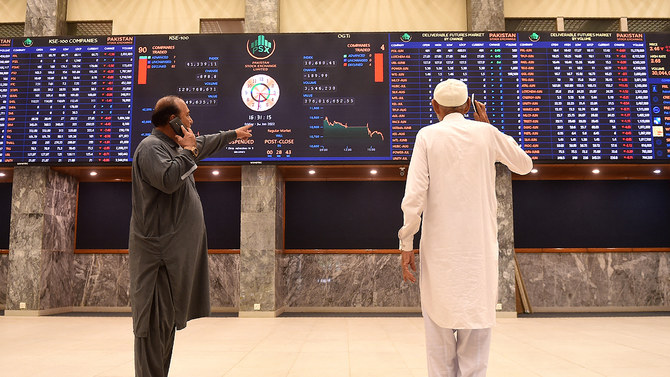
KARACHI: Pakistan’s equity market witnessed a bloodbath on Tuesday amid fears of another policy rate hike, looming default risk due to delayed International Monetary Fund (IMF) talks, and depressed industrial output data, said traders and analysts.
The benchmark KSE-100 index opened in the green zone and gained 222 points during intraday trade. However, investors resorted to selling which caused it to shed 1,379 points, bringing it down by 3.47 percent, which was its highest fall since June 24, 2022.
The bearish momentum was mainly triggered by fears of massive hikes in interest rate by 150 or 200 basis points in the upcoming monetary policy meeting on Monday, according to a Topline Securities survey.
“Stocks fell across the board on uncertainty over SBP [State Bank of Pakistan] policy announcement next week and investor concerns over the ongoing forex crisis,” Ahsan Mehanti, chief executive officer of Arif Habib Corporation, confirmed while speaking to Arab News.
“Rupee instability, dismal data regarding the decline of growth in LSM [Large Scale Manufacturing] by 5.5 percent on year-on-year basis and uncertainty over the outcome of the Pakistan-IMF talks on program conditions amid political uncertainty played a catalyst role in the bearish close,” he continued.
The country is only left with $4.3 billion in official reserves which cover less than a month of imports. The situation is also exerting huge pressure on the national currency.
On Tuesday, the Pakistani rupee depreciated by 0.14 percent to close at Rs228.66 against the US dollar in interbank market amid the severe shortage of the dollar for external payments, including the import of essential commodities and raw material.
The country’s industrial output has also suffered due to the liquidity crunch and slowing economic growth on the back of stalled import growth of raw materials.
The growth of Pakistan’s large scale manufacturing industries decreased by 5.49 percent in November, 2022, when compared to November, 2021, and increased by 3.55 percent when compared to October 2022.
According to the Pakistan Bureau of Statistics. the sector showed an overall decline of 3.58 percent during July-November 2022-23 when compared to the corresponding period the year before.
“Pakistan remains in a severe dollar liquidity crunch and, in the short run, IMF is the only option to sail through without seeing microeconomic instability,” Dr. Khaqan Najeeb, former finance ministry advisor told Arab News.
He added that any inflow from friendly countries would only “complement money from multilateral institutions and help build Pakistan forex reserve.”
Najeeb said Pakistan was likely to get the brunt of global economic slowdown in term of exports from emerging markets as well as the remittance flows.
The country has witnessed a decline in remittances, an important source to replenish foreign exchange reserves, in recent months. However, experts believe the situation can improve if the country avails the IMF program on time and save an impending default.


![]()

Bloodbath at Pakistan equity market amid fears of policy rate hike, dismal economic outlook
Short Url
https://arab.news/muhcy
Bloodbath at Pakistan equity market amid fears of policy rate hike, dismal economic outlook
- Benchmark KSE-100 index plunged by 1,379 points, its highest fall since last June, as investors resorted to selling
- Experts see IMF as Pakistan’s only option to resolve dollar liquidity crunch without microeconomic instability
Latest updates


© 2026 SAUDI RESEARCH & PUBLISHING COMPANY, All Rights Reserved And subject to Terms of Use Agreement.