



KARACHI: The Trade Development Authority of Pakistan (TDAP), an arm of the commerce ministry for the promotion of international trade, has signed an agreement with the Iran Trade Promotion Organization (ITPO) to promote barter trade between the two countries, in the absence of formal banking channels due to international sanctions on Iran.
Pakistan’s commerce ministry in April issued a notification for the operationalization of barter trade under an agreement between the Quetta Chambers of Commerce and Industry (QCCI) and Iran’s Zahidan Chambers of Commerce and Industry (ZCCI), but the mechanism has yet to be fully operationalized.
Pakistan at the time shared a list of 33 items, including rice, fresh or dried guavas, mangoes, meat, surgical goods, and textile fabrics, while an Iranian official shared a list of the same number of items, including gaseous hydrocarbons, liquefied gas, sacks and bags, fresh and dried dates, bars and rods of iron or non-alloy steel, for barter trade.
In 2021, Islamabad and Tehran resolved to take the bilateral trade to $5 billion by 2023. However, the official trade volume could not go beyond $1.5 billion, mainly comprising unofficial barter trade, as Tehran continues to face international sanctions and lacks formal banking channels.
Top Pakistani officials hoped that the signing of the agreement would further increase the bilateral trade volume.
“Looking at the trade potential of both the countries, I think the target of $5 billion is too less, potential is much higher,” Murad Ali Shah, chief minister of Pakistan’s Sindh province, said at the signing ceremony in Karachi on Monday.
“This MoU will go long way in increasing trade and will also attract Iranian companies to come and invest in Pakistan. There is a lot of potential for investment in Pakistan’s energy sector, particularly wind and solar energy, and also in the agriculture sector.”
Pakistan mainly exports rice, meat, paper and paper board, chemicals, textiles, fruit and vegetables to Iran, while major imports from Iran comprise iron ore, hide and skins and petrochemical products.
Muhammad Zubair Motiwala, the TDAP chief executive officer who signed agreement with his Iranian counterpart Alireza Peymanpak, was optimistic about the two countries benefitting from the barter trade agreement.
“We have signed barter trade agreements with Iran and this MoU would work long way in strengthening the business ambitions between the two countries. Today we have less than $1.5 billion of the bilateral trade, we should have $5 billion to $10 billion trade between two countries,” Motiwala told Arab News.
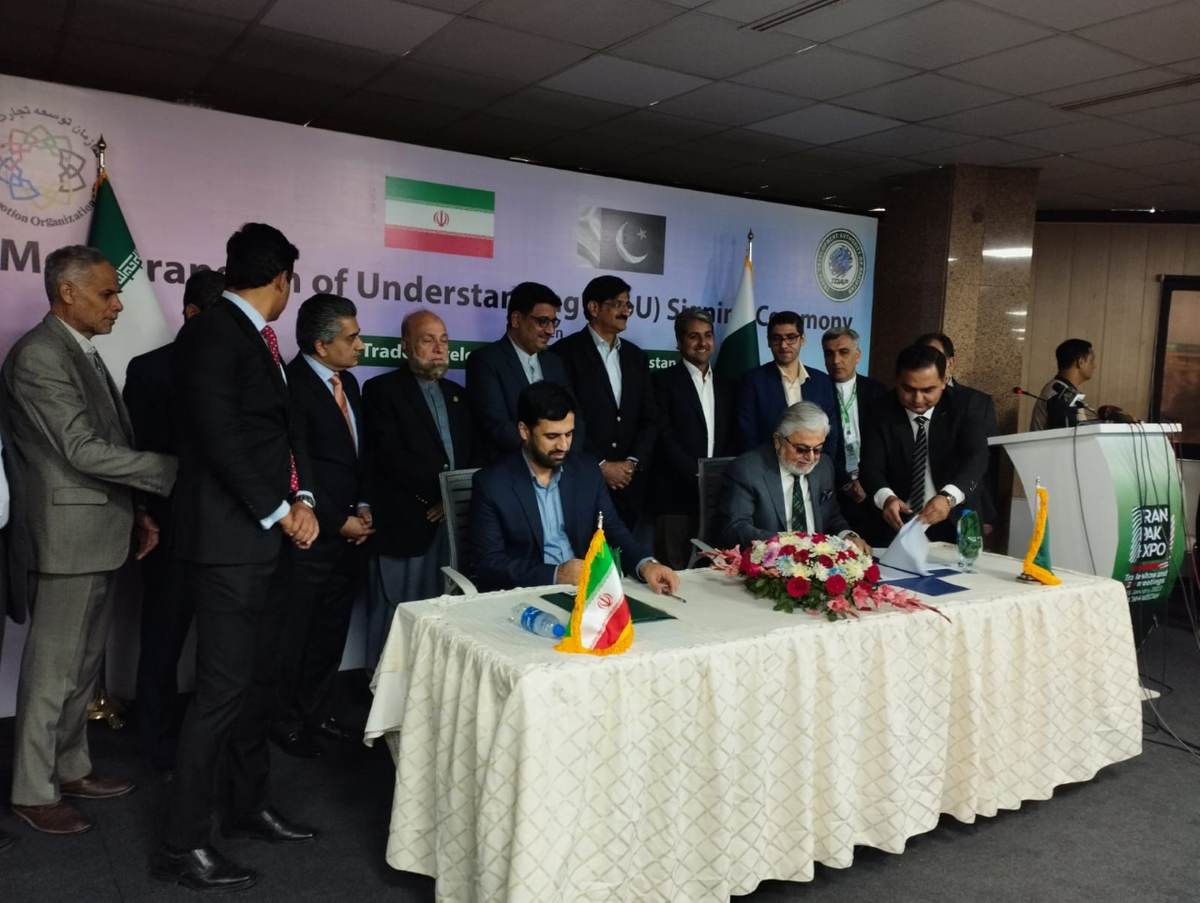
Muhammad Zubair Motiwala, CEO of Trade Development Authority of Pakistan and Alireza Peymanpak, Chairman of Iran Trade Promotion Organization (ITPO), sign an agreement to promote bilateral trade between the two countries at the Karachi Expo Center in Karachi, Pakistan on January 16, 2023. (AN Photo)
“Iran has done wonders in petrochemical sector and they can build plants in Pakistan and Pakistani entrepreneurs can explore business opportunities in Iran to beat the forces that don’t let us grow.”
As Pakistan and Iran, isolated from much of the rest of the world due to Western sanctions, both face a similar problem of dollar shortage, Pakistani experts said the barter system would help the two countries meet their product requirements.
“Iran and Pakistan both need dollars for their international payment requirements, though barter trade is not a long-term solution but it would help them meet short-term requirements,” Samiullah Tariq, a research director at the Pakistan-Kuwait Investment Company, told Arab News.
“Barter lacks common measure of value, exact quality of products, so parties involved have to compromise on the products available.”
In August last year, Islamabad and Tehran had expressed their desire to finalize and sign a Free-Trade Agreement within the next six months, according to the Pakistani commerce ministry.
The two sides had decided to work together to operationalize barter trade as per the agreement signed between Quetta and Zahidan chambers. Both sides had also agreed to discuss removal of tariff and non-tariff barriers to enhance the bilateral trade.


