Daesh claims church bombing in east Congo; 14 dead

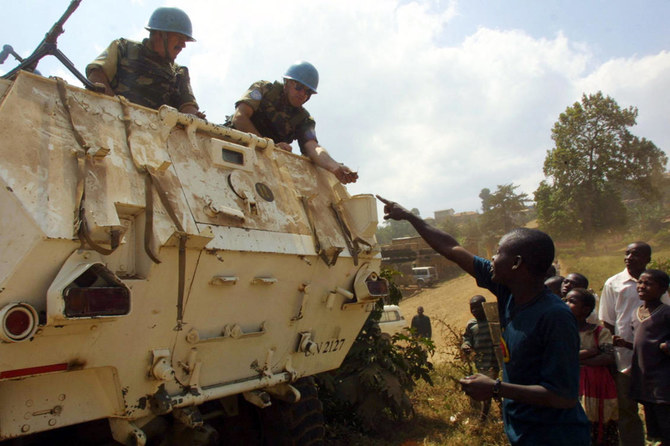
In this file photo taken on June 11, 2004 United Nations MONUC peacekeepers talk with children in Bukavu after the town's recapture by regular forces, following an occupation for several days by military dissidents under General Laurent Nkunda. (AFP)
Short Url
Updated 16 January 2023
Follow

Daesh claims church bombing in east Congo; 14 dead

KASINDI, Congo: Daesh extremists claimed responsibility for a bombing of a church in eastern Congo as authorities said Monday that the toll from Sunday’s attack had risen to at least 14 dead.
The Daesh group and its Aamaq news outlet issued statements saying that its militants had planted an explosive device inside the Pentecostal church in Kasindi and detonated it while people were praying.
“Let the Congolese forces know that their continued attacks on the Mujahideen will only bring them more failure and losses,” the group said in its statement.
The extremists claimed the bomb killed 20 Christians. Congolese authorities put the toll Monday at 14 dead and at least 63 wounded.
The injured were evacuated to Beni General Hospital by the UN peacekeeping mission known as MONUSCO, authorities said.
Violence has wracked eastern Congo for decades as more than 120 armed groups and self-defense militias fight for land and power. Nearly 6 million people are internally displaced, and hundreds of thousands are facing extreme food insecurity, according to the UN
Fighters with the Allied Democratic Forces, a rebel organization which is believed to have links to the the Daesh group, have carried out several attacks in Kasindi, which is located on the border with Uganda.
Troops from Uganda’s army have deployed to eastern Congo to try to stem the violence, but the attacks have increased and spread. ADF attacks since April have killed at least 370 civilians and involved the abduction of several hundred more, a report by the United Nations last month said.


Fourth Palestine Action activist ends hunger strike in UK prison

Protesters take part in a demonstration in support of "Defend Our Juries" and their campaign against the ban on Palestine Action
Updated 24 December 2025
Follow

Fourth Palestine Action activist ends hunger strike in UK prison

  • Amy Gardiner-Gibson began eating again after 49 days of protest
  • Govt rejects claims it ignored prison safety protocols

LONDON: A fourth Palestine Action activist imprisoned in the UK has ended her hunger strike.

Amy Gardiner-Gibson, who also uses the name Amu Gib, began eating again after 49 days of fasting, the campaign group Prisoners for Palestine said.

Qesser Zuhrah, another activist, ended her hunger strike last week after 48 days but said she might resume it next year, Sky News reported.

Four Palestine Action activists have now ended their hunger strikes while in prison, while four others are continuing to fast.

All of them are in prison on remand, awaiting trial for a series of high-profile alleged break-ins and criminal damage.

Palestine Action was proscribed as a terrorist organization and banned earlier this year.

On Tuesday, Swedish climate activist Greta Thunberg was arrested in central London at a rally in support of the hunger strikers.

The protesters are demanding that weapons factories in Britain with ties to Israel be shut down, as well as the removal of Palestine Action’s proscription.

They are also calling for immediate bail to be given to imprisoned pro-Palestine activists and an end to the alleged mistreatment of prisoners in custody.

Seven imprisoned members of Palestine Action have been transferred to hospital over the course of the hunger strike campaign. Doctors have highlighted concerns about the long-term impact of fasting on the activists.

Lawyers representing the group on Monday initiated legal action against the government over its alleged failure to follow prison safety regulations.

The government, however, has rejected this accusation, Sky News reported.

A Ministry of Justice spokesperson said: “Ministers do not intervene in individual cases. Where individuals are on remand, doing so would risk prejudicing ongoing legal proceedings and undermine the independence of the justice system.

“Concerns about welfare and process can be raised through established legal and administrative channels, including prison governors and ultimately the prison and probation ombudsman.

“Healthcare decisions are taken independently by qualified NHS professionals and appropriate care and oversight frameworks remain in place.”

The activists still on hunger strike include Heba Muraisi and Teuta Hoxha. Hoxha has been on remand for 13 months and her family told Sky News they feared she would die in prison.

Another of the activists, Kamran Ahmad, is believed to have been on hunger strike for 45 days and hospitalized three times.

Lewie Chiaramello, who has Type 1 diabetes, is on day 31 of his strike and taking part by fasting every other day.