Pakistan’s president condemns attack on Peshawar police station, vows to fight militancy

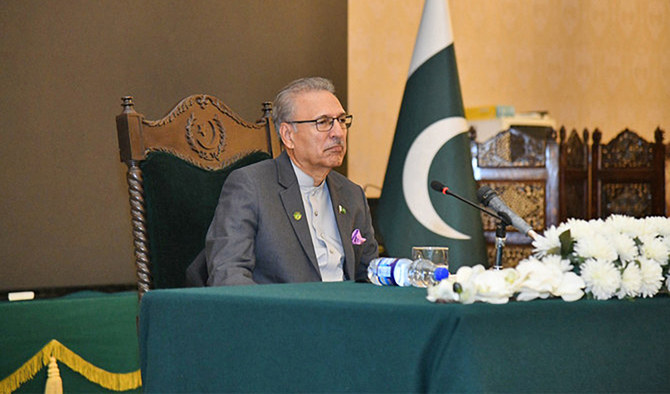
Pakistan's President Dr. Arif Alvi attends a gathering at the Parliament House in Islamabad, Pakistan, on January 05, 2022. (Photo courtesy: @PresOfPakistan/Twitter)
Short Url
Updated 15 January 2023
Follow

Pakistan’s president condemns attack on Peshawar police station, vows to fight militancy

  • The Pakistani Taliban killed three policemen after the attack on the police station in Peshawar's Sarband
  • President Alvi says war against ‘terrorists will continue until terrorism completely uprooted from country’

ISLAMABAD: President Arif Alvi has condemned a militant attack on a police station in the northwestern Pakistani city of Peshawar that killed three policemen this week and said the state would continue its fight against militancy until the menace was completely uprooted from the country, a statement from the president’s secretariat said on Sunday. 

Militants also shot and killed three police officers on the outskirts of Peshawar in the Khyber Pakhtunkhwa province, adding to a spate of violence in the restive northwestern region that borders Afghanistan. The Pakistani Taliban, or the Tehreek-e-Taliban Pakistan (TTP), claimed responsibility for the police station attack and killing the officers.  

The president condemned the attack and expressed grief over the death of the policemen, saying the state was standing with the families of the deceased in this hour of sorrow. 

“The president of the country Dr. Arif Alvi has condemned the attack on the Sarband police station in Peshawar and has expressed grief over the martyrdom of police officers and youths,” the statement said.  

“The war against terrorists will continue until terrorism was completely uprooted from the country.” 

The president, on behalf of the Pakistani nation, paid a tribute to the policemen who lost their lives while fighting “terrorism,” according to the statement. 

The TTP has waged an insurgency in Pakistan over the past 15 years, fighting for stricter enforcement of Islamic laws in the country, the release of their members in government custody, and a reduction of Pakistani military presence in the country’s former tribal regions. They also claimed responsibility for an attack Friday at a police checkpoint in Punjab’s Taunsa district that killed two officers. 

The group has stepped up attacks on security forces after unilaterally ending a cease-fire with the Pakistani government in November. The TTP is separate but allied with the Afghan Taliban. 


Pakistan remembers Benazir Bhutto, first woman PM in Muslim world, on death anniversary

Updated 22 min 26 sec ago
Follow

Pakistan remembers Benazir Bhutto, first woman PM in Muslim world, on death anniversary

  • Bhutto was daughter of ex-PM Zulfikar Ali Bhutto who was hanged during reign of former military ruler Gen. Zia-ul-Haq
  • Year before assassination in 2007, Bhutto signed landmark deal with rival Nawaz Sharif to prevent army interventions

ISLAMABAD: Prime Minister Shehbaz Sharif and other Pakistani leaders on Saturday paid tribute to Benazir Bhutto, the first woman prime minister in the Muslim world who was assassinated 18 years ago in a gun and bomb attack after a rally in the city of Rawalpindi.

Born on Jun. 21, 1953, Bhutto was elected premier for the first time in 1988 at the age of 35. She was deposed in 1990, re-elected in 1993, and ousted again in 1996, amid allegations of corruption and mismanagement which she denied as being politically motivated.

Bhutto only entered politics after her father was hanged in 1979 during military ruler Gen. Zia-ul-Haq’s reign. Throughout her political career, she had a complex and often adversarial relationship with the now ruling Sharif family, but despite the differences signed a ‘Charter of Democracy’ in 2006 with three-time former PM Nawaz Sharif, pledging to strengthen democratic institutions and prevent military interventions in Pakistan in the future.

She was assassinated a year and a half later.

“Mohtarma Benazir Bhutto took exemplary steps to strengthen the role of women, protect the rights of minorities, and make Pakistan a peaceful, progressive, and democratic state,” PM Shehbaz Sharif, younger brother of ex-PM Nawaz Sharif, said in a statement on Saturday.

“Her sacrifices and services are a beacon of light for the nation.”

President Asif Ali Zardari, Bhutto’s widower, said Bhutto believed in an inclusive Pakistan, rejected sectarianism, bigotry and intolerance, and consistently spoke for the protection of minorities.

“Her vision was of a federation where citizens of all faiths could live with dignity and equal rights,” he said. “For the youth of Pakistan, her life offers a clear lesson: speak up for justice, organize peacefully and do not surrender hope in the face of adversity.”

Powerful families like the Bhuttos and the Sharifs of Pakistan to the Gandhis of India and the Bandaranaike family of Sri Lanka have long dominated politics in this diverse region since independence from British colonial rule. But none have escaped tragedy at the hands of rebels, militants or ambitious military leaders.

It was Zulfikar Ali Bhutto, Bhutto’s father, who founded the troubled Bhutto dynasty, becoming the country’s first popularly elected prime minister before being toppled by the army in 1977 and later hanged. Both his sons died in mysterious circumstances.

Before her assassination on Dec. 27, 2007, Bhutto survived another suicide attack on her motorcade that killed nearly 150 people as she returned to Pakistan after eight years in exile in October 2007.

Bhutto’s Oxford-educated son, Bilawal Bhutto-Zardari, now leads her Pakistan Peoples Party, founded by her father, and was foreign minister in the last administration of PM Shehbaz Sharif.

Aseefa Bhutto Zardari, Bhutto’s daughter who is currently the first lady of Pakistan, said her mother lived with courage and led with compassion in life.

“Her strength lives on in every voice that refuses injustice,” she said on X.

Pakistan has been ruled by military regimes for almost half its history since independence from Britain in 1947. Both former premiers Imran Khan and the elder Sharif, Nawaz, have alleged that they were ousted by the military after they fell out with the generals. The army says it does not interfere in politics.