Pakistan’s president condemns attack on Peshawar police station, vows to fight militancy

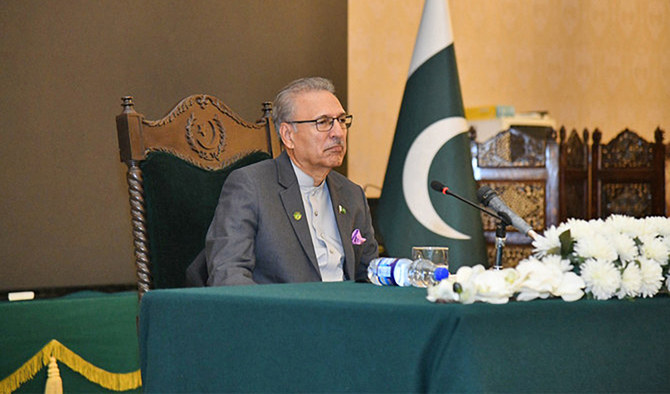
Pakistan's President Dr. Arif Alvi attends a gathering at the Parliament House in Islamabad, Pakistan, on January 05, 2022. (Photo courtesy: @PresOfPakistan/Twitter)
Short Url
Updated 15 January 2023
Follow

Pakistan’s president condemns attack on Peshawar police station, vows to fight militancy

  • The Pakistani Taliban killed three policemen after the attack on the police station in Peshawar's Sarband
  • President Alvi says war against ‘terrorists will continue until terrorism completely uprooted from country’

ISLAMABAD: President Arif Alvi has condemned a militant attack on a police station in the northwestern Pakistani city of Peshawar that killed three policemen this week and said the state would continue its fight against militancy until the menace was completely uprooted from the country, a statement from the president’s secretariat said on Sunday. 

Militants also shot and killed three police officers on the outskirts of Peshawar in the Khyber Pakhtunkhwa province, adding to a spate of violence in the restive northwestern region that borders Afghanistan. The Pakistani Taliban, or the Tehreek-e-Taliban Pakistan (TTP), claimed responsibility for the police station attack and killing the officers.  

The president condemned the attack and expressed grief over the death of the policemen, saying the state was standing with the families of the deceased in this hour of sorrow. 

“The president of the country Dr. Arif Alvi has condemned the attack on the Sarband police station in Peshawar and has expressed grief over the martyrdom of police officers and youths,” the statement said.  

“The war against terrorists will continue until terrorism was completely uprooted from the country.” 

The president, on behalf of the Pakistani nation, paid a tribute to the policemen who lost their lives while fighting “terrorism,” according to the statement. 

The TTP has waged an insurgency in Pakistan over the past 15 years, fighting for stricter enforcement of Islamic laws in the country, the release of their members in government custody, and a reduction of Pakistani military presence in the country’s former tribal regions. They also claimed responsibility for an attack Friday at a police checkpoint in Punjab’s Taunsa district that killed two officers. 

The group has stepped up attacks on security forces after unilaterally ending a cease-fire with the Pakistani government in November. The TTP is separate but allied with the Afghan Taliban. 


Punjab expands Pakistan-India Wagah border arena with museum, partition-themed park

Updated 4 sec ago
Follow

Punjab expands Pakistan-India Wagah border arena with museum, partition-themed park

  • The border crossing, near eastern city of Lahore, is the primary land route between Pakistan and India and one of the most recognizable symbols of their often-tense relations
  • The site is best known for its daily flag-lowering ceremony, a choreographed military ritual performed by border forces from both countries that draws thousands of spectators

ISLAMABAD: Maryam Nawaz, chief minister of Pakistan’s Punjab province, on Thursday inaugurated the newly constructed arena at Wagah border cross between Pakistan and India, which includes a museum and a partition themed park.

The Wagah border crossing, located near the eastern city of Lahore, is the primary land route between Pakistan and India and one of the most recognizable symbols of the often-tense relationship between the two neighbors. It serves as a key point for prisoner exchanges and limited movement of travelers, while remaining tightly regulated due to security considerations.

The site is best known for its daily flag-lowering ceremony, a choreographed military ritual performed by border forces from both countries that draws thousands of spectators. Over the years, the ceremony has evolved into a popular tourist attraction, blending displays of nationalism with public spectacle and making it one of Pakistan’s most visited landmarks, which connects with India’s Attari.

Flanked by military officials, CM Nawaz visited the crossing and inaugurated the new arena, with its seating capacity increased from 7,500 to 25,000 spectators, the state-run Radio Pakistan broadcaster reported. The chief minister also visited the martyrs’ monument and offered her respects.

“In addition to the arena’s expansion, several new constructions have been added at the Joint Check Post Wagah. These new developments include a theme park depicting the partition of the Subcontinent, featuring models of a railway station, military equipment and a Martyrs’ Memorial,” the broadcaster reported.

“A Pakistan Museum has also been established within the arena, showcasing the country’s history and culture from the Freedom Movement to the present day.”

In August 1947, Britain divided the Indian Sub-continent, its former colony, into two countries — Hindu-majority India and Muslim-majority Pakistan.

Excitement over independence was quickly overshadowed by some of the worst bloodletting that left up to 1 million people dead as gangs of Hindus and Muslims slaughtered each other.

Creating two independent nations also tore apart millions of Hindu and Muslim families in one of the world’s largest peacetime migrations, which displaced at least 15 million people.

The fate of Kashmir, then a princely state, was left undecided. The Himalayan territory continues to remain a flashpoint in relations between the neighbors, who have fought multiple wars over it.