

Lebanon blast victim’s brother freed after outcry

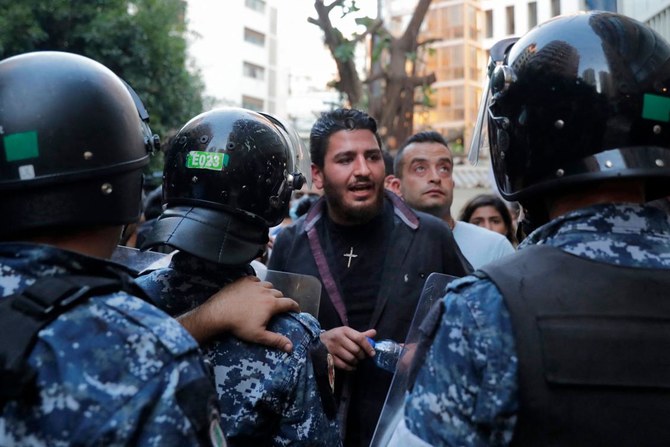
This file photo take on July 13, 2021 shows Lebanese activist William Noun (C), whose brother was killed in the massive port explosion in Beirut in August 2020, during a demonstration outside the residence of the minister of interior in the Lebanese capital against the authorities' lack of action to achieve justice for the victims of the bombing. (AFP)
Short Url
Updated 14 January 2023
Follow

Lebanon blast victim’s brother freed after outcry

  • Protesting families join chorus of condemnation over ‘idiotic’ detention

BEIRUT: Families of victims of the Beirut port explosion blocked roads in Beirut and Jbeil on Saturday in protest at the arrest of their spokesman, William Noun, by Lebanon’s national security agency.

Pressure by protesters, politicians and activists led to his release after 24 hours in detention.

Noun was arrested after a televised statement last Thursday in which he expressed indignation at the obstruction of the investigation into the port explosion in 2020 that claimed the life of his brother Joe, a fireman.

The massive blast, triggered when a large amount of ammonium nitrate stored in a warehouse exploded, caused at least 218 deaths and up to $15 billion in property damage.

In his statement, Noun criticized an attempt to appoint a substitute judge for investigator Tarek Bitar, who was removed from the case a year ago, and threatened to “blow up the Justice Palace.”

His arrest was based on a judicial notice issued by Beirut Attorney General, Judge Zaher Hamadeh.

Noun’s house was also raided by state security personnel searching for explosive material.

A political observer told Arab News that Hamadeh has boasted of his ties with Hezbollah and the Amal Movement.

Hamadeh was a judicial investigator in the case of Imam Moussa Al-Sadr’s disappearance and has been touted as a possible replacement for Bitar in the port explosion probe, the observer said.

Neither the President of the Higher Judicial Council Souheil Abboud nor the General Prosecutor Ghassan Ouweidat attended a council meeting on Saturday.

In a statement, those present defended Hamadeh’s decision to arrest Noun, and condemned what they described as “an attack on the judge’s work and dignity.”

Families of the victims gathered in front of the state security headquarters, vowing to remain until Noun was released.

MP Melhem Khalaf, former president of the Bar Association, joined the protesters, saying that Noun’s comments “were the result of grief and that he didn’t actually mean it.”

Noun’s mother, who visited her son while he was in detention, said: “William is doing fine and is strong.”

She added tearfully: “Is this how they treat the parents who lost their children? I buried my first son and now my second son is detained. Why? Are we the ones responsible for the explosion? Are we the criminals? If the judges had lost their children, how would they have dealt with the case?”  

Inhabitants of Jbeil, Noun’s birthplace, took to the streets on Friday to protest his detention.

Scuffles broke out between protesters and security forces personnel, who stepped in to open the roads.

Families of victims of the port explosion claimed Noun was “lured into a trap set by the corrupt and failing judiciary.”

His detention was an attempt to “scare and subjugate the martyrs’ families, in order to discourage them and undermine their determination to find out the truth,” they added.

Former prime minister Fouad Siniora described Noun’s detention as “an idiotic and shameful act.”

He called for the completion of investigation and the arrest of the “real criminals responsible for the port deaths.”

Elias Bou Saab, deputy speaker of parliament, described Noun’s detention “in this scandalous way as a questionable idiocy done for malicious purposes,” while former Labor minister Camille Abousleiman said the arrest was “a joke and an insolence.”

MP Bilal Abdallah said that “the state has turned into a police state in the case of the port explosion and the way the families of the victims are being treated.”

Samy Gemayel, head of the Kataeb party, said: “The fact that they are switching roles and turning the victims’ families into criminals means that we have reached the final chapters of the law of the jungle.”

The investigating judge in the Beirut port explosion case faced demands for his removal after he issued a series of subpoenas against politicians and security personnel.

Subpoenaed suspects, including deputies affiliated with the Amal Movement, refused to be questioned.

Hezbollah and the Amal Movement took to the street to protest Bitar’s decisions, which resulted in a bloody clash over a year ago that obstructed the investigation.


Refugees, migrants in Lebanon find rare sanctuary from Israeli strikes in Beirut church 

Updated 59 min 20 sec ago
Follow

Refugees, migrants in Lebanon find rare sanctuary from Israeli strikes in Beirut church 

  • Beirut church offers safe haven for displaced migrants, refugees
  • Many refugees lived through 2024 war, but are now more vulnerable

BEIRUT: When Israeli strikes began pummelling Beirut’s southern suburbs early on Monday, Sudanese refugee Ridina Muhammad and her family ​had no choice but to flee home on foot, eventually reaching the only shelter that would accept them: a church.
Eight months pregnant, Muhammad, 32, walked with her husband and three children for hours in the dark streets until they found a car to take them to the St. Joseph Tabaris Parish, which has opened its doors to refugees and migrants.
They are among 300,000 people displaced across Lebanon this week by heavy Israeli strikes, launched in response to a rocket and drone attackinto Israel by the Lebanese armed group Hezbollah.
Just 100,000 of the displaced are in government shelters. Others are staying ‌with relatives ‌or sleeping in the streets. But migrants and refugees say government ​shelters ‌were ⁠never an option ​for ⁠them, saying they were turned away during the last war between Hezbollah and Israel.
Muhammad’s oldest daughter, now seven, stopped speaking after the 2024 war.
This time, they are even more vulnerable: their home was destroyed in this week’s strikes and Muhammad is due to give birth at the end of the month.
“I don’t know if there’s a doctor or not, but I’m really scared about it because I haven’t prepared any clothes for the baby, nor arranged a hospital, and I don’t know where to go,” she told ⁠Reuters as her younger daughter leaned against her pregnant belly.
Muhammad ‌said she was registered with the United Nations’ refugee agency (UNHCR) ‌but had not received support.
“Us, as refugees, why did we ​register with the UN, if they are not ‌helping us in the most difficult times?” she said.
Dalal Harb, a spokesperson for UNHCR ‌Lebanon, said the agency had mobilized but reaching everyone immediately was extremely challenging given the scale and speed of displacement. The UNHCR operation in Lebanon is currently only around 14 percent funded, she said.
The Jesuit Refugee Service (JRS), which helped the church host displaced in 2024, is doing so again.
Michael Petro, JRS’ Emergency Shelter Director, said the church was ‌full within the first day of strikes, with 140 people from South Sudan, Ethiopia, Bangladesh, and other countries sheltering there.
“There are many, many more ⁠people coming than there ⁠were in 2024, and we have fewer and fewer places to put them,” he said.
Petro said he was told weeks ago that government shelters would be open to migrants if war erupted.
But when the strikes began and even Lebanese struggled to find shelter, the policy seemed to change, he said.
“We’re hearing from hotlines up to government officials and ministries that migrants are not welcome,” Petro said.
Lebanon’s Minister for Social Affairs Haneen Sayyed did not respond to a request for comment. On Thursday, Sayyed said Beirut shelters were full.
When Israeli strikes began, Othman Yahyeh Dawood, a 41-year-old Sudanese man, put his two young sons on his motorcycle.
They drove 75 kilometers (46 miles) from the southern Lebanese town of Nabatieh to St. Joseph’s, where they had sheltered in 2024.
“I know the area ​is safe and there are people who ​will welcome us,” he said.
“We don’t know where to go; there’s war there (in the south), war here (in Beirut), war in Sudan, and nowhere else to go,” he said.