

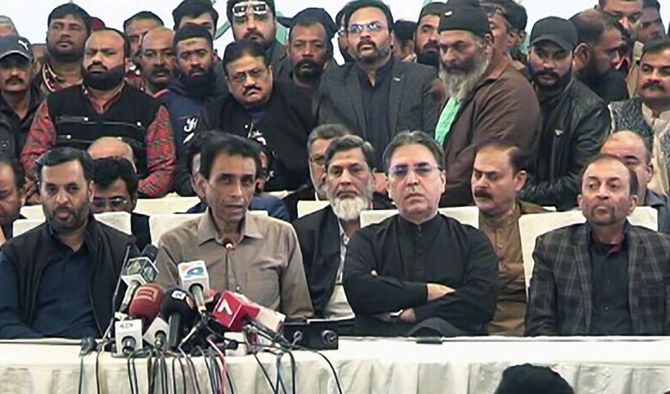

KARACHI: Experts on Friday called reunification of splinter groups of the erstwhile Muttahida Qaumi Movement (MQM) party a "merger of fear," days after the Pak Sarzameen Party and the Muttahida Qaumi Movement-Pakistan (MQM-P) factions came together following a significant drop in their votes in the last few elections.
Founded by Altaf Hussain in 1984, the MQM had won the hearts of the urban, middle-class people in the southern Pakistani port city of Karachi and secured nine out of 11 National Assembly seats in the seaside metropolis in the 1988 general polls, in which the party had fielded its candidates as independents. The party grew in the southern Sindh province and performed exceptionally well in four out of five elections until 2013 and claimed at one point to have "80 percent" public mandate in Karachi — a bustling megapolis of more than 15 million people and the commercial hub of Pakistan.
But the coming years were the toughest for the party, often accused of resorting to violence to suppress opposition and involvement in crime, after its self-exiled supremo, Hussain, delivered a controversial speech against the country in August 2016, having been frustrated over a loss of votes to former premier Imran Khan's Pakistan Tehreek-e-Insaf (PTI) party and a targeted operation in the city against militants.
The speech forced colleagues and supporters of Hussain, who has been living in London since the 1990s, to distance themselves and the party from him. Dr. Farooq Sattar, one of the top MQM figures, saved the party by disowning Hussain and having it registered under his name as MQM-Pakistan. But Sattar's differences with another senior member, Aamir Khan, led to a split in the party and the formation the PIB and Bahadurabad factions. Sattar was eventually expelled from the MQM-P, which is controlled by the Bahadurabad faction.
Months before Hussain’s speech, former Karachi mayor Mustafa Kamal along with Anees Qaimkhani, a former MQM member who is considered an expert on organizational matters, launched their own faction of the MQM, the Pak Sarzameen Party (PSP). While the MQM-P won 6 six out 21 seats in Karachi in the 2018 elections after losing majority of seats to Khan's PTI, the PSP failed miserably in the polls as it lacked public support.
On Tuesday, both Sattar and PSP's Kamal announced merging their respective groups in the MQM-P, which currently holds most of the electoral seats. However, experts and former party members don’t expect any major impact of the reunion on Karachi's politics.
“It is a merger of fear rather than hope,” Raza Haroon, a former provincial minister and an ex-member of the MQM and PSP, told Arab News.
“These groups have been unable to engage and mobilize the people of urban centers of Sindh, while it’s also reality that the electorate of the original [MQM] wasn’t happy with the divisions and the unceremonious removal of the founder.”
Haroon said there were multiple factors behind the "fear for survival" of these groups and a successful merger was dependent on the intent of each group.
“There has been a reduction in the vote bank of Urdu-speaking communities, while these groups were also facing pressure and boycott appeals from London,” Haroon said.
"In addition to this, their leadership has also remained disillusioned when it came to the narrative for the city."
The London-based MQM supremo, who still enjoys some public support within the urban centers of Sindh, has often urged supporters to boycott breakaway MQM factions in elections and, according to Haroon, the repeated defeats pushed these factions to merge with each other.
Mazhar Abbas, a senior political analyst, said the merger of MQM factions was being seen with “suspicious eyes” and its future depended on how they moved forward while overcoming their differences.
“It’s believed that some people within the establishment, if not the whole establishment, were behind this merger,” Abbas told Arab News.
“It also depends on how active the Altaf group remains. The future of this [new] group will become clear in the 2023 general elections. These are big names and can become successful, but there are many challenges.”
Abbas said the political strategy and performance of the ruling Pakistan Peoples Party (PPP), Jamaat-e-Islami (JI) and the PTI in urban areas of Sindh, which Karachi is the provincial capital of, will also decide the fate of the merged MQM factions.
“They are also under pressure to not adopt the organizational structure of the original MQM, which had units, sectors, organizational committees and a coordination committee,” Abbas said.
"They have been given the message that this old structure is not acceptable."
The analyst said the new group may have an ad hoc setup immediately. “But the biggest test is that if this party runs by itself or is run,” he added, hinting at the military establishment.
Pakistan's powerful army has ruled the South Asian country for nearly half of its 75-year history, and even when not in power, it is seen as the invisible guiding hand in the country's politics.
Abdul Jabbar Nasir, a political commentator and journalist closely covering electoral politics in the Sindh province, said there were multiple factors that forced these factions of the MQM to come together for a "political survival."
“The rise in support for Altaf Hussain, his successful boycott calls during the last few by-elections, delimitation by the PPP-led Sindh government, presence of strong support of the PTI and the JI gaining its lost ground are the reasons,” he told Arab News.
Nasir said these factors, coupled with the "external pressure," pushed them to become a single political force.
“But the question that if this merger will help them get the required results depends on if they are able to make a strong organization, which again is a challenge,” he added.


