

Pakistan police bust organ trafficking ring

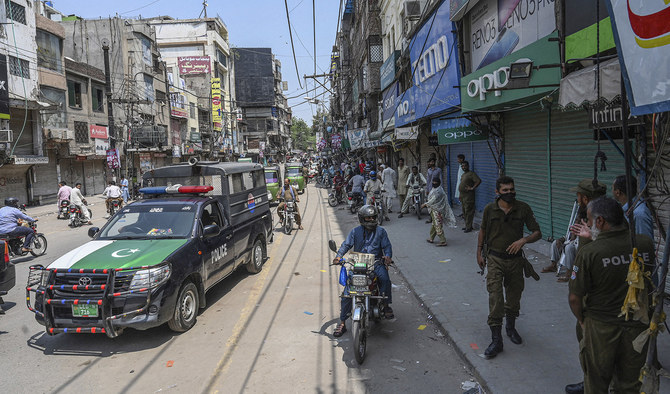
Policemen patrol on the streets of Lahore on July 28, 2020. (AFP/File)
Short Url
Updated 13 January 2023
Follow

Pakistan police bust organ trafficking ring

  • The ring lured young, vulnerable victims with promises of lucrative jobs and large payouts
  • The gang removed removing victims' organs, mainly kidneys, and sold them for up to $4,000

LAHORE: Police in Pakistan said Friday they busted an organ trafficking ring when a missing 14-year-old boy was found in an underground lab after having his kidney removed. 

The ring was responsible for luring young, vulnerable victims with promises of lucrative jobs and large payouts before removing their organs -- mainly kidneys -- to sell for up to 900,000 rupees ($4,000). 

"It was only after we followed the evidence and leads that we discovered that there was an organ trafficking operation behind the boy's disappearance," Rehan Anjum, a spokesman for Punjab police, told AFP on Friday. 

Six people were arrested. 

"The boy told us that when he woke up there was an Arab man on the stretcher next to him, so we think that most of the clients were foreigners," Anjum said. 

The gang's victims were taken to a medical testing lab used for clandestine organ transplant surgeries in the garrison city of Rawalpindi, near the capital Islamabad. 

Facilities for such clandestine surgeries in Pakistan often lack proper medical equipment and standards, and patients are known to die from complications as result. 

"I'm just grateful that the police found him alive, otherwise they had left him for dead," the boy's father told AFP in Lahore, from where the boy went missing. 

Police said the doctors and surgeons involved in the operation had not been tracked down. 

Pakistan outlawed the commercial trade in human organs in 2010, imposing a jail term of up to 10 years and fines in the hope of curbing the sale of organs to rich overseas clients by middlemen through exploitative means. 

Saudi Arabia leads Pakistan’s foreign remittances for January as inflows surge by 15.4%

Updated 5 sec ago
Follow

Saudi Arabia leads Pakistan’s foreign remittances for January as inflows surge by 15.4%

  • Pakistan received $3.5 billion in remittances in January, with Saudi Arabia leading inflows with $739.6 million
  • Foreign remittances are crucial in increasing Pakistan’s foreign reserves, stabilizing cash-strapped nation’s currency

KARACHI: Pakistan received $3.5 billion in foreign remittances in January 2026, the central bank said on Tuesday, with Saudi Arabia once again leading the inflows that Islamabad considers crucial to ensure economic stability. 

Foreign remittances are key for cash-strapped Pakistan as they increase foreign reserves, cushion the country’s current account and stabilize the national currency.

As per data released by the State Bank of Pakistan (SBP), foreign remittances increased 15.4% on a year-on-year basis in January 2026. 

“Workers’ remittances recorded an inflow of $3.5 billion during January 2026,” the SBP said in a statement. 

It added that cumulatively, with an inflow of $23.2 billion remittances increased by 11.3% during the July-January period of the current fiscal year. Last year, Pakistan reported receiving $20.9 billion during the same period.

Saudi Arabia remained the top source of foreign remittances in January with inflows recorded at $739.6 million, followed by the UAE with $694.2 million. The UK reported the third-highest inflows at $572.1 million while remittances from the USA totaled $294.7 million in January.

According to SBP data, remittances reached a record $38.3 billion in fiscal year 2024-25, up from about $30.3 billion the year before, reflecting strong labor migration to Gulf countries and improved formal banking channels. 
 
Millions of Pakistanis work abroad in Gulf countries, Europe and USA, sending money to their families in Pakistan to support them financially. Islamabad has attempted to take advantage of this development in recent years, encouraging the use of formal channels and cracking down on illegal money transfer systems such as hawala and hundi.